Ministry of Environment Announces Rainfall and Flood Volume Forecasts as Part of Flood Countermeasure Plan
Flood Volume Expected to Increase by 11.8% by 2050, Up to 50.4% Depending on Basin
This Year’s Monsoon Period Records 1.7 to 2 Times More Rainfall Compared to Average
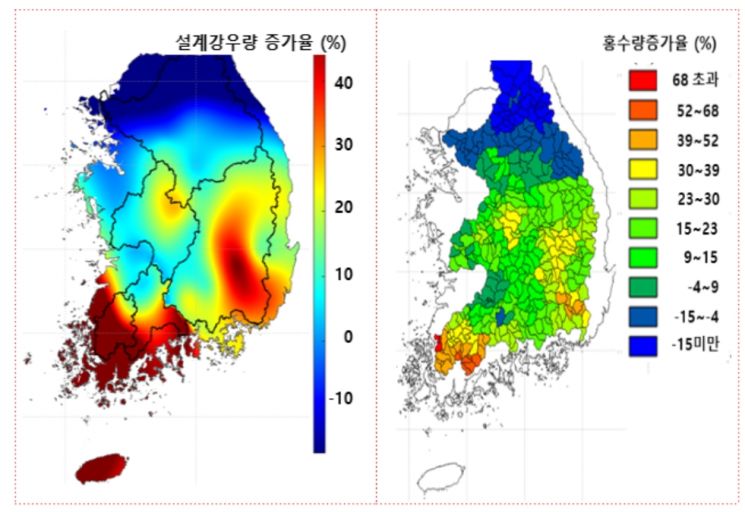
[Asia Economy Reporter Kim Bo-kyung] Predictions for flood volumes in 2050 indicate that the Yeongsan River basin will see an increase of 50.4% compared to current levels, while the Seomjin River basin will increase by 29.6%. During this year’s monsoon period from June to August, precipitation in the Seomjin River basin was recorded at 1069 mm, marking the highest level ever recorded.
The Ministry of Environment disclosed on the 20th the results of a study titled "Future Changes in Precipitation and Flood Volumes Due to Climate Change," conducted as part of flood countermeasure planning.
The prediction utilized 13 global climate models and 2 regional climate models, applying a greenhouse gas emission scenario (RCP 8.5) that assumes emissions remain at current levels.
Precipitation is projected to increase by 3.7%, 9.2%, and 17.7% in the early (2011?2040), mid (2041?2070), and late (2071?2100) 21st century, respectively.
Notably, in the late 21st century, precipitation in certain years is expected to increase by up to 41.3%. By month, September shows the largest increase at 24.3%, while November shows a slight decrease (-0.6%), indicating growing seasonal variability.
Predictions for flood volumes used in the design of flood defense facilities such as dams and river embankments indicate that flood volumes in 2050 will increase by 11.8% compared to current levels.
The increase in flood volumes is expected to vary significantly by basin. While the Han River basin is projected to see a slight decrease (-9.5%) in flood volume, the Geum River (20.7%), Nakdong River (27%), Yeongsan River (50.4%), and Seomjin River (29.6%) basins are expected to experience substantial increases.
Due to the projected increases in future precipitation and flood volumes, the flood safety levels of dams and river embankments currently designed for a 100-year flood frequency are expected to sharply decline by up to 3.7 years at certain locations. This means that river embankments currently designed to flood once every 100 years could flood once every 4 years in the future.
Additionally, the Ministry of Environment analyzed this year’s precipitation and rainfall scale based on data from various agencies including the Korea Meteorological Administration.
As a result, nationwide areal precipitation from the end of last year’s flood season (June 21 to September 20) until the start of this year’s monsoon (September 21, 2019 to June 23, 2020) was 686 mm, approximately 1.3 times (132%) higher than the average (520 mm).
Generally reported precipitation refers to measurements at specific points where rain gauges are located, whereas areal precipitation is the average precipitation over a wide area (entire basin). In water management such as flood control, areal precipitation is used rather than point precipitation.
During this year’s monsoon period (June 24 to August 16), nationwide areal precipitation was 840 mm, about 1.7 times (171%) higher than the average (492 mm).
In particular, the Seomjin River basin recorded 1069 mm, nearly double (192%) the average, marking the highest precipitation ever recorded in this basin.
Looking at point precipitation, the location with the highest cumulative rainfall during the monsoon was Hyangrobong in Inje, Gangwon Province. In less than two months, 2164 mm of rain fell, which is 1.7 times the annual precipitation (1300 mm) for that area.
Analysis of rainfall scale showed that precipitation at Namwon and Gwangju stations reached 364 mm and 462 mm over 24 hours, exceeding previous maximums by 54% and 22%, respectively. This corresponds to a rainfall scale exceeding a 500-year return period probabilistically.
Park Jae-hyun, head of the Flood Countermeasure Planning Division at the Ministry of Environment, stated, "To prepare for future increases in flood volumes, we plan to thoroughly inspect and improve the entire flood defense system including dams, rivers, and urban sewage systems, as well as to advance the flood forecasting system."
© The Asia Business Daily(www.asiae.co.kr). All rights reserved.
![User Who Sold Erroneously Deposited Bitcoins to Repay Debt and Fund Entertainment... What Did the Supreme Court Decide in 2021? [Legal Issue Check]](https://cwcontent.asiae.co.kr/asiaresize/183/2026020910431234020_1770601391.png)
















