Seoul Digital Foundation Conducts Survey and Interviews on Disposable Waste Disposal Among Seoul Citizens
Delivery Food Orders Increased 1.4 Times Since COVID-19... Concerns Over Excessive Use of Plastic Packaging Materials
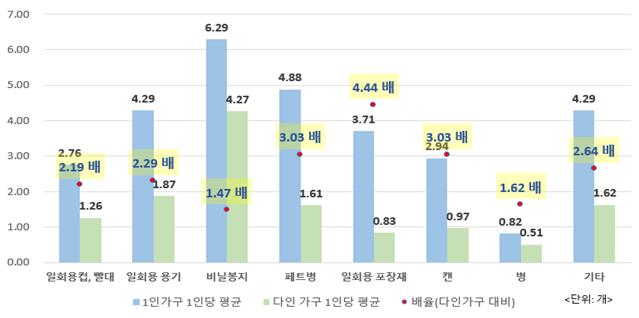 Comparison of Disposable Waste Generation Between Single-Person and Multi-Person Households (Per Capita)
[Asia Economy Reporter Jo In-kyung] Single-person households living in Seoul were found to dispose of an average of 30 disposable items per day. This amount is 2.3 times higher than the per capita disposal volume of multi-person households. A significant number of citizens did not use the bottle deposit system, which refunds a deposit when returning glass bottles, because they found it inconvenient.
According to the report titled "Analysis of Disposable Plastic Waste Emissions Due to the Increase in Single-Person Households," published by the Seoul Digital Foundation on the 20th, a survey of 41 Seoul residents over seven days showed that single-person households disposed of an average of 30 disposable items per day, which is 2.3 times more than the 13 items disposed of per person in multi-person households.
In particular, disposable packaging materials such as Styrofoam were disposed of 4.4 times more per person than in multi-person households, and PET bottles and cans were disposed of 3.03 times more.
Additionally, a survey of 1,000 Seoul citizens revealed that the frequency of ordering delivery food increased about 1.4 times, from an average of 3.0 times per month before the outbreak of COVID-19 in January this year to 4.0 times after the outbreak.
Kang Min-wook, senior researcher at the Seoul Digital Foundation, said, "The increase in single-person households enjoying convenience foods is one of the main causes of the rise in disposable waste," adding, "Considering that the proportion of single-person households in Seoul increased to 33% last year, along with the spread of subscription-based delivery services and increased deliveries due to COVID-19, the consumption of disposable items is expected to continue rising."
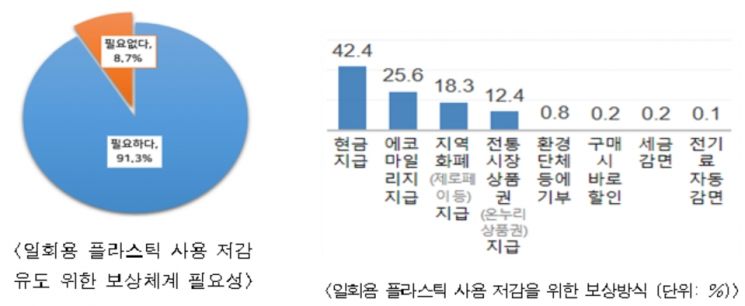
So, what are the ways to reduce disposable plastic waste? Citizens responded that 'strengthening regulations on businesses (4.08 points)' and 'providing and expanding rewards for using reusable items (3.97 points)' are the most effective methods.
Regarding the necessity of a reward system to encourage the reduction of disposable plastic use, 91.3% of respondents agreed on the need for incentives. Among reward methods, 'cash payments' were the highest at 42.4%, followed by 'eco mileage points (25.6%)' and 'local currency payments (18.3%).'
Regarding the bottle return system, although a system is in place at large supermarkets and other locations to refund a certain deposit upon return, 66.3% of respondents said they had not returned bottles in the past five years. The overwhelming reason, at 62.0%, was that "it is inconvenient to go and return them," while only 5.4% said "the deposit amount is too small."
As for centralized recycling collection points, 74.1% of respondents said they should be within 100 meters of their homes. This indicates that people perceive a psychological limit of a 5 to 10-minute distance, similar to that of community centers.
Researcher Kang said, "As can be seen from this survey, to improve the growing problem of disposable waste, it is necessary to improve the current collection methods," adding, "Improving non-face-to-face disposal conditions and the reward system is key."
© The Asia Business Daily(www.asiae.co.kr). All rights reserved.


















