Concerns Over "Good Friday Agreement Violation" Follow UK Internal Market Bill Announcement
US Speaker Pelosi, Presidential Candidate Biden, and Envoy Mulvaney Issue Warnings
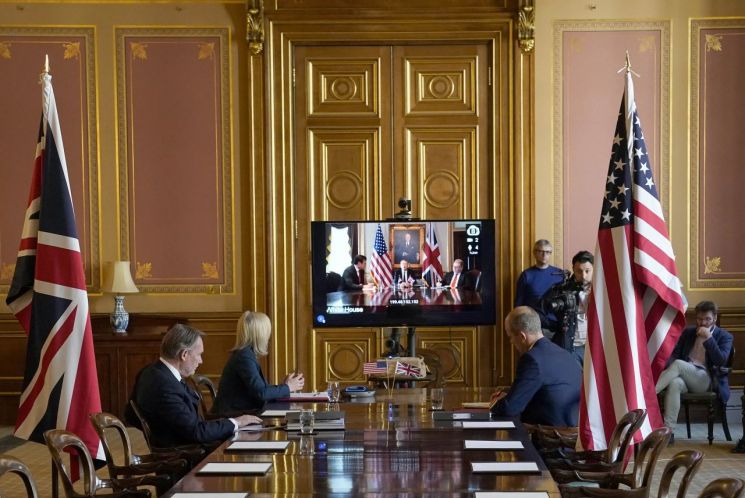
[Asia Economy Reporter Jeong Hyunjin] As the transition period ends at the end of this year, the UK government, which is facing difficulties in trade negotiations with the European Union (EU), has also triggered a 'warning light' in trade talks with the United States. Concerns have arisen that the UK government's announced Internal Market Bill violates international law, prompting the US to suddenly raise objections. What exactly happened?
According to BBC and other sources on the 19th (local time), the issue began when the UK government unveiled the Internal Market Bill on the 9th, which partially undermines the Withdrawal Agreement made for Brexit (the UK's exit from the EU). Nancy Pelosi, Speaker of the US House of Representatives, warned immediately after the bill's announcement that trade negotiations with the UK might not pass through the US Congress, citing the possibility of 'violating international law.' Subsequently, concerns were also expressed by Joe Biden, the Democratic presidential candidate, and Mick Mulvaney, former White House Chief of Staff and special envoy for Northern Ireland under President Donald Trump.
Prime Minister Boris Johnson included provisions in this bill concerning domestic trade within the UK after the Brexit transition period, covering England, Scotland, Northern Ireland, and Wales. The problematic part relates to Northern Ireland, which remains in the EU Single Market despite being UK territory. The bill includes provisions that allow goods moving from Northern Ireland to the rest of the UK to bypass customs checks and permits ignoring obligations stated in the Withdrawal Agreement, such as prior notification to the EU regarding state subsidies.
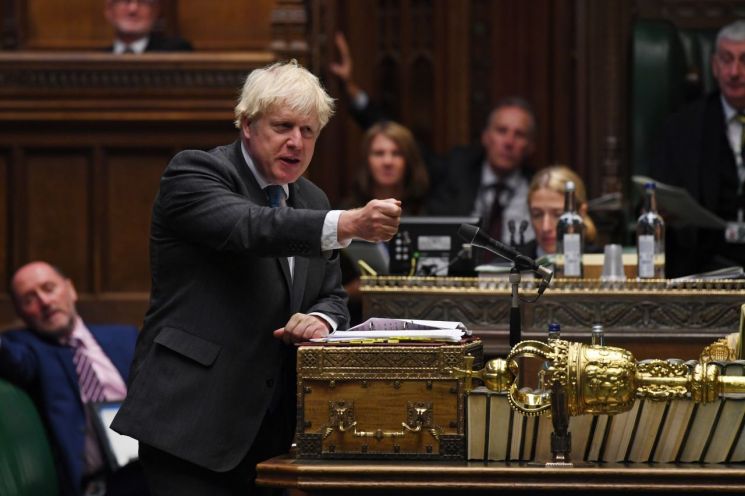
The US pointed out that this bill should not violate the 1998 Good Friday Agreement (Belfast Agreement), which ended the violent conflict between the UK and Ireland. The Good Friday Agreement broadly recognized the autonomy of Northern Ireland under UK sovereignty, with Ireland relinquishing claims over Northern Ireland and both sides removing borders to ensure free movement of goods and people. The possibility of establishing a 'hard border' with increased customs checks between Ireland and Northern Ireland after the UK's EU exit was the biggest issue during the Withdrawal Agreement negotiations. After lengthy talks, the EU and UK agreed to guarantee free movement between Ireland and Northern Ireland for a certain period.
However, the UK government's announcement of the Internal Market Bill raised the possibility that these terms might not be upheld, prompting the US to raise concerns. The US emphasizes adherence to this agreement because it played a key mediating role during its formation. Then-President Bill Clinton actively engaged by dispatching special envoys to the UK to facilitate dialogue. Biden, an Irish-American, tweeted on the 17th, "We cannot allow the Good Friday Agreement, which brought peace to Northern Ireland, to become a casualty of Brexit," adding, "Any trade agreement between the US and UK must be based on this agreement, and we must prevent a return to the era of hard borders."
Mick Mulvaney, Trump's special envoy, also clearly opposed the establishment of a hard border in an interview with a leading UK economic newspaper. He stated, "I assure you no one wants a hard border," emphasizing that the Trump administration, the US State Department, and Congress want the Good Friday Agreement to be respected. Following Pelosi and Biden, the Trump administration also sent a message to the UK to comply with international law. Additionally, US lawmakers warned that failure to uphold the Good Friday Agreement could block trade negotiations between the US and UK.
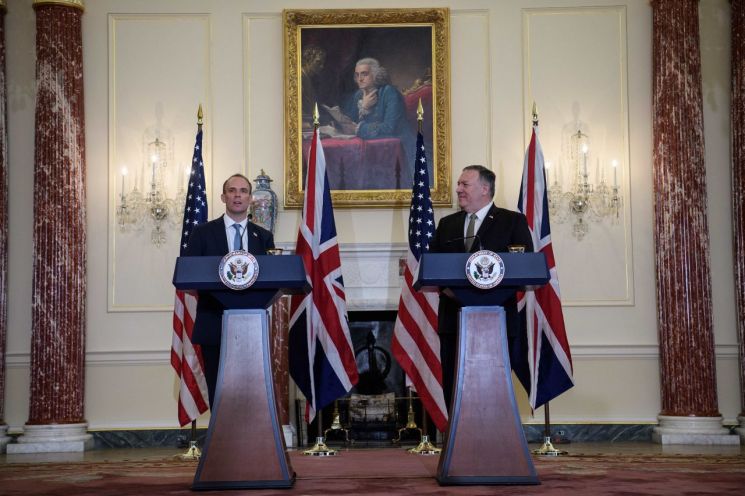 Dominic Raab, UK Foreign Secretary (left), and Mike Pompeo, US Secretary of State, at a press conference [Image source=Reuters Yonhap News]
This US backlash came as the fourth round of US-UK trade negotiations concluded. Dominic Raab, UK Foreign Secretary, who visited Washington DC, met with Pelosi and other Democratic leaders to explain the Internal Market Bill. Since any trade agreement must pass through Congress, this appears to be an effort to coordinate the situation. Raab recently told CNN that the Good Friday Agreement is not at risk and that there will be no hard border, but US concerns persist, drawing attention to the potential impact on future trade talks between the two countries.
Meanwhile, within UK political circles, there has been dissatisfaction over Biden expressing such concerns via Twitter and other platforms. Ian Duncan Smith, former UK Secretary of State for Work and Pensions, told a UK media outlet, "Biden does not need to lecture us on the Northern Ireland peace agreement," adding, "If I were him, before lecturing another sovereign country, I would think more about the need for peace negotiations to stop murder and riots within the US."
© The Asia Business Daily(www.asiae.co.kr). All rights reserved.
![Clutching a Stolen Dior Bag, Saying "I Hate Being Poor but Real"... The Grotesque Con of a "Human Knockoff" [Slate]](https://cwcontent.asiae.co.kr/asiaresize/183/2026021902243444107_1771435474.jpg)


















