The First Ever Negative Interest Rate on Korean Eurobonds
Yields Fall Below Issuance Rates in Secondary Market
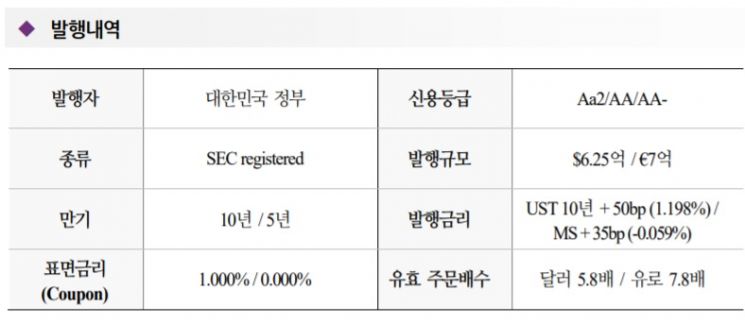
[Asia Economy Reporter Kim Eun-byeol] The government’s foreign exchange stabilization bonds (Oepyeongchae), successfully issued at historically low interest rates, have also proven popular in the secondary market. In an era of ultra-low interest rates, overseas investors had few suitable investment options, but because bonds were issued by a country with relatively stable external soundness even during the COVID-19 pandemic, lenders ended up paying interest to lend money. It is reported that some buyers even offered premiums to purchase Korea’s Oepyeongchae in the secondary market after issuance.
According to market insiders on the 19th, as of Bloomberg quotes on the 15th, the secondary market spread for the recently issued Oepyeongchae has fallen by 2 to 5 basis points (1bp = 0.01 percentage points) compared to the issuance spread. This means the bonds are trading at yields lower than the original issuance rates, indicating that investors are bidding up prices. Although the bonds were issued at historically low rates, their prices have risen further in the secondary market.
Some central banks in Asia reportedly purchased additional volumes in the secondary market. Among Asian countries, China, Singapore, and Indonesia are the main buyers of overseas bonds. An official from the International Financial Center said, "A U.S.-based asset management firm hopes for a larger issuance to facilitate active trading in the secondary market, and a Chinese asset management firm also stated that the further decline in secondary market spreads after issuance indicates strong investor demand for Oepyeongchae."
However, the issuance limit for Oepyeongchae this year is $1.5 billion, and this quota has already been fully utilized, making additional issuance difficult. The government initially planned to issue $500 million in dollar-denominated bonds and 500 million euros in euro-denominated bonds, but due to strong demand, the issuance size was increased close to the limit.
The Ministry of Economy and Finance’s issuance of Oepyeongchae this time was not merely to increase foreign exchange reserves but largely aimed at lowering benchmark interest rates for future foreign currency bond issuances by policy banks or public enterprises.
A government official said, "The Oepyeongchae maturing in 2029 had an interest rate above 60bp, and even when issued last year, the lowest rate was around 55bp. Since COVID-19, rates have been falling sharply. Because the secondary market yield of Oepyeongchae serves as a benchmark, a lower yield benefits institutions that need to raise foreign currency funds in the future."
Korean financial institutions and public enterprises issue about $30 to $35 billion worth of Oepyeongchae annually. Of this, policy banks account for about 66%, mostly represented by Korea Development Bank and Export-Import Bank of Korea. Public enterprises issue about $1 billion, and financial holding companies and banks issue about $500 million.
In fact, immediately after the Ministry of Economy and Finance’s Oepyeongchae issuance, public institutions such as the Export-Import Bank of Korea have issued foreign currency bonds at lower interest rates than before. It is expected that foreign currency bond issuances by public enterprises will continue. The Ministry estimates that the reduction in foreign currency borrowing interest costs due to the decline in Oepyeongchae spreads will amount to $400 million annually. As of the end of June, Korea’s external debt stood at about $400 billion; applying the reduced interest rate level (10bp) to this amount results in $400 million in savings.
© The Asia Business Daily(www.asiae.co.kr). All rights reserved.

















