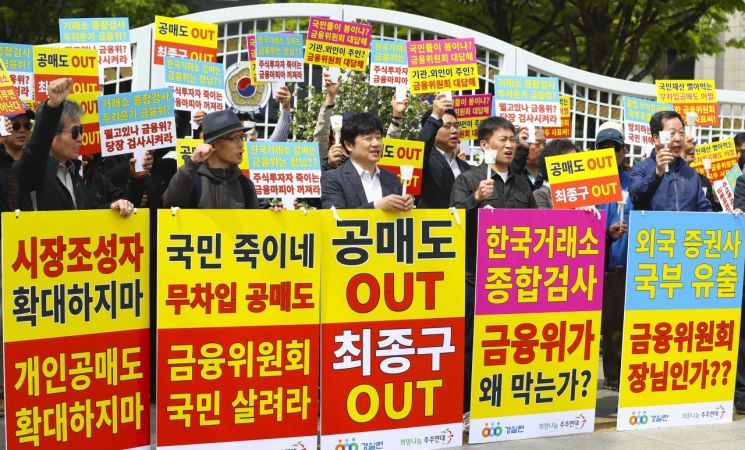
[Asia Economy Reporter Koh Hyung-kwang] The illegal practice of "naked short selling," which is banned in South Korea, has occurred again, prompting financial authorities to impose sanctions. Four entities, including foreign asset management firms and pension funds, were caught and fined. Short selling is an investment technique where stocks are sold in advance with the expectation that their prices will fall, allowing the seller to buy them back at a lower price to make a profit. Under current law, only "borrowed short selling," where stocks are borrowed before selling, is permitted. "Naked short selling," conducted without borrowing stocks, is illegal.
According to industry sources on the 19th, the Securities and Futures Commission under the Financial Services Commission decided on the 17th to impose a total fine of 730 million KRW on four companies, including a well-known US-based asset management firm and pension funds, for violating regulations prohibiting naked short selling.
The Securities and Futures Commission found that the four foreign asset managers and pension funds mistakenly placed sell orders due to errors regarding whether they had borrowing contracts or stock holdings. Unlike the case of Goldman Sachs, which was fined 7.5 billion KRW in November 2018 for intentional naked short selling, these instances were deemed to have occurred due to simple mistakes.
However, the Commission stated, "Even in cases of mistakes, violations of short selling restrictions by financial firms are considered fundamental breaches of duty and are dealt with strictly," adding, "Sanctions will be imposed even if the financial firms did not gain or gained only minimal profits."
The naked short selling by these entities occurred before the short selling ban implemented in March due to the COVID-19 pandemic. Foreign pension fund A, subject to the fine, engaged in naked short selling worth a total of 13 million KRW over 10 instances, resulting in a fine of 360 million KRW.
The Financial Services Commission announced, "We will actively cooperate in amending the Capital Markets Act to strengthen sanctions against naked short selling, promote institutional improvements to eradicate naked short selling, and strictly sanction violations under a zero-tolerance policy."
Naked short selling mainly occurs among foreign financial firms. Of the 101 cases of naked short selling detected since 2010, 94 cases (93%) involved foreign investment companies. Forty-five cases resulted in fines, while the remaining 56 received only warnings. This has led to criticism that penalties for illegal naked short selling are too lenient.
© The Asia Business Daily(www.asiae.co.kr). All rights reserved.

















