Proactive Administrative Measures and Comprehensive Regional Response
Citizens Show Voluntary Cooperation and Solidarity
Underlying This Are Empathy and Trust for 'Quarantine Success'
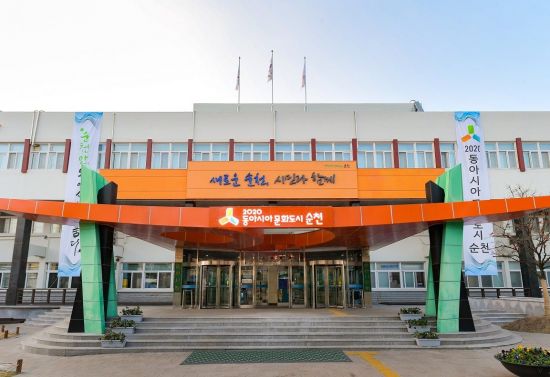
[Asia Economy Honam Reporting Headquarters Reporter Lee Hyung-kwon] Mr. K, who runs a hair salon on Suncheon Culture Street, decided to close his shop for two weeks starting from the 22nd of last month.
As social distancing was raised to level 2 and an administrative order equivalent to level 3 was issued, there were no people or cars on the street, and reservations were canceled.
Although sales decreased, he strongly felt that this was an opportunity to participate in preventing the spread of COVID-19.
Mr. S, president of the Suncheon Uutjang Merchants Association, said that since many restaurants are concentrated in the Gukbap Alley, which attracts many tourists, the merchants felt burdened and worried that the virus might spread not only in their area but also to other regions. Therefore, starting from the 25th of last month, they decided to close all 200 stores for two weeks.
After the August 15 Liberation Day rally, while the spread of COVID-19 did not subside nationwide from the Seoul metropolitan area, Suncheon City’s effective containment of the rapid increase in confirmed cases and its secret have attracted attention.
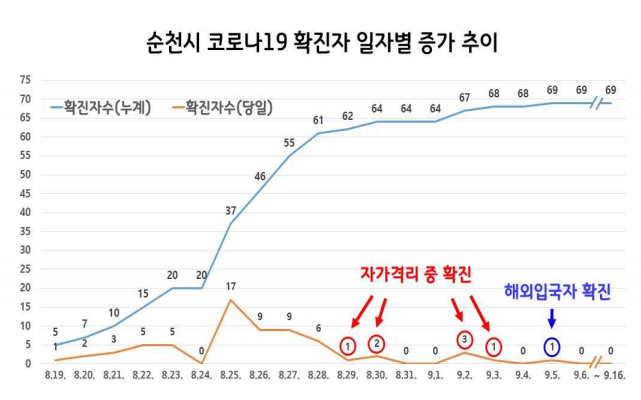
Starting with a woman in her 70s who visited a door-to-door sales company in Seoul on the 19th of last month, the spread of COVID-19 in Suncheon City, which continued through second, third, and nth infections, was frightening enough to remind one of a pandemic, but it entered a stabilization phase within 10 days.
According to Suncheon City, “As of the 17th, the cumulative number of confirmed cases is 69.” Excluding 7 confirmed cases under self-quarantine and those who entered from overseas since the 29th of last month, “the cluster infection was ended from 57 cases to zero within 10 days from the 19th to the 28th of last month.”
Since the 29th of last month until now, for 19 days, there have been zero new infections due to movement routes.
What was the secret behind Suncheon City’s success in controlling the outbreak in such a short period? Mayor Heo Seok of Suncheon City cited three reasons.
First is Suncheon City’s proactive administrative measures. Two days after the first confirmed case occurred, Suncheon City was the first in Jeollanam-do to raise social distancing to level 2.
Subsequently, three additional administrative orders equivalent to social distancing level 3 were issued, and strict business restrictions and social distancing were implemented for 3,553 businesses across 22 categories.
Second is the voluntary cooperation of citizens. As the number of confirmed cases continued to rise, small business owners and self-employed people voluntarily closed their businesses and shifted to takeout and delivery-focused operations, complying well with administrative orders.
Even businesses that were not required to suspend operations, such as hair salons and restaurants, voluntarily closed, and traditional markets like Suncheon Araetjang, Suncheon Uutjang, and the underground shopping mall all participated in the closure.
Citizens not only wore masks but also temporarily stopped daily activities such as park walks and sports, staying at home.
Third is the all-out regional response. Starting with the additional operation of drive-through screening clinics, Suncheon City deployed about 20 epidemiologists and police officers dispatched from the Korea Disease Control and Prevention Agency, Jeollanam-do, and neighboring local governments to conduct meticulous epidemiological investigations.
High-risk facilities, religious facilities, karaoke rooms, and bathhouses were inspected daily by public officials to gain cooperation from business owners. For 2,072 self-quarantined individuals, dedicated officials provided one-on-one close management to block additional infection routes.
During this process, a health center employee working at a screening clinic became infected and collapsed after removing protective gear to wipe sweat. Additionally, a public-private joint countermeasure committee involving 18 institutions such as local hospitals, schools, and police stations was operated to discuss joint cooperation and support plans.
Particularly noteworthy is the “Gwonbun Movement” promoted by Suncheon City. Since March, when free meals were suspended due to COVID-19, Suncheon City has been delivering “Gwonbun boxes” containing a week’s worth of groceries and medical supplies to vulnerable groups such as elderly people worried about meals, multicultural families facing livelihood difficulties, and people with disabilities.
Mayor Heo Seok said, “In difficult times due to COVID-19, quick action is needed, like the old saying ‘Cheolbujegeup (轍急之急),’ which means giving a thirsty person a sip of water immediately.” He explained that Gwonbun is a concept from the “Mokminsimseo” (The Mind of Governing the People), referring to a sharing movement by the wealthy to help hungry people during famine, and emphasized the need for the Gwonbun Movement in these challenging times.
So far, Gwonbun boxes have been distributed to over 5,500 people in six rounds through donations worth 244 million KRW. The Gwonbun Movement also extended to medical personnel support.
Geoje Geobung Baek Hospital dispatched five medical staff, and those with nursing licenses volunteered. In addition, donations of diagnostic kits, thermal cameras, and supportive messages were sent, greatly encouraging those on the front lines of quarantine.
On the other hand, there were regrettable cases. After the August 15 Liberation Day, as confirmed cases rapidly spread, politically motivated internet posts circulated claiming that Suncheon City’s poor response led to Jeollanam-do taking command through on-site visits.
False information about confirmed patients’ movement routes and personal details in some local communities also stirred citizens’ anxiety. However, rapid disaster text message dispatches, centralized information on the city’s website, and daily briefings on the situation helped dispel falsehoods.
Despite stronger proactive administrative orders than those in the metropolitan area or other local governments, the voluntary cooperation of citizens was based on a shared sense of crisis about COVID-19 among both the administration and citizens.
It is also analyzed that citizens’ trust in the city’s crisis management capability was the driving force behind the successful quarantine in a short period. In other words, empathy and trust instilled a sense of solidarity that “the strongest vaccine is the citizens,” giving confidence that “we can overcome this together.”
Mayor Heo Seok stated, “Regarding the unprecedented COVID-19 crisis, we plan to compile a COVID-19 crisis management manual by collecting response strategies from each department and citizens’ experience stories so that junior public officials can use it as a guideline.”
© The Asia Business Daily(www.asiae.co.kr). All rights reserved.
![Clutching a Stolen Dior Bag, Saying "I Hate Being Poor but Real"... The Grotesque Con of a "Human Knockoff" [Slate]](https://cwcontent.asiae.co.kr/asiaresize/183/2026021902243444107_1771435474.jpg)

















