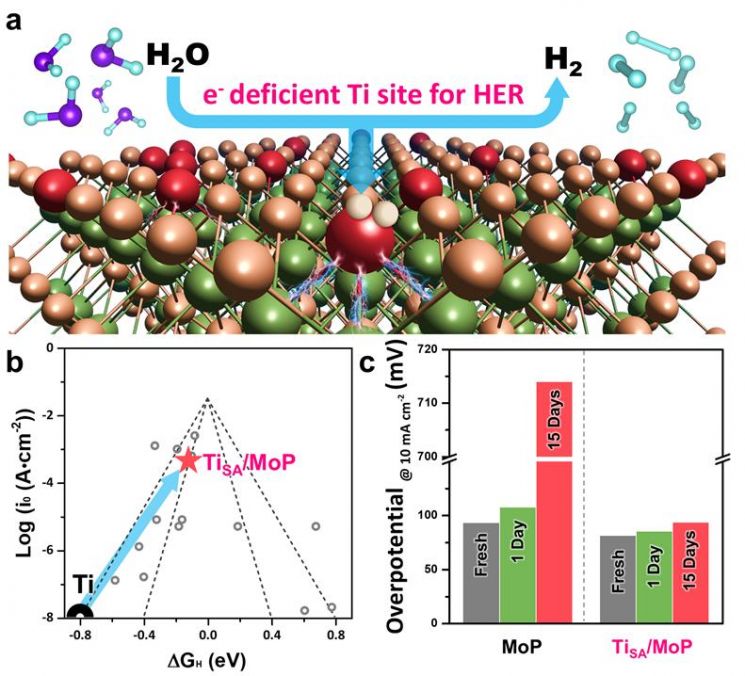
 (a) Schematic of the structure of titanium-doped molybdenum phosphide and the hydrogen evolution site. (b, c) Activity for the hydrogen evolution reaction and catalyst stability evaluation results over 15 days.
[Asia Economy Reporter Junho Hwang] A new catalyst has been developed to replace the platinum catalyst used in water electrolysis for hydrogen production. It offers price competitiveness by eliminating the need for expensive platinum and has durability 26 times higher than existing non-platinum catalysts, enabling stable hydrogen production. This is expected to open the way for more economical and stable hydrogen fuel production.
On the 20th, Dr. Seongjong Yoo's research team at the Hydrogen and Fuel Cell Research Group of the Korea Institute of Science and Technology announced the development of a transition metal-based catalyst to replace platinum used in water electrolysis. The related research paper was featured in the latest issue of the international journal Nano Energy.
The research team applied a spray pyrolysis process to molybdenum phosphide, a transition metal, and injected a small amount of titanium to develop the catalyst. Molybdenum is inexpensive and relatively easy to handle, making it a material used as a catalyst in energy conversion devices. However, molybdenum has the drawback of being easily corroded (oxidized).
The team reported that the hydrogen evolution activity of the new catalyst is on par with that of platinum-based catalysts. They also analyzed that the high corrosion susceptibility, a chronic limitation of transition metal-based catalysts, was improved 26 times compared to existing catalysts. This was the result of a complete reconfiguration of the electronic structure of each material during the synthesis process.
Dr. Seongjong Yoo stated, "This research is significant in improving the stability, which has been the biggest limitation of transition metal-based catalysts in water electrolysis devices. We hope that this study, which simultaneously enhanced hydrogen production efficiency to the level of platinum catalysts and improved stability, will contribute to advancing the commercialization of eco-friendly hydrogen energy production technology."
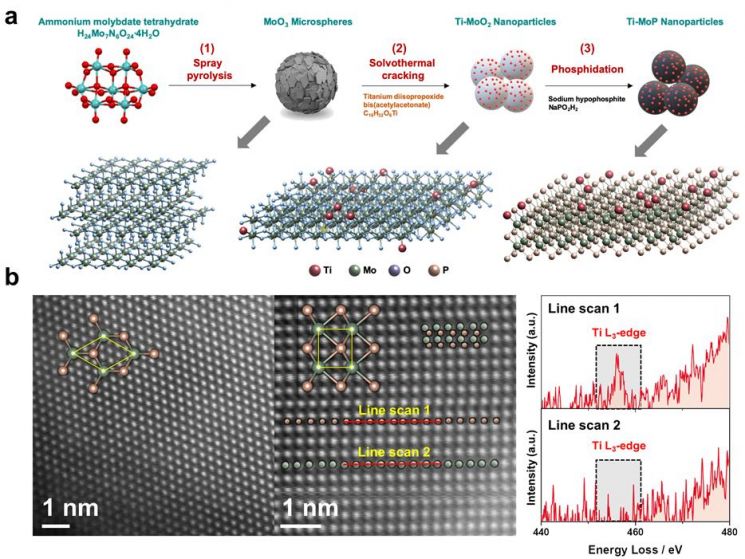 (a) Synthesis method of titanium-doped molybdenum phosphide catalyst. (b) Structure of the synthesized catalyst and analysis results of titanium doping sites.
© The Asia Business Daily(www.asiae.co.kr). All rights reserved.
![Clutching a Stolen Dior Bag, Saying "I Hate Being Poor but Real"... The Grotesque Con of a "Human Knockoff" [Slate]](https://cwcontent.asiae.co.kr/asiaresize/183/2026021902243444107_1771435474.jpg)

















