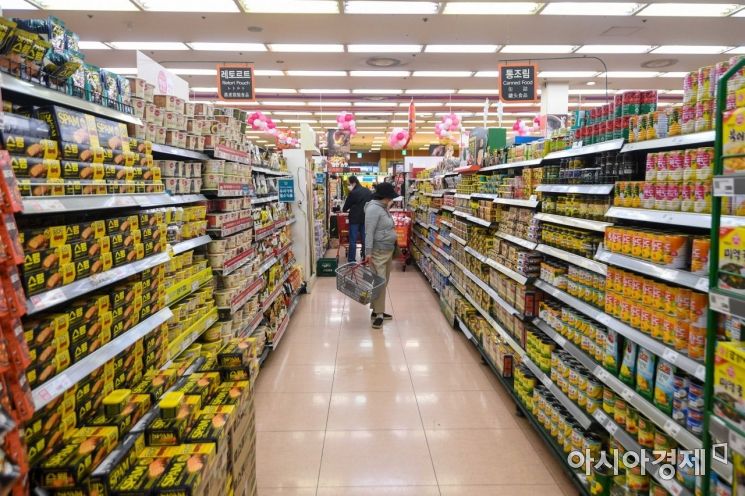
 Due to the impact of COVID-19, consumer sentiment has contracted, and a large supermarket in Jung-gu, Seoul is visible. Photo by Jinhyung Kang aymsdream@
[Asia Economy Reporter Seungjin Lee] The "Partial Amendment to the Distribution Industry Development Act," which extends restrictions on large discount store openings, passed the National Assembly on the 16th. Amid severe stagnation in the offline distribution industry due to the impact of the novel coronavirus disease (COVID-19) and the development of the online industry, the extension of these regulations has left the industry bewildered.
The bill, which passed the National Assembly, was primarily proposed by Lee Jang-seop of the Democratic Party of Korea and aims to protect local small businesses and small merchants. With the passage of this bill, large discount stores will be prohibited from opening within 1 km of traditional markets for an additional five years, and mandatory closure days and operating hour restrictions will apply to quasi-large stores.
Regarding this, the distribution industry expressed opinions that the regulations are regressive. On the 17th, a representative from a large discount store said, "Recently, there have been numerous store closures at large discount stores, and employment instability is continuing. Extending these regulations does not seem appropriate," emphasizing, "The times have changed since the bill was first introduced 10 years ago, so changes are necessary."
Another large discount store representative stated, "The center of gravity in distribution is shifting from offline to online, and it is undesirable to define large offline distribution companies as the enemy of traditional markets and traditional stores amid the dominance of online," pointing out the effectiveness of the regulations by saying, "There are no regulations on online distribution, which is growing daily, so it is questionable whether the regulatory effects will actually benefit traditional markets."
The distribution industry is even more worried about the future. Currently, more than ten bills containing stronger regulations than the recently passed bill have been proposed in the National Assembly.
One such bill, the "Partial Amendment to the Distribution Industry Development Act," primarily proposed by Lee Dong-joo of the Democratic Party, includes provisions allowing local government heads to impose operating hour restrictions or designate mandatory closure days for complex shopping malls, department stores, duty-free shops, and specialty stores, enforcing mandatory closures. Violations may result in business suspension for up to one month.
Regarding this, a department store industry representative said, "Most of the businesses in complex shopping malls or department stores are small and medium-sized enterprises and small merchants," pointing out, "Weekend sales are equivalent to three to four weekdays, so if mandatory closure is designated on weekends, small businesses will suffer significant damage, which contradicts the bill's purpose of protecting small merchants."
The representative continued, "If the purpose is to guarantee workers' rest rights, mandatory closure days should be designated through agreements between businesses," expressing frustration, "The binary logic that if large stores close, customers will go to traditional markets is also unconvincing."
Meanwhile, according to a research report titled "The Impact of Large Distribution Facilities on Surrounding Commercial Districts" published by the Korea Distribution Science Association, when large stores closed, the sales of small supermarkets and retail stores within a 3 km radius significantly declined. In particular, smaller stores with lower annual sales suffered greater damage.
According to a study by Professor Cho Chun-han's team at Gyeonggi Science and Technology University, which tracked changes in commercial districts over two years using credit card merchant payment data and surveys focused on the Emart Bupyeong branch that closed in 2018, the sales index of micro supermarkets with annual sales under 500 million KRW dropped from 16.6 to 15.3, a nearly 8% decrease, while small supermarkets with annual sales between 500 million KRW and 1 billion KRW saw sales fall from 8.6 to 7.5, a significant 12.8% decline.
© The Asia Business Daily(www.asiae.co.kr). All rights reserved.

















