Rapidly Growing Electric Vehicle Battery Market
LG Chem Realizes Spin-off of Battery Business to Secure Facility Investment Funds
SK Innovation Plans Spin-off at Break-even Point
Samsung SDI Also Drafting Investment Roadmap
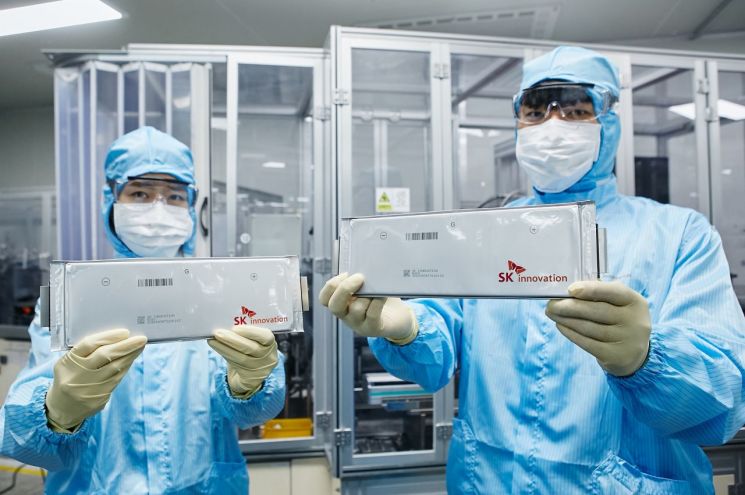
[Asia Economy Reporter Park So-yeon] With LG Chem's spin-off of its battery business division to secure facility investment and funding in the rapidly growing electric vehicle battery market, the era of independent battery companies has begun. To aggressively invest in the battery business with high future growth potential, not only LG Chem but also SK Innovation is reportedly preparing to spin off their battery business divisions. Just as LG Chem set this year, when its electric vehicle battery division turned profitable, as the spin-off timing, SK Innovation is also planning to pursue a spin-off at the break-even point. Industry insiders expect SK Innovation, a latecomer, to achieve profitability in its electric vehicle battery division around 2022.
◇The More You Invest, The More You Earn in the Battery Business... LG Chem 'All-in' to Secure Funds= Amid fierce competition for facility investment to dominate the global electric vehicle battery market, securing funds has become a key issue for the three major domestic battery companies. Expanding production facilities is crucial to capture the growing battery market.
The three Korean battery companies are continuing aggressive investments to maintain leadership in batteries, considered the next growth engine after semiconductors. Each company invests approximately 2 to 4 trillion KRW annually to expand investments.
LG Chem has poured an astronomical 10 trillion KRW into the electric vehicle battery business over the past three years. To fund battery investments, it has boldly sold off businesses with no future growth potential. This year, LG Chem sold its LCD polarizer businesses at three plants in Nanjing and Guangzhou, China, and Taichung, Taiwan, to the Chinese chemical materials company 'Sansan.' The sale proceeds, amounting to about 1.3 trillion KRW, are reportedly mainly invested in expanding the electric vehicle battery business. LG Chem also established joint ventures with China's Geely Automobile and the U.S.'s General Motors. However, a few business unit sales or joint ventures alone are insufficient to keep pace with the rapidly growing electric vehicle battery market, which is expanding by 30% annually. LG Chem's facility investment alone reached 4 trillion KRW last year. The market views LG Chem's battery business spin-off positively. Some estimates suggest that the corporate value of LG Chem's battery business division could reach around 50 trillion KRW through the spin-off.
◇Latecomers Samsung SDI and SK Innovation Also Preparing for Future Leap= Domestic battery companies are focusing all efforts on securing funds for facility investments because a 'battery shortage' is expected within a few years, where demand will exceed supply. Although Chinese battery companies continue aggressive investments, many among them are expected to fail to meet the quality standards required by leading European and American automakers, according to industry estimates. This structure inevitably leads to an explosive increase in orders for 'K-battery' companies, which guarantee technological capability and stability. Beyond simply issuing corporate bonds or cooperating with automakers, companies are exploring major changes such as spin-offs and mergers.
SK Innovation is also preparing for the IPO of its materials subsidiary SKIET in the first half of next year. The purpose of the IPO is to secure growth capital. Additionally, as a mid- to long-term strategy, SK Innovation is preparing for the spin-off and public listing of its battery business division. SK Innovation plans to increase its annual electric vehicle battery production capacity from the current 4.7 GWh to 100 GWh by 2025, about 20 times growth. The industry expects at least 10 trillion KRW to be invested during this period. Samsung SDI is also expected to explore various options in the long term, including mergers or investments from global automakers. A battery industry official said, "Battery companies' financial structures are weakening due to large-scale investments, but facility investments cannot stop, so drastic measures are all necessary," adding, "Samsung, LG, and SK groups will all have roadmaps and significant changes for expanding their battery businesses."
© The Asia Business Daily(www.asiae.co.kr). All rights reserved.

















