'Announcement of "Regulatory Innovation Plan for 10 Major Industries"
Recognition of Starting Same Industry Business 3 Years After Closure
Expansion of Eligibility for Youth Tomorrow Savings Program
Exemption of Burden Charges for Technology-Based Knowledge Service Industry'
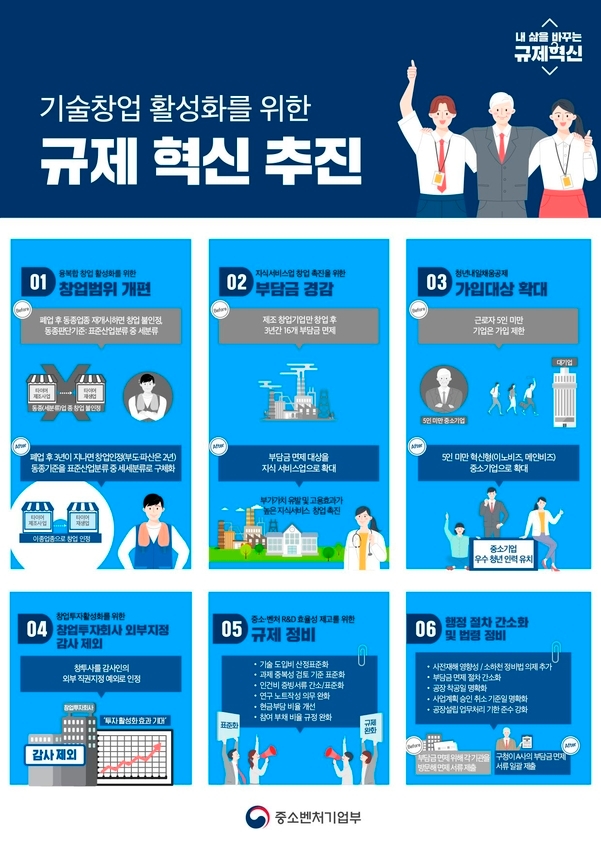 Promotion of Regulatory Innovation to Revitalize Technology Startups. Photo by Ministry of SMEs and Startups
[Asia Economy Reporter Kim Heeyoon] Going forward, the criteria for startups will be lowered, and the eligibility for the Youth Tomorrow Employment Deduction will be expanded to companies with fewer than 5 employees. Additionally, various charges will be exempted for technology-based knowledge service industries.
The Ministry of SMEs and Startups, together with the Ministry of Economy and Finance and related ministries, announced the '10 Major Industry Regulatory Innovation Measures (Ⅱ)' at the 16th Emergency Economic Central Countermeasures Headquarters meeting on the 17th.
This measure is a follow-up to the 'Regulatory Innovation in 10 Major Fields across 5 Areas' announced at the Economic Vitality Meeting in February, containing regulatory innovation tasks in four areas: chemical substance management, technology startups, resource circulation, and e-commerce/logistics.
The Ministry of SMEs and Startups took charge of the technology startup sector and selected 20 regulatory innovation tasks, including ▲removal of startup entry barriers (6 items) ▲promotion of growth for startup and venture companies (3 items) ▲efficiency improvement of R&D for SMEs and ventures (6 items) ▲simplification of administrative procedures and legal system maintenance (5 items).
First, startup entry barriers were lowered. To revitalize startups, if a company re-starts in the same industry three years after closing, it will still be recognized as a startup. Technology-based knowledge service industries will also be exempt from 16 types of charges for three years after establishment.
To promote the growth of startup and venture companies, the eligibility for the Youth Tomorrow Employment Deduction will be expanded from the current requirement of 5 or more employees to include Inno-Biz companies (technology-innovative SMEs) and Main-Biz companies (management-innovative SMEs) with fewer than 5 insured employees under employment insurance.
The government will also lower the threshold for support in research and development projects. To improve the efficiency of SME and venture R&D, the standards for conducting R&D projects will be standardized, and participation criteria for startup companies will be relaxed.
Furthermore, the necessary permits and approvals for startup companies to establish factories will be added to the list of items for collective consultation. Instead of startup companies having to visit each imposing agency individually to apply for charge exemptions, local governments will assist by submitting a collective application for charge exemptions on their behalf.
The 'Regulatory Reform Sinmungo' currently operated on the K-Startup website will also be revitalized. From the second half of this year, a permanent regulatory discovery system in the startup sector will be established, centered on the Korea Institute of Startup & Entrepreneurship Development.
Cha Jung-hoon, Director of the Startup and Venture Innovation Office at the Ministry of SMEs and Startups, stated, "We will closely monitor the progress of the regulatory innovation tasks included in this measure until improvements are completed," adding, "We will actively respond to regulatory innovation to ensure that new business models do not wither due to regulations in preparation for the post-COVID-19 era."
© The Asia Business Daily(www.asiae.co.kr). All rights reserved.
![Clutching a Stolen Dior Bag, Saying "I Hate Being Poor but Real"... The Grotesque Con of a "Human Knockoff" [Slate]](https://cwcontent.asiae.co.kr/asiaresize/183/2026021902243444107_1771435474.jpg)











