OECD Releases Interim Economic Outlook... South Korea's Growth Rate Revised Down from -0.8% to -1.0%
Numbers Show Resilience, but Gap with Domestic Current Situation Remains
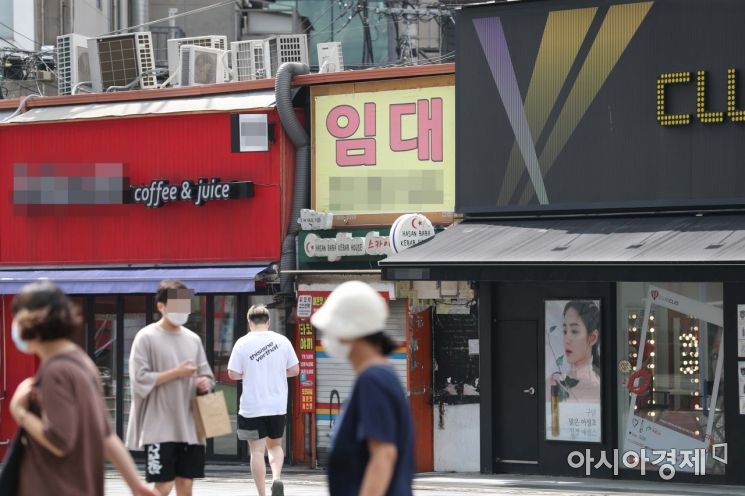 On the 27th, as the spread of the novel coronavirus infection (COVID-19) continued, a rental notice was posted on Yonsei-ro in Sinchon, Seodaemun-gu, Seoul. On the same day, the Bank of Korea forecasted that South Korea's real gross domestic product (GDP) growth rate for this year would be -1.3% due to the resurgence of COVID-19 and other factors. / Photo by Moon Honam munonam@
[Sejong=Asia Economy Reporter Kim Hyunjung] Amid the resurgence of the novel coronavirus infection (COVID-19), which is exacerbating difficulties for small business owners and vulnerable groups, there are criticisms that the government is overly intoxicated with the achievement of being the 'No. 1 in growth rate' among OECD member countries. Given the unexpected resurgence and the increased economic uncertainty ahead, there is a need to perceive the situation more seriously.
According to the 'Interim Economic Outlook' released by the OECD on the 16th, South Korea's economic growth rate for this year was revised downward by 0.2 percentage points from the August Korean Economic Report forecast (-0.8%) to -1.0%. Compared to the June figures, which presented growth rates for OECD member countries and G20 nations through the 'Economic Outlook,' this is 0.2 percentage points higher. However, it is 0.2 percentage points lower than the figure (-0.8%) forecasted in the August Korean Economic Report. This appears to reflect the COVID-19 resurgence situation after August.
In this regard, the Ministry of Economy and Finance distributed reference materials, stating, "Our country's growth rate this year ranks first among OECD member countries and second among G20 countries, excluding China, making it the best performance among G20 nations." They interpreted this as indicating that "our country's COVID-19 response, including fiscal policy, has been very effective during this period." To alleviate uncertainty, the OECD recommended ▲maintaining an active macroeconomic policy stance ▲expanding tailored support and infrastructure investment in digital and environmental sectors ▲enhancing the government's capacity to respond to COVID-19 resurgence, emphasizing that "most of these recommendations align with our policy direction."
Deputy Prime Minister and Minister of Economy and Finance Hong Nam-ki also said in his opening remarks at the Emergency Economic Central Countermeasures Headquarters meeting on the 17th, "(The OECD forecast) shows some disappointment as the upward revision compared to the August forecast has somewhat narrowed due to the recent COVID-19 resurgence." However, he added, "Our growth rate forecast remains the highest compared to major countries." He referred to the OECD forecast that Korea, the United States, and Turkey are expected to recover to pre-crisis levels (2019) in 2021, with Korea showing the greatest degree of recovery, and said, "We must have confidence and unite our efforts to maintain the momentum of economic recovery going forward."
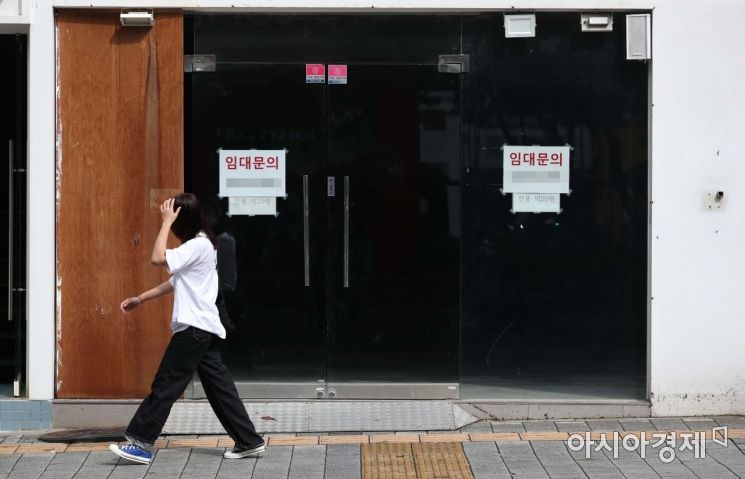 On the 27th, as the spread of the novel coronavirus infection (COVID-19) continued, a rental notice was posted on Yonsei-ro in Sinchon, Seodaemun-gu, Seoul. On the same day, the Bank of Korea forecasted that South Korea's real gross domestic product (GDP) growth rate for this year would be limited to -1.3% due to the resurgence of COVID-19 and other factors. Photo by Mo Nam Moon munonam@
However, the 2019 economic growth rate of South Korea, which the government presented as a 'return to previous levels,' was not very favorable. In September last year, before the outbreak of COVID-19, the OECD presented South Korea's growth rate as 2.1% in its 'Interim Economic Outlook,' which was a downward revision from 2.8% in November 2018, 2.6% in March 2019, and 2.4% in May 2019. This was analyzed at the time as due to the prolonged export slump, South Korea's growth engine, caused by the slowdown in global trade amid the US-China trade conflict.
Even though South Korea ranks first among OECD member countries, there are criticisms that a positive interpretation of the negative growth (-1%) is far removed from the current situation. The contraction in consumption activities due to social distancing continues to act as a factor freezing domestic demand. The Bank of Korea lowered its economic growth forecast for South Korea from -0.2% to -1.3% last month, a 1.1 percentage point drop. Additionally, as the government recently chose a method of broader support by setting certain conditions rather than concentrated support for a few crisis-hit industries and households through the 4th supplementary budget, evaluations suggest that it has become difficult to satisfy both 'revitalization of domestic demand through increased disposable income' and 'income compensation for vulnerable groups.'
© The Asia Business Daily(www.asiae.co.kr). All rights reserved.
![Clutching a Stolen Dior Bag, Saying "I Hate Being Poor but Real"... The Grotesque Con of a "Human Knockoff" [Slate]](https://cwcontent.asiae.co.kr/asiaresize/183/2026021902243444107_1771435474.jpg)

















