'Gaecheonjeol Large-Scale Rally' Expected to Gather 1,000 People
Minjunochong Jeonse Bus Solidarity "Refusal to Operate Gaecheonjeol Rally Buses, Over 70-80% Participation"
Experts "Concerns of 3rd Wave Spread During Large-Scale Rally"
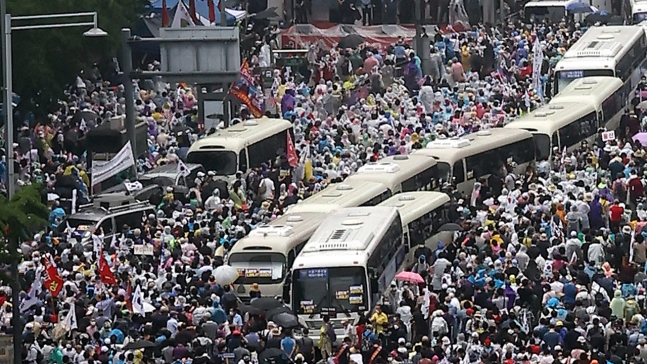 Participants gathered at a rally condemning the government and ruling party held in front of Donghwa Duty Free Shop in Jongno-gu, Seoul, on the afternoon of the 15th of last month. Photo by Yonhap News
[Asia Economy reporters Han Seung-gon and Kim Yeon-ju] As some conservative groups have announced plans to proceed with the 'National Foundation Day rally' on October 3 following the 'Liberation Day rally,' concerns are growing that the novel coronavirus disease (COVID-19) may spread again. Experts have expressed strong worries that it could lead to a third wave of COVID-19.
The conservative groups that announced plans for a large-scale rally went ahead with the National Foundation Day rally report on the 16th. The Free Democratic People's Movement reported the National Foundation Day rally at the civil service office of Jongno Police Station in Seoul that afternoon. The reported number of participants is 1,000, and the location is known to be the northern park road of Sejong Center in Gwanghwamun.
Choi In-sik, the representative of the Free Democratic People's Movement, held a press conference in front of Jongno Police Station in Seoul and said, "It is absolutely unacceptable to issue a blanket prohibition notice on rally reports in a free democratic country," adding, "The government is ruthlessly trampling on the freedom of assembly and association guaranteed by Article 21, Paragraph 1 of the Constitution under the pretext of COVID-19."
Choi said, "They are trampling on the basic rights of the people to silence the voices of the people who will raise louder voices on October 3 (National Foundation Day)," and added, "Even if they brand opposing citizens with the scarlet letter of 'COVID-19 confirmed case' and divide people, they can never permanently silence the voices of the people."
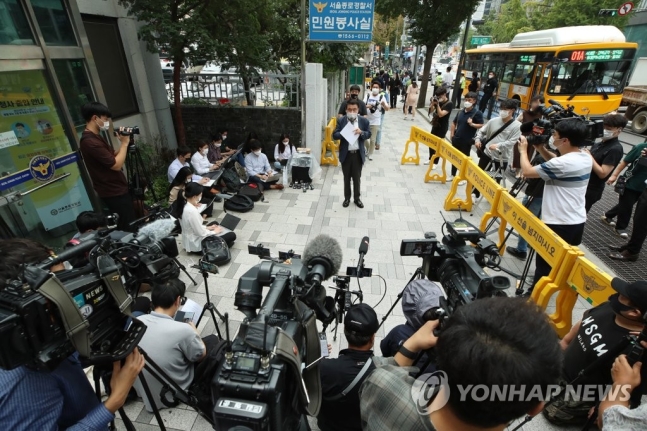 Choi In-sik, Secretary General of the August 15 Emergency Committee, holds a press conference on the afternoon of the 16th in front of Jongno Police Station in Seoul before reporting the Gaecheonjeol rally. Photo by Yonhap News
About 1,000 people from groups affiliated with the 'August 15 National Emergency Response Committee' are expected to participate in the rally. The August 15 Emergency Committee is a coalition of groups, including the Free Democratic People's Movement, that participated in last month's Liberation Day rally in Gwanghwamun.
While conservative groups have effectively shown their determination to proceed with the National Foundation Day rally by reporting it, the bus industry has announced a policy not to operate services related to the downtown rally. The plan is to block bus operations, which are the means of transportation for rally participants, to prevent as many people as possible from attending the National Foundation Day rally.
Heo I-jae, head of the chartered bus union of the Korean Confederation of Trade Unions, said in an interview on the YTN radio program 'Start New Morning' on the morning of the 16th, "Despite the difficult situation for chartered bus companies nationwide, we declared a refusal to operate in the spirit of preventing COVID-19 infections as citizens."
Heo explained the background of the refusal to operate, saying, "After the Liberation Day rally, COVID-19 cases spread rapidly to an unimaginable extent. In such a situation, large-scale rallies like the National Foundation Day rally should not be held."
According to the National Federation of Chartered Bus Transport Business Associations, as of the 15th, five regional associations in Gwangju, Jeonnam, Busan, Gyeongnam, and Chungbuk have resolved to refuse operations for the downtown Seoul rally next month among the 16 city and provincial associations.
Heo said, "Besides the chartered bus union of the Korean Confederation of Trade Unions, many chartered bus companies in various regions are reluctant to provide transportation for the National Foundation Day rally," adding, "Although it is impossible to block all operations nationwide, more than 70-80% are participating in the trend."
However, he expressed concerns that even if transportation is refused, participants might still attend the rally through planned schedules to Gwanghwamun or other loopholes.
Heo said, "Although we refuse to operate, (conservative groups) seem likely to attempt boarding in a more strategic and intelligent way," adding, "Even if we prepare meticulously, we have no power unless the users tell us in advance where they are going."
He added, "During the August 15 Liberation Day rally, buses disguised as wedding vehicles were mobilized on the morning of the day," explaining, "The destination was confirmed on the morning of the departure day, so we could not refuse operation and were in a reluctant situation."
He also shared his difficulties, saying, "'If you don't want to go, just say so,' but due to regional characteristics, there are already many complaints about the refusal of chartered bus transportation," and "Conservative groups seem to be pressuring, not openly but indirectly, asking 'Why aren't you going?'"
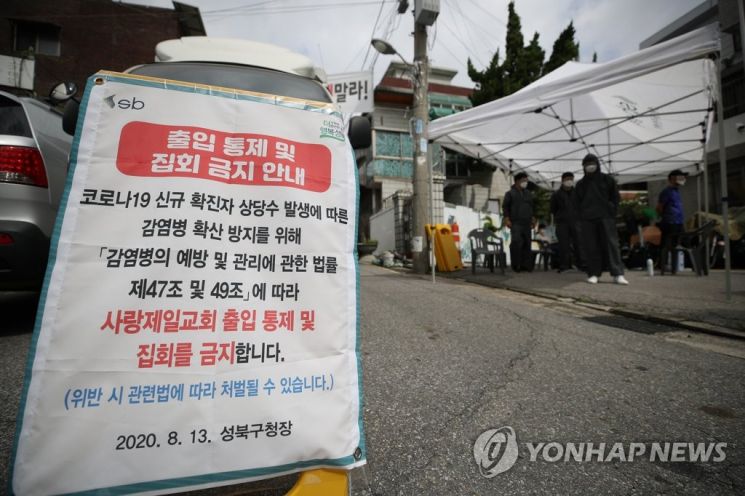 On the morning of the 16th of last month, a notice restricting access and prohibiting gatherings was installed in front of Sarang Jeil Church in Seongbuk-gu, Seoul, where a cluster infection of the novel coronavirus occurred.
 [Image source=Yonhap News]
Meanwhile, the Seoul Metropolitan Government decided on the 21st of last month to extend the ban on rallies of 10 or more people throughout Seoul until the 11th of next month to prevent COVID-19.
Son Young-rae, head of the Strategic Planning Division of the Central Disaster and Safety Countermeasures Headquarters, said, "The Assembly and Demonstration Act provides grounds for using physical force to disperse illegal rallies," adding, "The police are currently reviewing methods for dispersal using physical force."
He continued, "Those who participate in illegal rallies despite knowing the ban on rallies will be fined up to 3 million won under the Infectious Disease Control and Prevention Act," emphasizing, "Rally organizers may face imprisonment of up to two years or fines of up to 2 million won."
Experts have stressed the need to strengthen rally ban regulations, fearing the spread of COVID-19 following the August 15 Liberation Day rally last month.
Professor Eom Jung-sik of the Department of Infectious Diseases at Gachon University Gil Medical Center pointed out, "There is a high risk of a third wave as the large-scale spread that occurred after the Liberation Day rally could be repeated," adding, "More participants gathered in Gwanghwamun than the number of applicants at last month's rally. More people than the 1,000 applicants could gather at the National Foundation Day rally, increasing the risk of infection."
Professor Eom emphasized, "It is only a matter of whether the number of confirmed cases after the rally is low or high; the number will increase," and added, "Since gatherings are restricted under social distancing level 2, there is a need to strongly regulate large-scale rallies."
© The Asia Business Daily(www.asiae.co.kr). All rights reserved.



















