Nanoplastics Are Fatal to the Human Body
Positively Charged Nanoplastics Generate Reactive Oxygen Species, Destroying Lung Cells
Real-Time Analysis of Living Lung Cells Reveals Impact
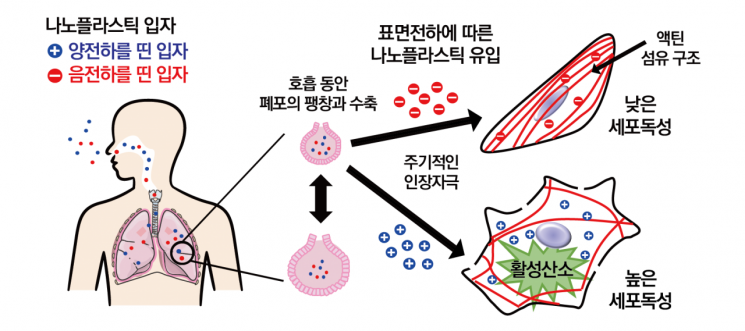
[Asia Economy Reporter Junho Hwang] A study analyzing live lung epithelial cells in real time revealed that lung cells can be destroyed depending on the electrical properties of the surface of nanoplastics. The research team stated that this is the first study to reveal that microplastics are fatal not only to the environment but also to the human respiratory system.
The research team led by Dr. Seongsu Lee from the Gwangju Center of the Korea Basic Science Institute and Professor Eungsam Kim from the Department of Biology at Chonnam National University announced on the 17th that they discovered that lung cells are destroyed (cell apoptosis) depending on the electrical properties of the surface of inhaled nanoplastics, and the related paper was published in Nano Letters, an international journal in the field of nanoscience.
Positively Charged Nanoplastics Destroy Lung Cells
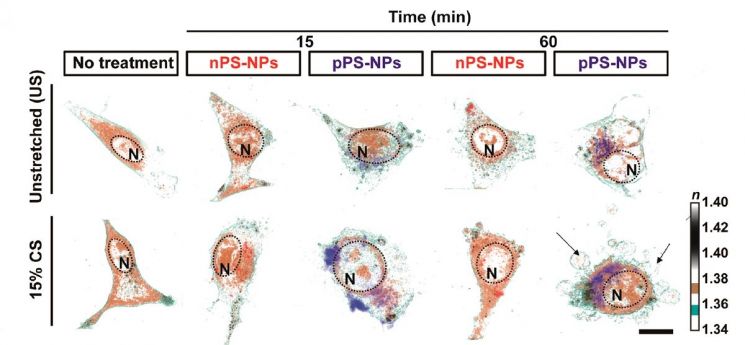 Changes in Alveolar Epithelial Cells Observed Through Three-Dimensional Holographic Tomography Microscopy
The research team uncovered how nanoplastics accumulated in the lungs act within cells to cause diseases. Although nanoplastics accumulated in alveolar epithelial cells are known to cause various diseases, how they act to lead to disease had not been revealed.
Nanoplastics are plastics with a diameter of 100 nm (nanometers) or less. Due to their very small size, they float in the air and are absorbed and accumulated in lung epithelial cells through respiration.
The research team analyzed in real time the morphological changes and cell destruction processes of alveolar epithelial cells caused by nanoplastics under lung-mimicking conditions that periodically contract and relax similar to the human respiratory cycle. They then confirmed that there were significant differences in changes to alveolar epithelial cells depending on the electrical properties of the nanoplastics.
When the surface of nanoplastics carries a negative charge, they induce the growth of unidirectional, regular fibrous structures within alveolar epithelial cells, causing the cells to stretch, but there was no adverse effect on the cells themselves.
On the other hand, positively charged nanoplastics caused irregular fibrous structures to grow inside the cells. They also induced excessive reactive oxygen species generation within the cells, leading to cell apoptosis.
Real-Time Analysis of Lung Cell Conditions

The research team obtained these results by observing live lung cells in real time using three-dimensional holographic tomography microscopy technology, which quantitatively and qualitatively analyzes cell structures based on refractive index of light.
Regarding this research achievement, Director Hyungsik Shin stated, "This is a result analyzing the effects of nanoplastics, a major national and social issue, on the human body, and it once again demonstrates that analytical science can be the key to opening the door to public health and safe living."
© The Asia Business Daily(www.asiae.co.kr). All rights reserved.
![Clutching a Stolen Dior Bag, Saying "I Hate Being Poor but Real"... The Grotesque Con of a "Human Knockoff" [Slate]](https://cwcontent.asiae.co.kr/asiaresize/183/2026021902243444107_1771435474.jpg)


















