Seoul City-Kakao Jointly Announce 'Measures to Improve Parking Lot Utilization Efficiency to Solve Parking Problems'
[Asia Economy Reporter Jo In-kyung] A study has found that if adjacent facilities such as large shopping centers and office buildings share parking information in real time to link and utilize vacant spaces, it can effectively alleviate parking difficulties in downtown Seoul. The analysis suggests that even without increasing the number of parking lots, convenience in using parking lots can be improved through demand dispersion.
The Seoul Digital Foundation and Kakao Mobility jointly announced a report titled "Measures to Improve Parking Lot Utilization Efficiency to Solve Seoul's Parking Problems" on the 17th, containing these findings.
Last year, the two organizations compared about 150 million destination data points from Kakao Navi with real-time parking lot entry and exit information collected from the Kakao T app to analyze differences in parking demand patterns by weekdays, weekends, and time slots at major downtown facilities. This big data analysis of parking demand, utilizing both real-time navigation usage information and real-time usage information from some parking lots simultaneously, is the first attempt of its kind in Korea.
The Seoul city government explained, "Considering the lack of space to newly expand parking lots in downtown Seoul, this study was conducted to find ways to maximize the utilization efficiency of existing parking lots."
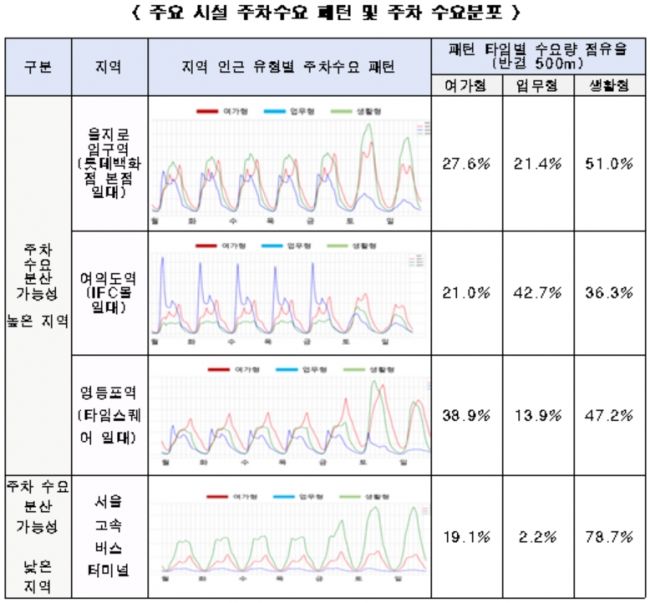
First, the city identified the types of parking demand by time slot at major Seoul facilities as ▲ leisure type (parks, sports, leisure facilities, public transportation facilities) with high demand on weekends and weekday evenings ▲ business type (office, education, medical facilities) with high demand on weekdays and daytime ▲ and living type (large shopping malls, convenience facilities) with high demand on weekends and weekday daytime.
Based on this, the occupancy rates by parking demand type within a 500m radius of 15 major points in downtown Seoul with many visitors using cars were verified. The areas expected to have significant dispersion effects through information sharing were Yeouido Station, Euljiro 1(il)-ga Station, and Yeongdeungpo Station areas.
The two organizations also categorized major metropolitan transportation facilities, large shopping malls, and university hospitals in downtown Seoul with high car user visits into three categories and selected five places with many visitors in each category, totaling 15 landmarks. These include Gimpo International Airport, Express Bus Terminal, Seoul Station, Yongsan Station, Dong Seoul Terminal, Lotte Department Store Main Branch and Lotte World Tower (Jamsil), Times Square, COEX, IFC Mall, Catholic University St. Mary's Hospital, Yonsei University Sinchon Severance Hospital, Seoul Asan Medical Center, Samsung Seoul Hospital, and Seoul National University Hospital.
These areas showed a relatively balanced distribution of the three types of parking demand and significant changes in demand depending on time and day of the week. Since the times when parking lots are crowded differ, sharing information in real time allows linking and efficiently utilizing vacant parking lots.
For example, in the Euljiro 1(il)-ga Station area, parking demand is high on weekends due to vehicles visiting department stores, while parking lots of nearby large office buildings are almost empty. If parking information is shared so that weekend department store visitors can use the nearby office building parking lots, parking demand concentrated at the department stores can be effectively dispersed.
However, the expected effects vary by region. For example, in areas like Seoul Express Bus Terminal, where parking lots are evenly distributed nearby but parking demand is concentrated in a specific type (living type 78.8%) and the time and day differences in parking demand for other business and leisure types are not significant, the demand dispersion effect is expected to be minimal.
This study is the second outcome since the two organizations signed a business agreement in October 2018 for a "Data-based Joint Research to Solve Seoul's Traffic Problems." Last year, they released an analysis titled "Nighttime Traffic Status Analysis to Improve Citizen Mobility."
Shin Woo-jae, lead researcher at the Seoul Digital Foundation, said, "Although it was difficult to accurately calculate parking demand due to the lack of detailed usage information for all city parking lots, we were able to effectively conduct parking demand analysis research through organic cooperation between the public and private sectors. We will continue to share public and private data and pursue research to solve Seoul's urban problems."
Kim Geon-woo, senior economist at Kakao Mobility, said, "To alleviate downtown parking problems, connecting parking spaces based on real-time parking lot information and the characteristics of parking demand by region is key. We hope that the phased introduction of parking lot informatization will efficiently utilize idle parking spaces and contribute to improving traffic flow in downtown areas."
© The Asia Business Daily(www.asiae.co.kr). All rights reserved.

![Clutching a Stolen Dior Bag, Saying "I Hate Being Poor but Real"... The Grotesque Con of a "Human Knockoff" [Slate]](https://cwcontent.asiae.co.kr/asiaresize/183/2026021902243444107_1771435474.jpg)















