Longest-Serving Cabinet Record Since Meiji Restoration
Cabinet Resigned Completely...Most Ministers Expected to Remain
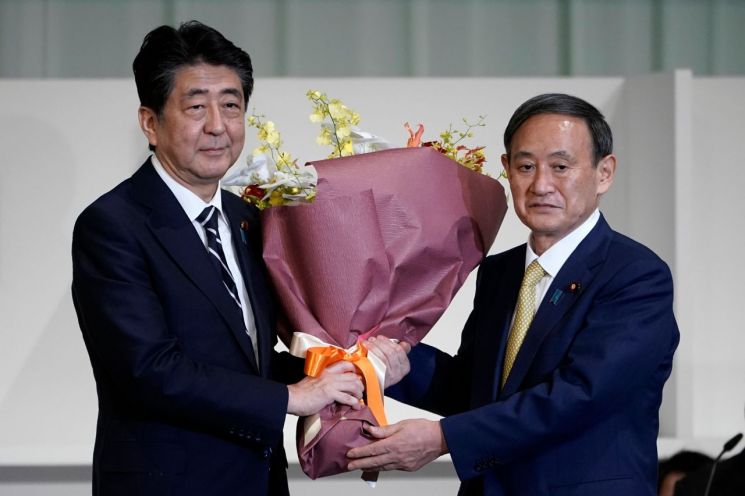
[Asia Economy Reporter Hyunwoo Lee] Prime Minister Shinzo Abe, who set the record for the longest-serving prime minister in Japanese history, and the Abe Cabinet have all resigned. However, it is expected that most of the Abe Cabinet members will be retained in the newly formed Suga Cabinet, indicating that former Prime Minister Abe's political influence will continue for a considerable period.
According to NHK and other foreign media, the Abe Cabinet held an extraordinary cabinet meeting (State Council) on the morning of the 16th and resigned en masse. Later that afternoon, if Yoshihide Suga, the Liberal Democratic Party leader, is nominated as the next prime minister by the House of Representatives and the House of Councillors, Japan's new cabinet will be launched. This marks the end of the longest-serving tenure in Japanese history held by Prime Minister Abe and the Abe Cabinet.
Former Prime Minister Abe's tenure includes his first term (September 2006 to September 2007, 366 days) and his second term starting from December 2012, totaling 3,188 days, the longest among Japanese prime ministers since the Meiji Restoration. The consecutive days served during his second term, 2,822 days, also set a historical record. Abe resigned in September 2007 during his first term due to his chronic illness, ulcerative colitis, and on the 28th of last month, he expressed his intention to resign again citing a relapse of the same illness during his second term.
During his second term, Abe won landslide victories in six House of Representatives and House of Councillors elections, establishing a strong one-party dominance. In economic policy, he was credited with achieving certain successes for a period through so-called "Abenomics," which centered on quantitative easing, fiscal expansion, and growth strategies. However, during his tenure, he faced criticism from various sectors due to scandals such as the Moritomo and Kake Gakuen scandals and controversies over the privatization of the government-hosted "Cherry Blossom Viewing Party." Earlier this year, his approval ratings plummeted following poor responses to the COVID-19 pandemic.
Nevertheless, about half of the ministers from the Abe Cabinet who resigned on this day are reported to be reappointed in the newly formed Suga Cabinet, suggesting that former Prime Minister Abe's political influence will persist for some time. Key Abe Cabinet members confirmed to be retained include Deputy Prime Minister and Finance Minister Taro Aso, Foreign Minister Toshimitsu Motegi, Minister of Education, Culture, Sports, Science and Technology Koichi Hagiuda, Minister of Economy, Trade and Industry Hiroshi Kajiyama, Minister of Land, Infrastructure, Transport and Tourism Kazuyoshi Akaba, Minister of the Environment Shinjiro Koizumi, Minister for Economic Revitalization Yasutoshi Nishimura, and Minister in charge of the Olympics Seiko Hashimoto.
© The Asia Business Daily(www.asiae.co.kr). All rights reserved.

















