Only 29.7% Participation from All Social Sectors
41.7% Say Curriculum Content Should Connect to Student Life
2nd National Curriculum Innovation Forum Held
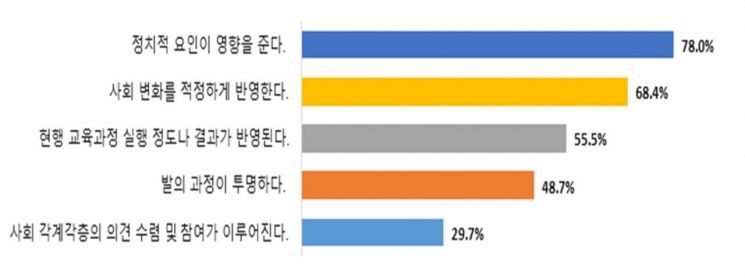
[Asia Economy Reporter Hyunju Lee] When revising the national curriculum, 8 out of 10 education officials perceive 'political factors' as having the greatest influence.
The Presidential Commission on National Education announced the main results of a perception survey related to the revision, application, and evaluation cycle of the national curriculum on the 16th. The survey was conducted from July 15 to August 17, targeting 1,603 elementary and secondary school teachers and education office staff.
When proposing revisions to the national curriculum, 78.0% of respondents answered that political factors influenced the process. Positive responses included appropriate reflection of social changes (68.4%) and consideration of the implementation level or results of the current curriculum (55.5%), but less than half of respondents believed the proposal process was transparent (48.7%), and only 29.7% thought that opinions and participation from various social sectors were gathered, indicating an overall critical view of the revision process.
As considerations when revising the national curriculum, respondents cited the appropriateness and validity evaluation of research and development organizations, processes, and outcomes (95.8%), review of suitability for school sites (95.4%), and securing political and ideological neutrality (94.5%).
The most important criterion for determining the content of subject curricula was the connection to students' lives at 41.7%, followed by the situation and circumstances of school sites (26.3%), and new knowledge according to social and academic development (12.2%).
Based on this survey, the National Education Commission will hold the 2nd National Curriculum Innovation Forum on the 17th together with the National Association of Metropolitan and Provincial Superintendents of Education and the Korean Curriculum Association. Under the theme "Innovating the National Curriculum through Systems," the forum will be held on the National Education Commission’s YouTube channel. The keynote speech and thematic discussions will focus on directions for improving the education system to realize learner-centered curricula, decentralization of the curriculum, and implementation of educational governance.
In his keynote speech, Kim Jin-kyung, Chairperson of the National Education Commission, emphasized, "A future-oriented curriculum that cultivates students' competencies should not be fixed as a national document but should be supported by a system that allows dynamic self-change and development at school sites." He added, "To this end, metropolitan and provincial education offices should be restructured into specialized support units that assist in combining the expertise of teacher training institutions and local communities with teachers' competencies."
Teachers and education office staff will participate together in the thematic discussions.
© The Asia Business Daily(www.asiae.co.kr). All rights reserved.
![Clutching a Stolen Dior Bag, Saying "I Hate Being Poor but Real"... The Grotesque Con of a "Human Knockoff" [Slate]](https://cwcontent.asiae.co.kr/asiaresize/183/2026021902243444107_1771435474.jpg)
















