Resumption of School Attendance in the Capital Area on the 21st... Attendance Limited to 1/3 for Kindergarten, Elementary, and Middle Schools, 2/3 for High Schools
Working Parents Complain "Considering Resignation Due to Childcare Issues"
Experts Urge "Government Should Support Flexible Work Arrangements Like Remote Work"
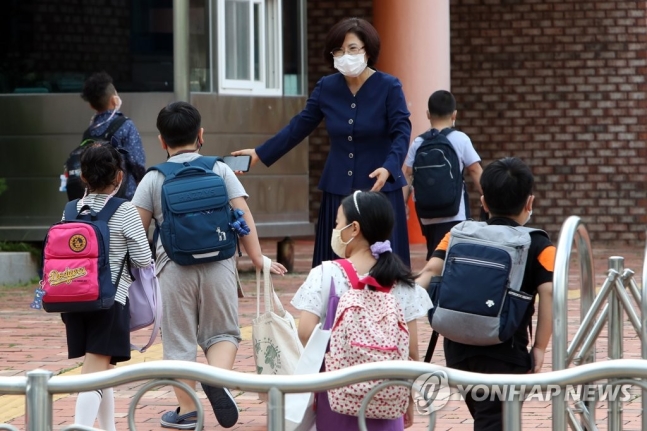
[Asia Economy Reporter Kim Su-wan] Schools in the Seoul metropolitan area, including Seoul, Gyeonggi, and Incheon, which have maintained full remote classes due to the spread of the novel coronavirus infection (COVID-19), will resume in-person classes starting on the 21st. However, as the number of students attending in-person classes nationwide, including the metropolitan area, is limited to within one-third for kindergartens, elementary, and middle schools, and within two-thirds for high schools, parents are voicing concerns that "resuming in-person classes is practically no better than not resuming at all."
Since in-person and remote classes are being conducted concurrently, with students attending only 1-2 times per week, childcare issues remain unresolved. In particular, the number of dual-income couples considering quitting their jobs due to childcare problems is increasing, making urgent measures necessary.
Experts have suggested that flexible work arrangements such as staggered commuting hours or telecommuting should be supported to address childcare gaps.
On the 15th, Yoo Eun-hye, Deputy Prime Minister for Social Affairs and Minister of Education, stated at a briefing held at the Government Seoul Office, "Following the adjustment of social distancing to level 2 in the metropolitan area, all schools in Seoul, Gyeonggi, and Incheon will resume in-person classes from the 21st. However, considering the special quarantine period during the Chuseok holiday, enhanced measures to minimize school density must be observed until October 11."
Accordingly, schools in the metropolitan area that have replaced all second-semester classes with remote learning since the 26th of last month will resume in-person attendance. However, considering that the quarantine authorities have designated the Chuseok holiday special quarantine period (September 28 to October 11), the number of students attending in person will be restricted until the 11th of next month, after the holiday.
Kindergartens and elementary and middle schools must keep in-person attendance below one-third, and high schools are limited to within two-thirds. The problem is that even with these measures, the actual number of days students attend in-person classes is at most one week.
As a result, working parents with children are sighing despite the news of resuming in-person classes. Many dual-income families have already exhausted their childcare leave or annual leave during the first semester.
A(43), a working parent raising two elementary school children, lamented, "I thought I could breathe a sigh of relief with the resumption of in-person classes, but they say classes will be a mix of in-person and remote. I have no remaining annual leave, and I've taken so much time off that I feel pressured at work. Relying on my parents has its limits, so I'm very worried."
He added, "My kids don't go to school every day. They only attend in-person classes for exactly two days before Chuseok, and it feels like it's no better than not going at all. In the end, it's no different from the previous remote classes. The school also contacted us saying they will pilot Zoom classes. Preparing for in-person classes and Zoom classes has made things busier. Since I have two elementary school kids, I'm seriously considering quitting my job to take care of them."
There are also concerns about the limitations of emergency childcare classrooms operated by the government to minimize childcare gaps. A member of a mom caf? with a third-grade elementary school child said, "As a working mom, I can't help my child study at home, so I sent them to the emergency childcare classroom. Honestly, the elementary emergency childcare classroom is just a place to keep the kids; they can't really study there." She continued, "Since in-person attendance is only once or twice a week, it's meaningless. I'm seriously considering quitting my job for my child."
With the easing of social distancing, many companies have lifted telecommuting, leading to an increase in parents considering quitting their jobs altogether. According to an online survey conducted by Jang Cheol-min, a member of the Democratic Party of Korea, on the 15th targeting 410 parents with children in elementary school or younger, 143 respondents (50.5%) answered that they are "considering leave or quitting because they cannot endure the childcare gap." Since it is difficult to resolve both work and childcare issues simultaneously, one spouse seriously considers quitting their job.
It was also found that using family care leave supported by the Ministry of Employment and Labor or personal annual leave is not easy. Among 196 dual-income workers, 69.2% responded that "using annual leave is not easy," and 84% of 238 respondents said "it is difficult to use family care leave."
As solutions to address childcare gaps, the most common response was △support for telecommuting or flexible work (115 respondents, 40.6%), followed by △expansion of childcare leave subsidies (19%), △lifting of school closures and online classes (16%), and △extension of childcare leave periods (11%).
Given this situation, there are calls for measures to address childcare gaps for dual-income couples. In August, a petition titled "Mandatory Telecommuting for One Parent in Dual-Income Couples" was posted on the Blue House's public petition board. The petitioner said, "What about dual-income families? Our child cannot safely learn just because both parents work," and urged, "We ask the government for a prompt response."
An official from the Ministry of Education responded to some criticisms regarding the resumption of in-person classes, saying, "Currently, it is impossible to conduct full in-person classes due to COVID-19, and the health and safety of students are more important. The Ministry of Education made this decision after long discussions with quarantine authorities. Whether in-person classes resume or not, problems are inevitable. We plan to quickly address these issues to create an educational environment that satisfies students and parents."
Experts pointed out that government policies and corporate culture improvements are necessary to minimize childcare gaps for dual-income couples.
Jang, who conducted the survey on childcare gaps for dual-income couples, emphasized, "It is important to create a workplace atmosphere where employees can use annual leave or leave in urgent childcare situations," and added, "Support for flexible work arrangements such as staggered commuting hours or telecommuting is necessary so that working parents with children do not have to choose between work and childcare."
© The Asia Business Daily(www.asiae.co.kr). All rights reserved.


















