Hana Financial Research Institute Analyzes Court Registry Data
Confirmed by Numbers of 30s' Full-Leverage Loans... Seoul Real Estate Purchase Share 28%
[Asia Economy Reporter Kim Min-young] It has been revealed that one out of every two people purchasing real estate for the first time in their lives chose the Seoul and Gyeonggi-do areas. This proportion increased by 12 percentage points over the past decade. The proportion of homebuyers without housing among all real estate transactions in Seoul and the Gyeonggi area fell from 41% in 2013 to 31% this year, indicating that it has become more difficult for the homeless to secure their own homes due to the rapid rise in real estate prices.
On the other hand, multi-homeowners recorded the highest levels of trusts and gifts ever, showing a contrast. Also, over the past three years, the average actual transaction price of apartments in Seoul rose by 45.5% according to the Korea Real Estate Board, but during the same period, prices of major popular apartments in each district of Seoul mostly increased by 50-80%, showing a significant difference from the average.
The Hana Financial Management Research Institute, affiliated with Hana Bank, announced a report on the 16th studying the trend changes in domestic real estate transactions over the past 10 years through analysis of real estate registration data provided by the court registration information plaza.
While it has become difficult for the homeless to newly enter the market, the preference of people in their 30s for Seoul and Gyeonggi was clear. According to the report, based on collective buildings (apartments, multi-family houses, row houses, officetels, and other commercial buildings), the proportion of first-time real estate buyers choosing Seoul and Gyeonggi-do increased from 37% in 2010 to 49% in 2020.
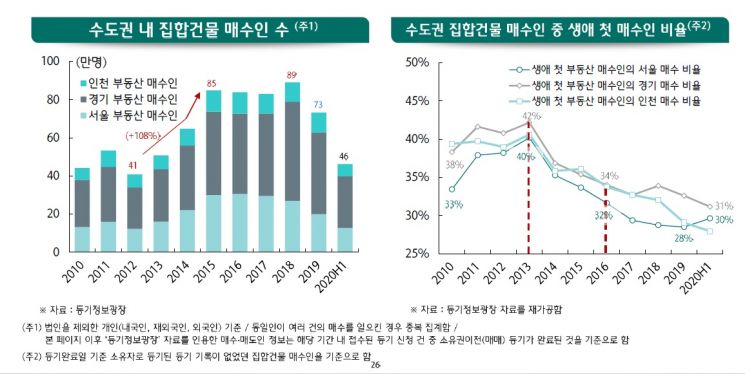
However, the proportion of purchases in Seoul began to decline from 20% in 2016 due to the recent rapid rise in real estate prices and strengthened regulations, recording about 15% this year. Some buyers who gave up purchasing real estate in Seoul chose the Gyeonggi area, increasing the purchase proportion in Gyeonggi-do from 30% in 2016 to 34% in 2020.
The proportion of homebuyers without housing among real estate transactions in Seoul and Gyeonggi fell from 41% in 2013 to 31% in the first half of this year. The institute analyzed, “While existing homeowners increased their replacement or additional purchases, the number of homeless people postponing or giving up home purchases due to the rapid rise in real estate prices increased, reflecting the reality that it has become even more difficult for the homeless to secure their own homes.”
Confirmed by Numbers: 30s 'Yeongkkeul'
Also, despite the decreasing proportion of people in their 30s in Seoul, the proportion of buyers in their 30s among collective building buyers in Seoul increased from 24% in 2017 to 28% in the first half of this year, drawing attention.
Researcher Kim Ki-tae said, “Recently, the subscription competition rate for new town apartments in Seoul reached as high as 340 to 1, and the subscription cutoff score was 69 points, practically impossible for people in their 30s. As it became difficult to secure a home through winning subscriptions, the phenomenon of buying by taking out loans seems to have spread.” This confirms the so-called 'Yeongkkeul (borrowing to the soul) loan' phenomenon in numbers.
Multi-homeowners were found to have evaded real estate regulations through trusts, gifts, and corporate name transactions. Although various real estate policies targeting multi-homeowners have been implemented since 2017, multi-homeowners responded by using trusts, gifts, and corporate name transactions to avoid regulations.
When regulations on multi-homeowners were strengthened through the August 2, 2017 measures, the number of collective building trusts in Seoul reached a record high of 6,589 cases in August of the same year, which is 13.6 times the 486 cases in April 2011.
Also, as the July 10 measures recently reduced benefits for trusts and corporate name transactions and showed signs of regulating real estate gifts by multi-homeowners, the number of gifts for collective buildings in Seoul reached 6,456 cases in July, a sharp increase to 19.6 times the 330 cases in September 2013.
Non-residents and Foreigners Also Buying Real Estate in the Capital Area
According to the institute’s analysis of buyers in the capital area, the number of collective building buyers increased from 410,000 in 2012 to 850,000 in 2015, more than doubling in three years.
Also, the proportion of non-residents buying real estate in Seoul increased from 21% in January 2014 to 32% last January, and the number of foreigners buying real estate in the capital area rose from 2,731 in 2010 to 12,946 last year, reaching 1% of all individual buyers nationwide.
In particular, among foreigners buying in the capital area, the number of Chinese buyers surged from 331 in 2010 to 9,658 last year.
Seoul Apartment Prices Soared Over the Past 3 Years, Major Apartments Show Above-Average Increase Rates
The report stated that the transaction price per 1㎡ of collective buildings in Seoul rose about 28% over the past three years (May 2017 to May 2020).
Among them, the rise in Seoul apartment prices has recently become controversial. According to the Korea Real Estate Board statistics, the actual transaction price index rose 45.5% during the same period, and the average actual transaction price (39.1%), median actual transaction price (38.7%), and sales price index (14.2%) all increased, the institute said.
The Ministry of Land, Infrastructure and Transport cited the sales price index, which showed the lowest increase among Korea Real Estate Board statistics, to announce that Seoul apartment prices rose 14.2% over three years. However, the institute explained that the sales price index is based on survey results of samples and may differ from actual market prices.
In particular, analyzing the actual transaction prices of major popular apartments in Seoul, it was found that prices mostly rose 50-80% over the past three years, greatly exceeding the average.
Researcher Jung Hoon of Hana Financial Management Research Institute explained the gap between some housing price indices and the actual perceived market prices by saying, “It is necessary to objectively verify whether representative samples of the population are secured and whether market-reflective price data are accurately collected during the survey stage.”
© The Asia Business Daily(www.asiae.co.kr). All rights reserved.



















