80,000 Households Without Power... Gu Ja-geun "Supporting Welfare Blind Spots More Urgent Than Communication Costs"
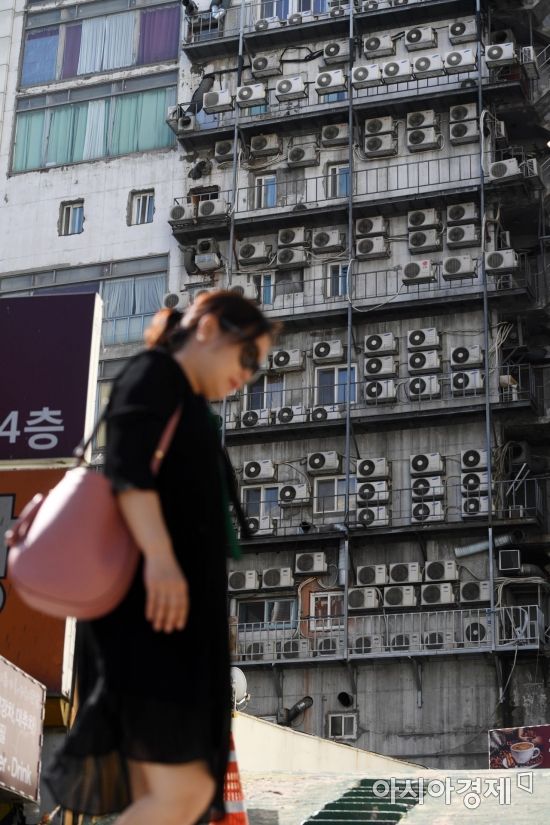 On the 31st, as power demand increases due to the heatwave, air conditioner outdoor units are densely installed on the exterior wall of a building in Jung-gu, Seoul. Photo by Moon Honam munonam@
[Asia Economy Reporter Moon Chaeseok] Due to the economic recession caused by the novel coronavirus infection (COVID-19), the number of households overdue on electricity bills reached approximately 800,000 as of July.
According to data received from Korea Electric Power Corporation (KEPCO) by Ku Ja-geun, a member of the People Power Party on the National Assembly's Industry, Trade, Energy, Small and Medium Enterprises Committee, as of the end of July, the number of households overdue on electricity bills was 798,000, with overdue payments totaling 146.3 billion KRW.
The number of overdue households (overdue amount) by year was 636,000 households (75.7 billion KRW) in 2015, 705,000 households (86.0 billion KRW) in 2016, 751,000 households (98.2 billion KRW) in 2017, 760,000 households (127.4 billion KRW) in 2018, and 757,000 households (139.2 billion KRW) last year, remaining around 700,000 households annually.
The annual overdue status data is based on households overdue by more than two months from the due date, compiled by KEPCO at the end of each year.
Looking at last year's data by region, the highest number of households overdue on electricity bills was in Daegu and Gyeongbuk (107,000 households), followed by Gyeonggi Province (99,000 households), Busan (80,000 households), Daejeon and Chungnam (76,000 households), and Gwangju and Jeonnam (57,000 households).
The average overdue amount per household over the past five years was 118,891 KRW in 2015, 121,958 KRW in 2016, 130,747 KRW in 2017, 167,536 KRW in 2018, and 184,164 KRW last year, showing an increasing trend each year. As of July, it was 183,261 KRW.
The number of households whose electricity was cut off due to unpaid bills was 166,000 in 2015, 161,000 in 2016, 144,000 in 2017, 151,000 in 2018, and 150,000 last year, exceeding 150,000 almost every year. This year, as of July, it was recorded at 82,000 households.
Representative Ku said, "The number of households overdue on electricity bills, which can be considered the most essential, has surged due to COVID-19 and the economic downturn," adding, "Support for the welfare blind spots who cannot even pay electricity bills is more urgent than the 20,000 KRW communication fee support being discussed in the recent supplementary budget."
© The Asia Business Daily(www.asiae.co.kr). All rights reserved.
















