Despite Weak Dollar Trend, Dollar Demand for Overseas Stock Investment Continues
Won-Dollar Exchange Rate Falls Only Around 4% as Dollar Value Drops 9%
[Asia Economy Reporter Kim Eunbyeol] Individual investors investing in overseas stocks, so-called 'Seohak Gaemi', have also defended against the decline in the won-dollar exchange rate. Since the outbreak of the novel coronavirus infection (COVID-19), the U.S. Federal Reserve (Fed) has released an enormous amount of dollars to prevent financial market instability, maintaining a weak dollar trend, but the won value, which should have relatively risen, has increased less than expected. This is explained by the surge in individual demand for dollars due to the overseas stock investment craze in Korea.
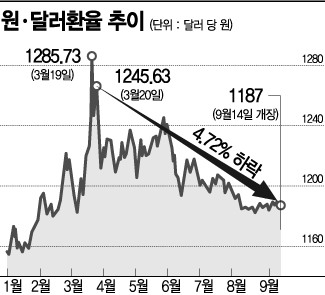
On the 14th, in the Seoul foreign exchange market, the won-dollar exchange rate opened at 1,187.0 won, up 0.1 won from the previous trading day, and has been moving in the mid-to-late 1,180 won range. The exchange rate, which rose close to 1,300 won in the early days of the COVID-19 outbreak, stabilized by trading in the low 1,200 won range from April to June, and since July, the average exchange rate has formed a box range in the high 1,100 won range.
Although the exchange rate has fallen compared to the early days of the COVID-19 outbreak, analysis shows that the won value has risen relatively less compared to the dollar value, which also fell during the same period.
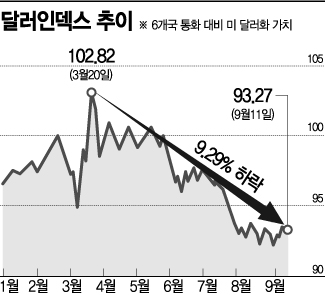
In fact, the dollar index (the value of the U.S. dollar against six currencies), which soared to 102.82 on March 20, fell to 93.27 on the 11th (local time). This means the dollar value dropped by 9.29% over about six months. On the other hand, the won value increase (won-dollar exchange rate decline) did not reach this level. The won-dollar exchange rate fell from 1,245.63 won to 1,187.0 won during the same period, a decrease of only 4.72%.
An official from the foreign exchange authorities said, "This phenomenon was particularly strong when overseas stock investment demand was concentrated in July and August," adding, "Observing daily foreign exchange settlement demand, domestic investors' stock investment demand was large." Considering that the exchange rate slightly turned upward in September, comparing the trends of the dollar and won values until the end of August shows that when the dollar weakened by 10%, the won value rose by only 3-4%.
Compared to emerging market currencies, the won value has moved relatively less. According to the Bank of Korea, from August 1 to September 9, currencies such as Mexico (4.3%), China (1.9%), and India (1.6%) showed strength, while the won value showed only a 0.2% increase. During the period from July 1 to August 11, when the dollar value sharply declined, currencies in the UK (5.6%) and Eurozone (4.8%) showed strength, but Korea's currency value rose by 1.5%.
The surge in dollar demand due to increased overseas stock investment can be confirmed by other figures as well. According to the Korea Securities Depository Securities Information Portal, the foreign currency stock settlement amount through the depository from January 1 this year to the 11th reached about 67.1 billion dollars, three times the annual foreign currency stock purchase amount last year (about 21.7 billion dollars). As of the end of July, residents' foreign currency deposits at foreign exchange banks increased by 2.87 billion dollars in one month to 87.4 billion dollars, with 96% of the increase concentrated in dollar deposits. A foreign exchange authority official explained, "Dollar deposits have increased mainly in investors' deposits and trusts at securities companies," adding, "It is not that foreigners' market influence has decreased recently in the foreign exchange market, but rather that domestic investors' influence has relatively increased."
© The Asia Business Daily(www.asiae.co.kr). All rights reserved.

![A Woman with 50 Million Won Debt Clutches a Stolen Dior Bag and Jumps... A Monster Is Born [Slate]](https://cwcontent.asiae.co.kr/asiaresize/183/2026021902243444107_1771435474.jpg)
















