Publication of 'Kakao Mobility Report 2020'
[Asia Economy Reporter Jin-gyu Lee] It has been revealed that the proportion of short-distance trips in Kakao T Taxi has improved. Additionally, the application of artificial intelligence (AI) technology to Kakao T Daeri has shortened driver assignment times.
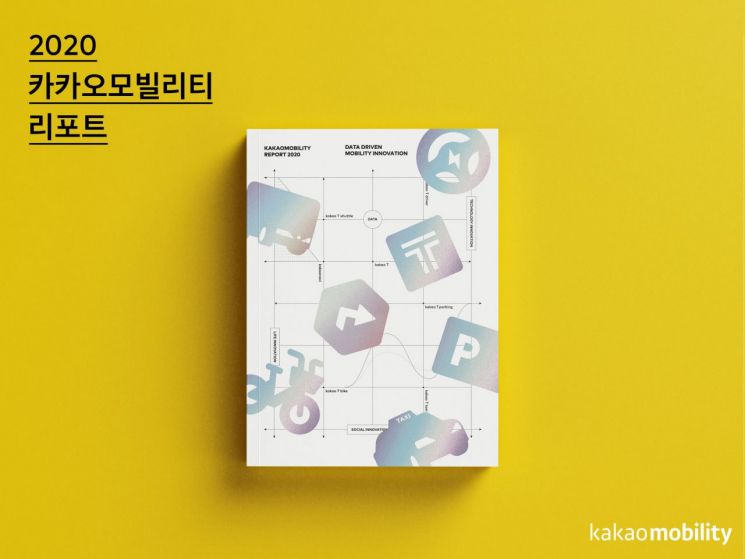
Kakao Mobility published the "Kakao Mobility Report 2020" on the 14th, analyzing various mobility big data provided by Kakao T. Now in its fourth edition, this report focuses on "data-driven mobility innovation," which Kakao Mobility has been concentrating on.
Kakao T Taxi Improves Conditions for Short-Distance Trips
Since the introduction of the Kakao T Taxi service, short-distance trips, which were previously subject to ride refusals, have increased. The proportion of short-distance trips, which was 45% in 2018, rose by 5 percentage points to 50% in the first half of this year. In Seoul, for trips under 5 km, the proportion of short-distance trips completed per driver was 27% for regular taxis in the first half of this year. In contrast, Kakao T Blue recorded 31%, meaning the short-distance trip rate per driver for Kakao T Blue was 4 percentage points higher.
Among Kakao T Taxi users, 61.7% set their pickup locations on side streets or near buildings, while only 23% called from main roads. Thanks to GPS-based technology features such as displaying the call location, boarding location, and vehicle direction, users can conveniently hail taxis even in complex areas between buildings and alleys.
Kakao T Daeri AI Recommended Fare Helps Faster Return Home
The data technology applied to Kakao T Daeri is the "AI Recommended Fare." This service uses machine learning to analyze five years of actual usage fares, call locations, times, distances, and other data to propose optimal fares. Since the introduction of the AI Recommended Fare, from November last year to June this year (8 months), driver assignment time has been reduced by 22%, and the probability of driver assignment has increased by about 21%. As a result, more than 1.7 million users have been able to get home faster.
Since its launch, Kakao T Bike has secured a strong loyal user base, with the top 10% of users accounting for 51% of the total service usage amount over one year and five months. Usage patterns varied by service region. In Seongnam City and Incheon City, where subway lines are established, the service prominently served as last-mile transportation to subway stations. In contrast, in Jeonju City and Ulsan City, where public transportation infrastructure is relatively lacking, active usage patterns were observed throughout the entire city.
Collaboration with Related Organizations to Utilize Mobility Big Data
The report also introduced close cooperation with related organizations to ensure that mobility big data can be meaningfully utilized socially and in policy. Through joint research with the Seoul Digital Foundation, Kakao Mobility derived solutions to alleviate parking problems and traffic congestion in downtown Seoul by connecting idle parking spaces through the Kakao T parking system. The Kakao Navi "Safe Speed 5030" campaign conducted with the Korea Transportation Safety Authority reduced average driving speeds by up to 5.4 km/h during late-night hours when speeding is frequent, and increased speeds by up to 3.3 km/h during heavily congested rush hours.
According to Kakao Navi navigation standards, trips to indoor locations such as complex shopping malls and cinemas decreased by up to 54.5%, and usage rates in office areas like Bundang-gu and Gangnam-gu dropped by 10-20% due to the impact of remote work. Ryu Geung-seon, CEO of Kakao Mobility, stated, "In these times of great changes to daily life caused by the novel coronavirus disease (COVID-19), mobility data will play a milestone role in presenting new mobility standards in the new normal era."
© The Asia Business Daily(www.asiae.co.kr). All rights reserved.

















