Korea Basic Science Institute Uses Bioluminescence for Cancer Treatment
Utilizing Self-Luminous Proteins to Induce Cancer Cell Death
Applicable Not Only for Cancer Treatment but Also for Elderly Disease Therapy
 Medical staff performing colorectal cancer surgery. (Unrelated to the article)
[Asia Economy Reporter Junho Hwang] Domestic researchers have developed a technology that removes cancer cells in the human body using only pure proteins. This protein emits light when it attaches to cancer cells, and the increased reactive oxygen species within the cancer cells caused by this light lead to their death. The research team anticipated that a new chapter in anticancer treatment will open.
The research teams led by Seongsu Lee, principal researcher at the Gwangju Center of the Korea Basic Science Institute, Youngpil Kim, professor of Life Sciences at Hanyang University, and Kyungjin Lee, professor at the College of Medicine, University of Ulsan, jointly developed a new concept technology that treats cancer by killing cancer cells with proteins that emit light by themselves. The research results were published on the 12th (local time) in the international journal Science Advances.
Development of Bioluminescent Protein
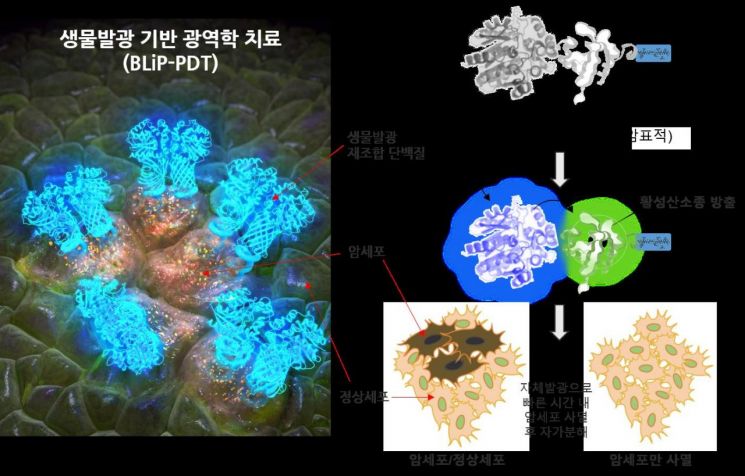
The research team developed a new protein by combining a bioluminescent protein domain that specifically binds to the cancer cell membrane and emits light with a protein domain that induces cancer cell death upon light stimulation. The protein bound to cancer cells emits light by itself, which increases the reactive oxygen species concentration in the cancer cells, leading to their death.
Using the three-dimensional holotomography microscope of the Korea Basic Science Institute, the research team observed in real time the process of the newly developed protein binding to living cancer cells, the protein’s luminescence phenomenon, the induction of reactive oxygen species generation within cancer cells, and the subsequent cancer cell death caused by reactive oxygen species.
The research team stated, "By accurately observing the therapeutic mechanism and changes in cancer cells through this microscope, we were able to rapidly verify the drug’s efficacy using animal models."
Potential Application in Treatment of Age-related Diseases

The research team explained that using the newly developed protein allows cancer treatment to be induced without external light stimulation, and since the protein is decomposed in the body after cancer cell death, side effects from anticancer treatment are minimal. They emphasized that this study is significant as it proposes a new treatment method that treats cancer using only pure proteins rather than chemical anticancer drugs.
Professor Youngpil Kim of Hanyang University explained, "The bioluminescence phenomenon of biomaterials emitting light by themselves has been considered limited in application due to low light intensity, but by changing the perspective, it has become a key technology for developing more biocompatible and less side-effect-prone therapeutics."
Principal researcher Seongsu Lee stated, "By applying three-dimensional holotomography technology, biological changes occurring in living cells can be observed in real time," adding, "This can be applied not only to the development of new concept cancer therapeutics like this but also to understanding the pathogenesis and developing treatments for various diseases such as degenerative brain disorders."
© The Asia Business Daily(www.asiae.co.kr). All rights reserved.


















