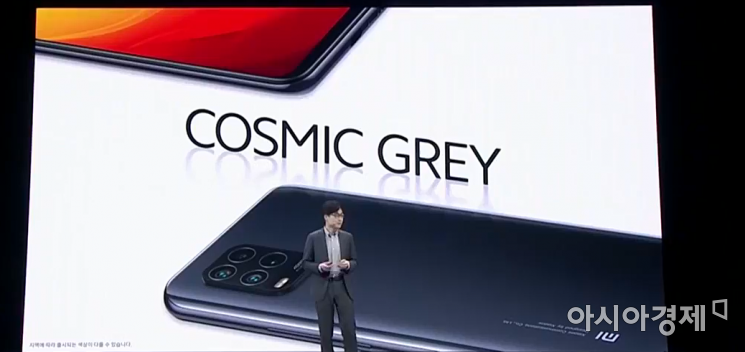
[Asia Economy Reporter Joeslgina] Xiaomi's Mi 10 Lite 5G, China's first 5G smartphone priced in the 400,000 KRW range, has become a '0-won phone' just over two months after its release. Although it declared its intention to target the Korean market by emphasizing its 'cost-effectiveness,' which is about half the price of the latest domestic smartphones, it is evaluated that it was ignored by consumers due to disappointing performance.
According to the telecommunications industry on the 14th, SK Telecom raised the official subsidy for the Mi 10 Lite to a maximum of 393,000 KRW as of the 10th. This is the second increase from 300,000 KRW at the time of its release in July. By plan, except for the youth-only plan (0Teen 5G), the subsidies for 5G Slim (55,000 KRW/month), 5GX Standard (75,000 KRW/month), 5GX Prime (89,000 KRW/month), and 5GX Platinum (125,000 KRW/month) were all raised to the same level.
Including the additional subsidy (58,000 KRW), the subsidy exceeds the Mi 10 Lite 5G's retail price (451,000 KRW), making the actual purchase price at the T Direct Shop 0 KRW. Currently, the Mi 10 Lite 5G is the only smartphone priced at 0 KRW at the T Direct Shop. Even when applying the cheapest youth-only plan 0Teen 5G (official subsidy 330,000 KRW), the actual purchase price drops to around 70,000 KRW. In KT's case, the official subsidy for the Mi 10 Lite 5G is still 150,000 KRW based on plans around 90,000 KRW/month, but there is a possibility of an increase following SK Telecom.
This shows that Xiaomi's new smartphone is experiencing sluggish sales in Korea. Since Xiaomi does not follow the domestic official subsidy system, such subsidy increases become the burden of the carriers. For carriers, it means they are trying to clear inventory despite the subsidy burden. An industry insider said, "Xiaomi introduced the first 5G smartphone in Korea priced in the 400,000 KRW range with a 'cost-effectiveness strategy,' but it did not resonate with consumers," adding, "In fact, even as a 0-won phone, it is not attracting market attention."
There is also an evaluation that Xiaomi, which was confident in its success by emphasizing cost-effectiveness, has once again knelt before the Korean market, known as the 'graveyard for foreign phones.' Xiaomi planned to expand its lineup starting with the Redmi Note 9S and Mi 10 Lite this year and to intensify its Korean market strategy. Although it aimed for total sales of 200,000 units, setbacks in future marketing strategies have become inevitable. This contrasts sharply with the Mi 10 Lite's global sales of over 1 million units within two months of release.
Foreign phones, except for Apple, have long struggled in the domestic market. Especially Chinese smartphones such as Xiaomi, Huawei, and Vivo, despite achieving high sales overseas by emphasizing cost-effectiveness, face difficulties domestically due to lack of carrier offline distribution networks and low brand awareness.
Moreover, Samsung Electronics, LG Electronics, and Apple, which have secured overwhelming market shares in Korea, are continuously releasing budget smartphones to counter the cost-effectiveness strategies of Chinese manufacturers. The release of second-half flagship smartphones such as the Galaxy Note 20 since last month is also evaluated as a barrier to Xiaomi's Korean market strategy.
© The Asia Business Daily(www.asiae.co.kr). All rights reserved.

















