Insufficient Data Submission, Failure to Prove 'Unintentional Mistake' Leads to Prosecution
Increased Regulation on Unfair Support to Top Affiliate in Family-Controlled Group's Governance Structure
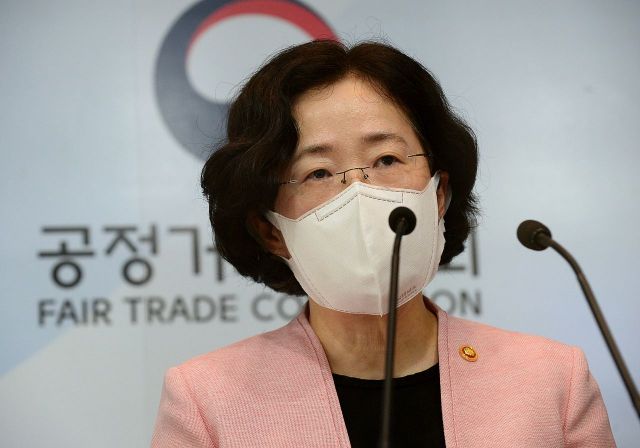 Fair Trade Commission Chairman Cho Sung-wook actively refuted criticism that "the Fair Trade Commission's edge seems to have dulled" during a press conference marking his first anniversary in office at the Government Complex Sejong on the 8th. Chairman Cho stated that the decision not to prosecute Park Hyun-joo, Chairman of Mirae Asset Group, on May 27 and the dismissal of charges against Hanwha Group on the 24th of last month are rather evidence that the Fair Trade Commission's adjudication and investigation functions are being conducted independently and impartially. (Photo by Fair Trade Commission)
[Asia Economy Reporter Moon Chaeseok] From now on, if a company is deemed to have knowingly submitted false information to the government, it will be difficult to avoid prosecution by the prosecution. Not only large corporations but also small and medium-sized enterprises (SMEs) and mid-sized companies face an increased likelihood of government sanctions if caught engaging in actions that enhance the controlling shareholder's power through practices such as 'toll fees.'
Over the past week, the Korea Fair Trade Commission (KFTC) announced that it will implement the "Prosecution Guidelines for Violations of Reporting and Data Submission Obligations Related to Corporate Groups" (on the 7th) and the "Review Guidelines for Unfair Support Practices" (on the 10th).
The guidelines were issued following controversies such as prosecutorial non-indictments and accusations of corporate crackdown involving several companies including Naver, Kakao, Hite Jinro, SK, Hyosung, Taekwang, and SPC Group.
◆Prosecution upon Determination of Intentional False Data Submission: "Resolving Uncertainty" vs. "Arbitrary Interpretation"
 Seong Gyeong-je, Director of the Corporate Group Policy Division at the Korea Fair Trade Commission, giving a briefing on the establishment and implementation of the "Guidelines for Reporting Violations and Submission of Data Related to Corporate Groups" on the 7th at the Government Complex Sejong in Sejong City. (Photo by Yonhap News)
The government states that this measure aims to reduce uncertainty by blocking futile disputes and securing grounds for prosecution. Companies, however, worry that the KFTC's arbitrary judgment may increase the risk of prosecution.
First, through the prosecution guidelines for data violation acts, the KFTC explained that it will classify allegations of violations of companies' reporting and data submission obligations into three categories?'significant,' 'considerable,' and 'minor'?based on 'recognizability' and 'severity' and then decide whether to prosecute.
Going forward, prosecution will be pursued in cases where ▲both recognizability and severity are significantly high (high), ▲recognizability is considerably high (medium) and severity is significantly high (high), and ▲both recognizability and severity are considerably high (medium).
From the KFTC's perspective, this establishes grounds for prosecution if a company knowingly conceals illegal facts. It means that violations such as failure to submit designated data, violations of reporting on holding company establishment/conversion and business content, and failure to report corporate group stock ownership status, if knowingly concealed and detected, will be subject to criminal punishment.
However, companies believe that although the grounds for prosecution by the KFTC may become clearer after the guideline announcement, the structure where the intentionality of data submission violations is ultimately determined only after prosecution investigation and court proceedings will remain.
There is concern that a case similar to that of Lee Hae-jin, Naver's Global Investment Officer (GIO), who was designated as part of a large corporate group and prosecuted in 2018 for failing to report 20 affiliates but was later cleared, could recur.
◆Stronger Sanctions on SMEs and Mid-sized Companies if Controlling Shareholder’s Power is Unfairly Increased
The review guidelines for unfair support practices notably expand the scope of considering 'toll fees' as unfair support.
When assessing toll fees, factors such as whether direct transactions with other companies could be conducted at lower prices, whether the method is disadvantageous to the supporting party, whether it is difficult to view the transaction as a result of normal business judgment, whether the transaction form is unusual, and whether the supported party’s role is minimal will be considered.
Additionally, cases where internal transactions between affiliates block competitors from contracting with major clients have been added as examples of unfair support.
The business and industrial sectors express dissatisfaction, arguing that since 'work allocation' regulations that examine the controlling shareholder’s private gain only apply to large corporate groups, the government has begun intervening in transactions of SMEs and mid-sized companies through unfair support regulations.
Separately, the KFTC conveyed a message that it will continue to introduce strengthened regulations on unfair support practices for large, small, and mid-sized corporate groups.
The KFTC has announced plans to establish "voluntary compliance standards for opening logistics work" within this year.
© The Asia Business Daily(www.asiae.co.kr). All rights reserved.



















