2nd Anniversary of Vice Chairman Chung Eui-sun's Appointment on the 14th
Transition to Mobility Solutions Company and Open Innovation
Realizing Hydrogen Economy Vision and Accelerating Eco-friendly Vehicle Strategy
Introducing Flexible Organizational Culture with Casual Dress and Work System
[Asia Economy Reporter Suyeon Woo] "For innovative change in an organization, even the way of thinking and working must change."
This is what Chung Euisun, Executive Vice Chairman of Hyundai Motor Group, emphasized to employees in his New Year's address this year. Since taking the helm of the global company Hyundai Motor Group in September 2018, he has frequently mentioned keywords implying change and innovation such as paradigm shift and game changer, urging continuous transformation.
Executive Vice Chairman Chung will mark two years overseeing the group on the 14th. Since the establishment of the 'Chung Euisun system,' Hyundai Motor Group has experienced an unprecedentedly rapid process of change over the past two years. Not only has there been an internal atmosphere shift related to organizational culture, but external changes such as business direction and vision have become even more noticeable.
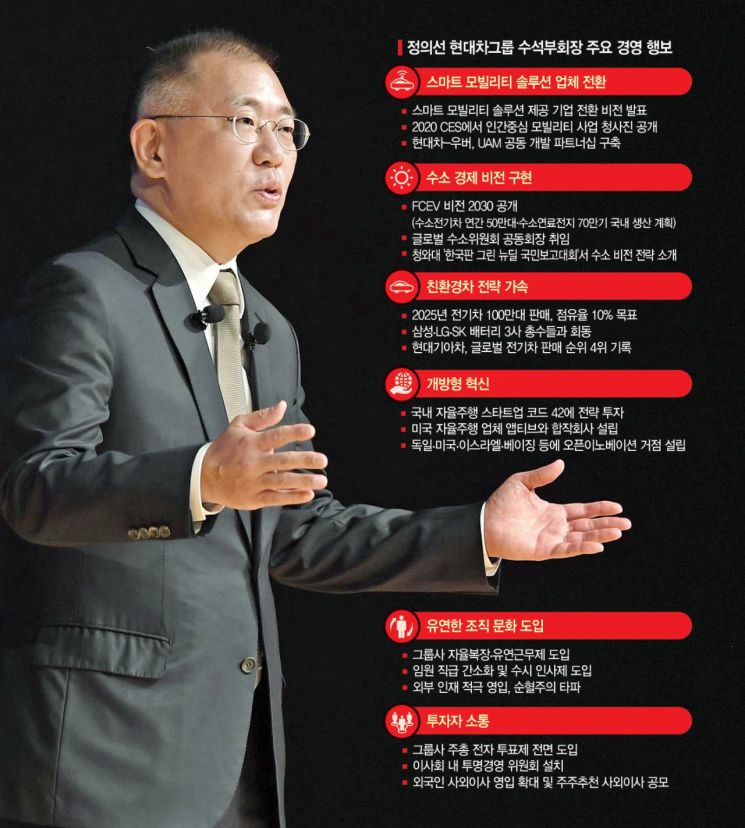
The group's long-term vision, revealed by him just before his inauguration at the 'India MOVE Global Mobility Summit,' was a transition to a 'smart mobility solutions company.' Hyundai Motor Group, once synonymous with traditional manufacturing and a key national export industry, presented a blueprint to leap forward as a mobility solutions provider. This was a bold decision by Executive Vice Chairman Chung, coinciding with the paradigm shift in the automotive industry.
Since then, he has tackled the tasks necessary for the transition to a mobility solutions company one by one. Defining future automotive industry trends as connectivity, autonomous driving, sharing economy, and electrification, he unveiled the future mobility vision at this year's CES.
Hyundai Motor Group's future mobility solutions will be realized in a future city connecting Personal Air Vehicles (PAV) ? Mobility Transfer Hubs (Hub) ? Purpose Built Vehicles (PBV). The concept involves traveling without traffic congestion by riding a vertically takeoff and landing-capable PAV, then transferring at a Hub to a PBV that shuttles back and forth to reach the destination.
Executive Vice Chairman Chung envisions Hyundai Motor Group's future as 50% automobiles, 30% PAVs, and 20% robotics. To this end, he recruited Shin Jae-won, an urban air mobility (UAM) expert from NASA, as Vice President and established the UAM business division. Additionally, he formed a strategic alliance with Uber, which is preparing air taxi services in the U.S., and decided to jointly develop PAVs.
To solve the challenges of mobility solutions represented by autonomous driving and vehicle sharing, open innovation was pursued. Open innovation hubs called 'Cradle' were established in major cities with active startups such as Germany, the U.S., Israel, and Beijing, and investments were made in leading global startups. Furthermore, through joint investment with U.S. autonomous driving company Aptiv, the joint venture Motional was established.
Another pillar of Hyundai Motor Group's mobility strategy is an eco-friendly approach based on hydrogen energy and electrification. In December 2018, just three months into his tenure, Executive Vice Chairman Chung announced the 'FCEV 2030' strategy to strengthen global hydrogen leadership. The plan is to establish an annual production system of 500,000 hydrogen electric vehicles domestically by 2030 and increase hydrogen fuel cell system production to about 700,000 units.
According to global consulting firm McKinsey, the hydrogen fuel cell market is expected to grow to between 5.5 million and 6.5 million units by 2030. To this end, leading global companies such as Japan's Toyota, U.S.'s Nikola, China's Sinopec, and Saudi Arabia's Aramco are actively entering hydrogen-related businesses. Hyundai Motor Group is evaluated as a leading group in the hydrogen energy business, and Executive Vice Chairman Chung's global leadership is also drawing attention.
Hyundai Motor Group is pursuing an electrification strategy alongside hydrogen energy by expanding electric vehicle sales. Currently, Hyundai Motor Group ranks 4th globally in electric vehicle supply, and Executive Vice Chairman Chung has set an aggressive goal of 1 million electric vehicles and a 10% global market share by 2025.
Under Executive Vice Chairman Chung's leadership, Hyundai Motor Group's organizational culture has also changed noticeably. Starting with dress code liberalization, the conservative and rigid corporate culture has been broken down, and an efficiency-centered flexible culture has been established.
Now entering the third year of his term, Executive Vice Chairman Chung's immediate challenges are securing profitability in the global automotive market, which has contracted due to COVID-19, and completing the group's governance restructuring. In 2018, he initiated a governance restructuring making Hyundai Mobis the holding company but withdrew due to investor opposition, and last year he defended against an attack by activist investor Elliott at the shareholders' meeting.
A business insider said, "It is surprising even within the business community that Hyundai Motor Group, once synonymous with traditional manufacturing, has changed so rapidly," adding, "The past two years have been successful in change, but challenges remain from improving profitability after COVID-19 to governance restructuring."
© The Asia Business Daily(www.asiae.co.kr). All rights reserved.

















