Technology Developed to Reduce Fire Risk of Electric Vehicle Lithium-Ion Batteries
and Increase Charging Speed by 4 Times
[Asia Economy Reporter Junho Hwang] A technology has been developed that reduces the fire risk of lithium-ion secondary batteries used in electric vehicles and energy storage systems (ESS), increases energy density, and boosts charging speed by more than four times.
The National Research Foundation of Korea (Chairperson No Jeong-hye) announced that Professor Seungwan Song's research team at the Department of Chemical Engineering, Chungnam National University, has developed a high-safety interface control technology that can improve the charging speed of lithium-ion secondary batteries by more than four times. The research results were recently published in the energy chemistry journal 'CampusCam'.
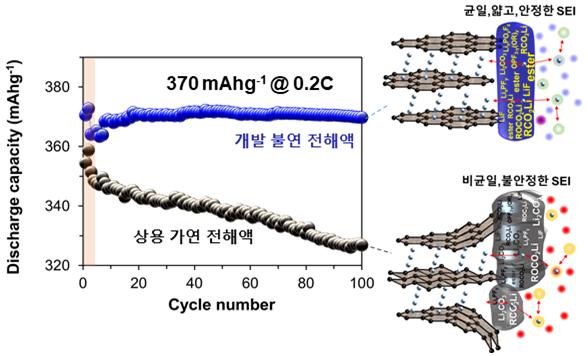
The research team developed a graphite anode with a charging speed more than four times faster than existing ones. It is a graphite anode covered with a surface protective layer formed through an electrolyte containing a self-developed lithium salt. This anode is thinner, more stable, and has lower interfacial resistance compared to conventional graphite anodes.
The surface protective layer is a protective film formed on the electrode surface due to electrolyte decomposition during lithium secondary battery operation. It electrochemically stabilizes the surfaces of both the anode and cathode.
The research team reported achieving the theoretical capacity level of the graphite anode, 370 mAhg-1, through this graphite anode and confirmed stable charge-discharge cycle performance.
In the case of conventional graphite anodes, the surface protective layer can be uneven or thickly formed, and the protective layer itself acts as resistance, limiting charging speed and capacity. As a result, it took more than 20 hours to reach the theoretical capacity (372 mAhg-1) of conventional graphite anodes.
The research team stated, "This is the first case of a technology that simultaneously improves the capacity of graphite anodes, the energy density of lithium-ion secondary batteries, charging speed, and safety by applying a non-flammable electrolyte with no battery fire risk, controlling and stabilizing the surface protective layer, thereby delivering excellent performance for lithium-ion secondary batteries." They added, "It can be immediately applied to existing lithium-ion secondary batteries, and through this, an increase in electric vehicle charging speed is expected."
© The Asia Business Daily(www.asiae.co.kr). All rights reserved.
![Clutching a Stolen Dior Bag, Saying "I Hate Being Poor but Real"... The Grotesque Con of a "Human Knockoff" [Slate]](https://cwcontent.asiae.co.kr/asiaresize/183/2026021902243444107_1771435474.jpg)
















