Korea Philip Morris Receives FDA Marketing Authorization for 'Harm Reduction Tobacco Products'
"Government Must Implement Rational Regulations on Electronic Cigarette Devices"
Korea Electronic Cigarette Association, "Excessive Tax Rates on Liquid-Type E-Cigarettes Should Not Be Imposed"
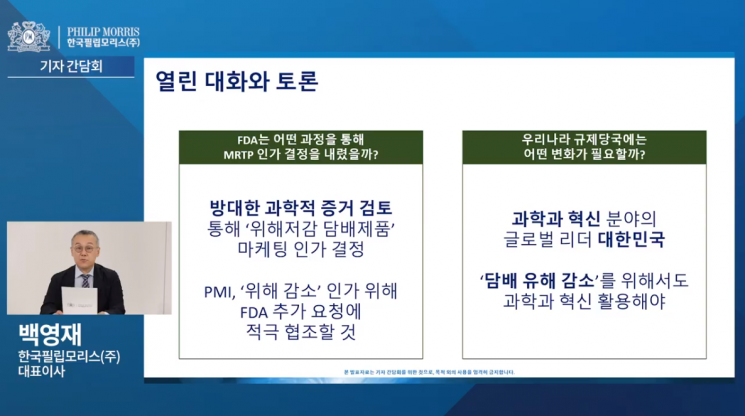 Baek Young-jae, CEO of Korea Philip Morris, held an online briefing on the 9th and explained the significance of IQOS's FDA marketing authorization as a tobacco product with reduced harm.
[Asia Economy Reporter Choi Saeng-hye] Korean Philip Morris, which introduced the heated tobacco product 'IQOS,' has reignited the long-standing controversy over the harmfulness of electronic cigarettes following the U.S. Food and Drug Administration (FDA)'s marketing authorization for 'Modified Risk Tobacco Products (MRTP).' Meanwhile, the Ministry of Food and Drug Safety (MFDS) has been postponing the announcement of the harmful effects of liquid-type electronic cigarettes, which have been recommended for discontinuation, causing the tobacco industry to closely monitor the situation.
According to industry sources on the 10th, Baek Young-jae, CEO of Korean Philip Morris, held an online briefing the day before and said, "After reviewing scientific evidence, the FDA authorized IQOS as a modified risk tobacco product in July, allowing claims of reduced exposure to harmful substances," adding, "Our government should also implement reasonable regulations on electronic cigarette devices based on scientific evidence."
According to Korean Philip Morris, the FDA's decision allows marketing claims based on the following information: ▲ The IQOS system heats tobacco without burning it ▲ Heating without burning significantly reduces the generation of harmful and potentially harmful substances ▲ Scientific studies show that smokers who completely switch from conventional cigarettes to the IQOS system experience reduced human exposure to harmful and potentially harmful substances. The FDA based its authorization on factors such as the lower temperature during IQOS heating, insufficient combustion process, and similar levels of harmful substances regardless of oxygen presence, evaluating that "there is a reasonable likelihood that subsequent studies will show measurable and substantial reductions in disease incidence or mortality among individual smokers."
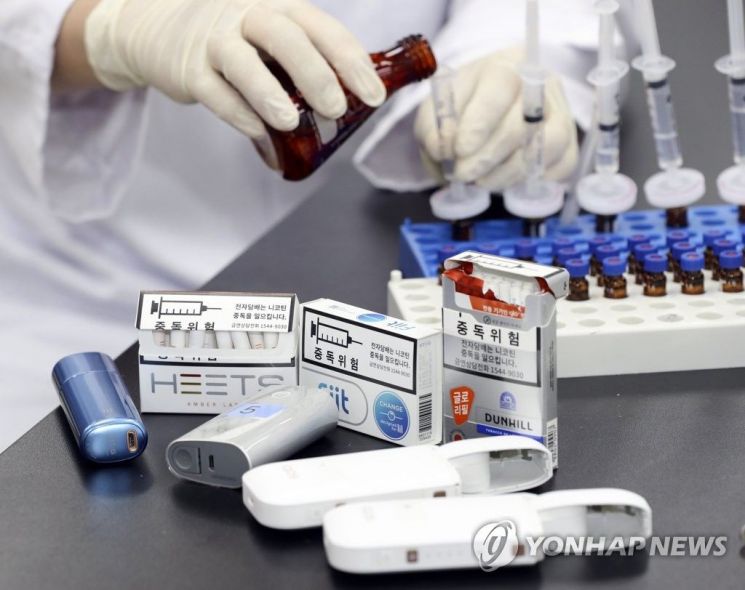
CEO Baek said, "The FDA's decision is a landmark event in public health," and added, "It is an important case showing how governments and public health agencies can regulate non-combustible products differently from conventional cigarettes to improve public health." He emphasized, "This authorization should lead to differentiated regulations for electronic cigarettes compared to conventional cigarettes domestically."
Korean Philip Morris criticized the MFDS's analysis of harmful substances in heated tobacco products as incomplete. The controversy continues as the MFDS claims that heated tobacco is "as harmful as conventional cigarettes," while the FDA's analysis concludes it is "less harmful than conventional cigarettes." CEO Baek stated, "The analyses by MFDS and FDA on heated electronic cigarettes are similar," urging, "The government should provide transparent and accurate communication to address public concerns."
On the same day, Korean Philip Morris also expressed its position on the tax increase issue for liquid-type electronic cigarettes and regulations on electronic cigarette devices. CEO Baek said, "Generally, heated tobacco products like IQOS and liquid-type electronic cigarettes have been found to generate significantly fewer harmful substances compared to conventional cigarettes," and added, "Considering this, incentives and differentiated tax rates for electronic cigarette devices should be provided to support complete switching."
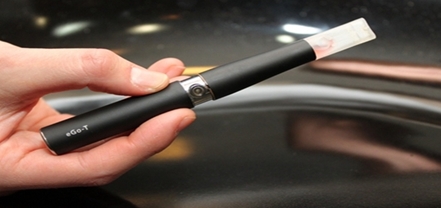
Earlier, the government finalized and submitted to the National Assembly a plan to double four types of taxes and charges related to liquid-type electronic cigarettes, including individual consumption tax in July, tobacco consumption tax, local education tax, and the National Health Promotion Fund in August, which was confirmed at the Cabinet meeting. In response, the Korea Electronic Cigarette Association Federation strongly opposed, stating, "The current and increased tax rates on liquid-type electronic cigarettes are already at a level that the industry cannot bear."
Kim Do-hwan, spokesperson for the Korea Electronic Cigarette Association Federation, warned, "In Italy, excessive tax rates on liquid-type electronic cigarettes caused an 80% market collapse, closure of over 3,000 businesses, and loss of more than 20,000 jobs. Despite knowing this, Korea continues to push policies recklessly," adding, "Policies implemented without reflecting market opinions will make the people in the market pay the price." He further said, "The government's direction is completely wrong, but we earnestly hope the National Assembly will correct it."
© The Asia Business Daily(www.asiae.co.kr). All rights reserved.
![User Who Sold Erroneously Deposited Bitcoins to Repay Debt and Fund Entertainment... What Did the Supreme Court Decide in 2021? [Legal Issue Check]](https://cwcontent.asiae.co.kr/asiaresize/183/2026020910431234020_1770601391.png)
















