Housing-vulnerable groups and non-beneficiaries prefer Jeonse, while beneficiaries prefer monthly rent
Most housing-vulnerable groups do not receive benefits from housing support policies
[Asia Economy Reporter Park Sun-mi] Advice has been given that customized policy support is needed depending on the type of residence and receipt status of the housing vulnerable class.
The Korea Housing Finance Corporation's Housing Finance Research Institute concluded through the research report "Analysis of Housing Finance Demand of the Housing Vulnerable Class" on the 9th that most of the housing vulnerable class are in the blind spots of housing support policies and advised that customized policy support is necessary.
The survey was conducted from October last year to June this year targeting heads of households or their spouses who have lived for more than three months in goshiwon or gositel, or heads of households or their spouses living in jjokbang (small rooms).
According to the survey results, 14.9% of goshiwon residents and 65.5% of jjokbang residents were basic livelihood security recipients. The average monthly household income was 1.31 million KRW for goshiwon residents and 750,000 KRW for jjokbang residents. The majority of the housing vulnerable class are in a housing information blind spot, such as not knowing that housing support policies exist or not knowing how to apply. In fact, most of the housing vulnerable class responded that they do not receive benefits from housing support policies.
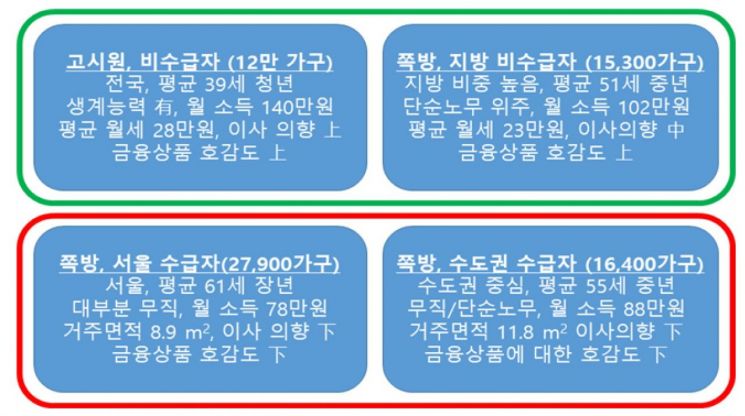
Among the four classification units?▲goshiwon non-recipients ▲jjokbang non-recipients in provinces ▲jjokbang recipients in Seoul ▲jjokbang recipients in the metropolitan area?the percentage of respondents who answered "there is currently no housing support policy they use" was 93.4% for goshiwon non-recipients, 95.8% for jjokbang non-recipients in provinces, and 95.4% for jjokbang recipients in the metropolitan area.
Non-recipients living in goshiwon and jjokbang, who have relatively higher living abilities, showed a high intention to move and a favorable attitude toward financial products, with an average preference for jeonse (long-term lease) at 46.4%. On the other hand, recipients in jjokbang in Seoul and the metropolitan area, who are more vulnerable, showed a strong desire to settle in their current address and a low preference for financial products.
The Housing Finance Research Institute advised, "For the non-recipient class, the jeonse rental method through jjokbang counseling centers and welfare centers (intermediary institutions) is worth proposing," adding that "jjokbang counseling centers and welfare centers maintain continuous contact and counseling with the vulnerable class, forming mutual trust, and they are well aware of their living standards and patterns, so they can provide support services such as selecting appropriate financial institutions and guiding customized financial products."
It continued, "For the recipient class, expanding the supply of rental housing using vacant houses is worth considering," adding that "if public institutions lead the purchase or acquisition of vacant houses and idle spaces in deteriorated residential areas and supply them as rental housing to the vulnerable class in those areas, it can prevent slum formation and enable the promotion of various projects for the public interest of the region."
© The Asia Business Daily(www.asiae.co.kr). All rights reserved.
![Clutching a Stolen Dior Bag, Saying "I Hate Being Poor but Real"... The Grotesque Con of a "Human Knockoff" [Slate]](https://cwcontent.asiae.co.kr/asiaresize/183/2026021902243444107_1771435474.jpg)
















