2035 Target Plan Approved by Minister of Environment... Closure of Gyeyang Water Purification Plant
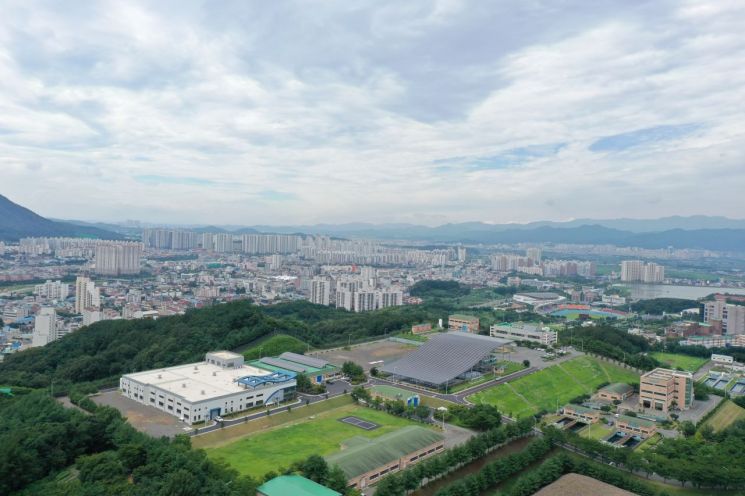
[Asia Economy Yeongnam Reporting Headquarters, Reporter Park Dong-wook] Gyeongsan City, Gyeongbuk, which had been struggling with chronic water source shortages, has finalized and announced a mid- to long-term "Basic Water Supply Maintenance Plan" focused on doubling the daily treatment capacity of the Gyeongsan Water Purification Plant and upgrading aging pipelines spanning 95 km.
According to Gyeongsan City on the 8th, by 2035, the Gyeongsan Water Purification Plant, which currently has a daily treatment capacity of 50,000 tons, will be expanded to 100,000 tons, and the Gyeyang Water Purification Plant (30,000 m³/day), which is scheduled to be incorporated into the urban planning road, will be closed.
Along with this, facilities related to process, mechanical, electrical, and instrumentation control at the Gyeongsan intake and purification plants, Gyeyang Water Purification Plant, and Jinryang Industrial intake and purification plants will be upgraded, and aging pipelines covering 94.7 km will be modernized by 2024.
As part of the water quality and maintenance management plan, the city will implement and establish measures such as ▲ biannual pipe cleaning in two hydraulically vulnerable blocks ▲ preliminary seismic performance evaluation (49 facilities, 643 km of pipelines) and detailed evaluation (49 facilities) ▲ precise pipeline surveys of 15.4 km of water supply pipes, 71.8 km of transmission pipes, and 587.5 km of distribution pipes ▲ and a smart pipeline network management system.
Gyeongsan City had attempted to revise the existing water supply maintenance plan since 2015 but postponed the mid- to long-term plan due to the lack of secured water rights. According to the city, this plan was recently approved by the Minister of Environment based on the 2035 target after five years of consultations with related agencies and review by the Ministry of Environment.
Besides the Unmun Dam and Kumho River raw water sources, Gyeongsan City, which has not secured additional raw water sources, obtained consent from Daegu City in 2009 to jointly use the nearby Gosan Water Purification Plant. However, the water supply agreement stipulated "suspension and restriction of water supply upon Daegu City's demand," posing a fundamental risk.
In this regard, Gyeongsan City negotiated with Daegu City in August last year to change the supply period in the water supply agreement from "upon Daegu City's suspension request" to "until Gyeongsan City's suspension request," somewhat enhancing the stability of water supply. However, the challenge of securing additional water sources remained.
A Gyeongsan City official stated, "Due to the limitation that most of the region's water rights are for temporary use, there was a time (1996?1999) when construction of apartment complexes was restricted due to water shortages," adding, "Since water resources and supply areas are limited by local governments, securing additional water was difficult. However, after confirming the surplus capacity of Yeongcheon Bohyeonsan Dam and conducting over 100 visits and consultations with related agencies such as the Korea Water Resources Corporation, we negotiated to enable additional allocation."
© The Asia Business Daily(www.asiae.co.kr). All rights reserved.
![Clutching a Stolen Dior Bag, Saying "I Hate Being Poor but Real"... The Grotesque Con of a "Human Knockoff" [Slate]](https://cwcontent.asiae.co.kr/asiaresize/183/2026021902243444107_1771435474.jpg)
















