Broad OTT Concept...Concerns Over Careful Legislation
Foreign OTTs Like YouTube May Benefit More
Three Ministries Flood Legislation
Criticism of Administrative Overlap and Waste of Resources
[Asia Economy Reporter Koo Chae-eun] There are growing concerns about the 'over-legislation' by government ministries regarding the OTT (Over-The-Top) online video service industry. Despite the rationale for a new market order and promotion policies, the legislative battles among related ministries are perceived as power struggles. Industry insiders point out that the lack of coordination leads to inconsistent government policies and even reverse discrimination that regulates only domestic companies.
Proliferation of Legislation and Councils Among Three Ministries

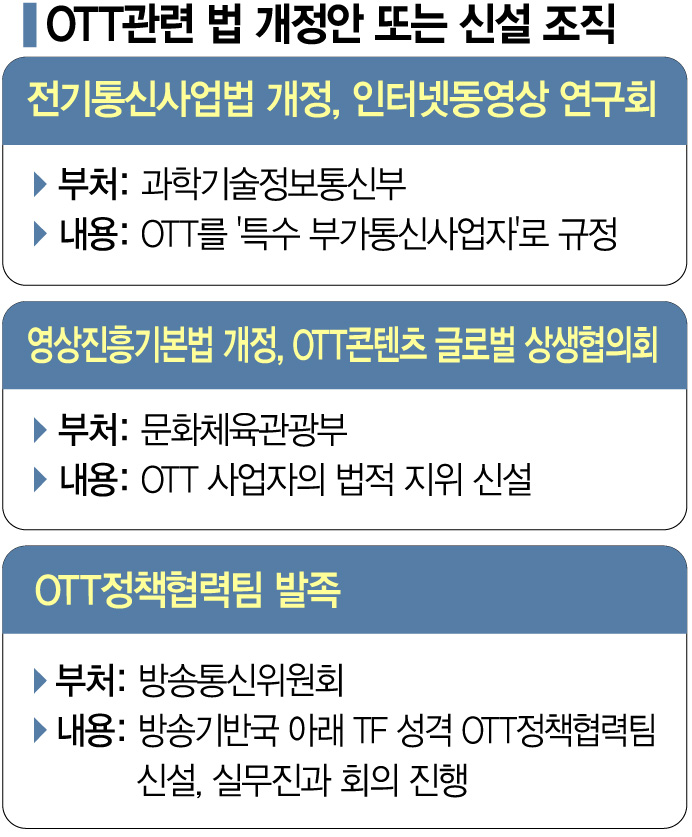
According to the industry on the 8th, the Ministry of Science and ICT recently amended the Telecommunications Business Act to classify OTT as a 'special type of value-added telecommunications business,' the same category as webhard services. The intention is to grant OTT a looser legal status than broadcasters and value-added telecommunications operators, easing regulations and supporting industry development. The system is lowered from registration to notification, and regulations are minimized through voluntary rating systems and tax benefits.
The problem is that the Ministry of Culture, Sports and Tourism is also pushing for similar legislation. The Ministry, together with Lee Kwang-jae, a member of the Democratic Party, plans to propose a full revision of the Basic Act on Video Promotion this week, which includes establishing a new legal status for domestic OTT operators. Although the content of 'industry promotion' is similar, the regulation targets OTT, overlapping with the Telecommunications Business Act and raising concerns about administrative inefficiency.
Various subcommittees, private councils, and committees with similar goals are emerging under different ministry banners. The Korea Communications Commission has launched an 'OTT Policy Cooperation Team,' and the Ministry of Culture, Sports and Tourism has formed an OTT council. This raises concerns about inter-ministerial power struggles, differing perspectives, inefficiency, turf wars, and lack of a central coordinating body. An OTT industry insider said, "The business models of native OTTs are still in their infancy, but there is much discord and noise among ministries over government-led agenda setting," adding, "The best approach now is to minimize intervention and provide only backend support to promote market competition."
OTT Concept Is Too Broad
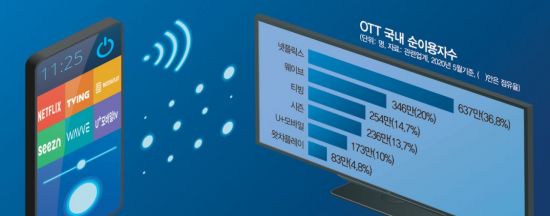
Although each ministry is rushing to propose legislative amendments emphasizing 'OTT activation and minimal regulation,' there are calls for cautious legislation due to the immature definition of OTT. Currently, the industry collectively refers to all app-based services that provide both Video On Demand (VOD) and live TV as OTT. For example, YouTube's subscription-based free model, including YouTube Super Chat (a live video sponsorship feature), paid models like 'YouTube Red' and 'YouTube TV,' are all considered OTT. Netflix, Facebook, Disney Plus, Amazon Fire TV, Amazon Video, CBS All Access, Hulu, and Roku also fall under OTT.
There is also concern about whether the legally incomplete OTT concept can be lumped into the 'special value-added telecommunications business' category (as per the Telecommunications Business Act amendment) focusing on 'regulatory relaxation.' According to the principle of 'equal regulation for domestic and foreign operators,' foreign content providers like YouTube and Netflix would be subject to the same laws. For now, the largest OTTs, YouTube and Netflix, stand to benefit the most.
According to WiseApp, as of June, YouTube dominates with an 89.8% share of playback time among Android users in South Korea. TikTok holds 3.4%, Netflix 3.0%, while native OTTs like Wavve and AfreecaTV account for only 1.4%. A broadcasting industry official pointed out, "OTT is not covered by IPTV law or broadcasting law, so content review and advertising regulations do not apply. Foreign OTTs, which domestic regulators cannot reach, are almost entirely self-regulated."
Lee Sang-sang, senior expert at the Democratic Party, said, "We need to examine how appropriate it is to include OTT in the 'special value-added telecommunications business' concept, which was newly created in 2010 to crack down on webhard and P2P services notorious for obscene content uploads," adding, "There could be serious reverse discrimination issues with legacy media such as terrestrial and pay TV, and above all, it could benefit only foreign operators rather than native OTTs."
© The Asia Business Daily(www.asiae.co.kr). All rights reserved.
![Clutching a Stolen Dior Bag, Saying "I Hate Being Poor but Real"... The Grotesque Con of a "Human Knockoff" [Slate]](https://cwcontent.asiae.co.kr/asiaresize/183/2026021902243444107_1771435474.jpg)












