Changes in Key Indicators Such as Movement Volume Before and After Level 2 Upgrade
 The government has decided to extend the enhanced social distancing level 2.5 in the Seoul metropolitan area until the 13th. Meanwhile, on the weekend of the 6th, Sejong-daero in Seoul was quiet. Photo by Moon Honam munonam@
[Asia Economy Reporter Kim Heung-soon] The government and quarantine authorities' decision to raise social distancing measures nationwide to Level 2 and to Level 2.5 in the metropolitan area since mid-last month to curb the spread of the novel coronavirus disease (COVID-19) in South Korea is showing effects through big data. Key indicators such as the number of taxi calls via mobile apps, national mobility analyzed from mobile phone base station data, public transportation usage, and nationwide highway traffic volume have significantly decreased.
Fewer Taxi Calls and Reduced Public Transportation Usage
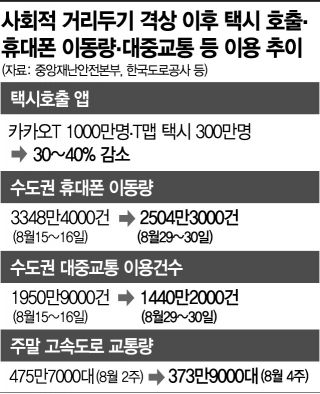
According to related industries on the 8th, the proportion of users calling taxis through Kakao's call taxi and public transportation service app 'KakaoT' and SK Telecom's taxi call app 'T map Taxi' decreased by 30-40% compared to three weeks before the social distancing level was raised. KakaoT's monthly active users surpassed 10 million in December 2018 and, except for March-April this year when social distancing was strengthened due to a COVID-19 cluster infection centered around Shincheonji Church of Jesus, the number has generally remained stable. When divided weekly, the average number of active users is around 2.5 million, but with the recent social distancing upgrade, usage sharply dropped to the mid-1 million range as of the end of August.
T map Taxi, which has secured 3 million subscribers, also reportedly saw a similar decline in usage. When divided weekly, the usual number of users around 700,000 to 800,000 is estimated to have dropped recently to about 200,000 to 300,000. Office worker Song Gyu-hyun (42) said, "I used to frequently use taxi call services for business trips or after evening gatherings," adding, "Since telecommuting was implemented and external appointments were postponed, I haven't had a chance to use it recently."
Not only taxis but also public transportation usage in the metropolitan area, including buses and subways, has decreased. According to the Central Disaster and Safety Countermeasures Headquarters, the number of public transportation rides in the metropolitan area on the weekend of August 29-30 was 14,402,000, down 26.2% from 19,509,000 on the weekend of August 15-16 before the social distancing upgrade. The 'mobile phone mobility,' which counts movements when people visit administrative districts outside their actual residence area and stay for more than 30 minutes, also dropped 25.2% from 33,484,000 to 25,043,000 during this period.
Weekday and Weekend Traffic Volume Also Reduced by Up to 20%
The proportion of private and commercial vehicle operation also decreased by more than 20%. According to Korea Expressway Corporation, highway traffic volume in the fourth week of August was 3,739,000 vehicles, down more than 21% from 4,757,000 vehicles in the second week of August before the social distancing upgrade. During this period, weekday highway traffic also declined from 4,718,000 vehicles to 4,441,000 vehicles, and further to 4,335,000 vehicles in the first week of September, marking the lowest figure since July.
As of midnight on this day, the number of new confirmed COVID-19 cases in South Korea was 136 (120 local transmissions and 16 imported cases). The number of diagnostic tests increased to 14,781 the day before, compared to 8,890 and 5,362 tests over the past weekend, and the number of new cases slightly rose from 119 the previous day due to ongoing small cluster infections.
However, thanks to the public's participation in social distancing, the daily number of confirmed cases has remained in the 100s for six consecutive days since September 3 (195 cases), stabilizing compared to the 300-400 range in late last month. The average daily number of domestic confirmed cases over the recent week (August 30 to September 5) was 218.6, a 34% decrease from the previous week (331 cases). Yoon Tae-ho, head of the Central Disaster and Safety Countermeasures Headquarters' quarantine team, said, "The effect of social distancing is showing as a result of the public's efforts, leading to the containment of infection spread," adding, "I am confident that these efforts will result in infection control in one or two weeks."
© The Asia Business Daily(www.asiae.co.kr). All rights reserved.
![Clutching a Stolen Dior Bag, Saying "I Hate Being Poor but Real"... The Grotesque Con of a "Human Knockoff" [Slate]](https://cwcontent.asiae.co.kr/asiaresize/183/2026021902243444107_1771435474.jpg)












