Average Number of Payments and Payment Amount per Person on Delivery Apps Reach All-Time Highs
Delivery Fee Increases Follow Fierce Competition for Delivery Drivers
Self-Employed Suffer Impact... Consumer Burden Also Rises
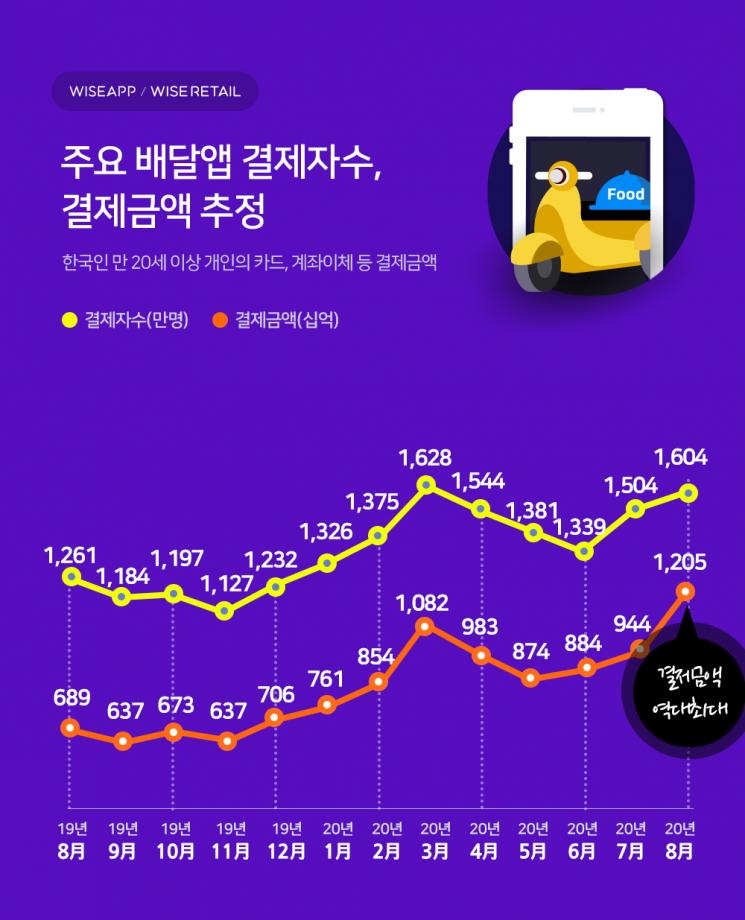
[Asia Economy Reporters Kim Cheol-hyun, Choi Sae-hye] As social distancing measures were strengthened due to the novel coronavirus infection (COVID-19), the monthly payment amount on major delivery applications (apps) has exceeded 1 trillion won.
On the 8th, app analysis service company WiseApp announced that the average monthly payment amount exceeded 1.2 trillion won based on a sample survey of payments made over one year (August 2019 to August 2020) on major delivery apps operated by Woowa Brothers and Delivery Hero (Baedal Minjok, Yogiyo, Baedaltong, Foodfly).
In the most recent August, the payment amount on the two delivery apps operated by Woowa Brothers and Delivery Hero Korea was estimated at 1.205 trillion won, with approximately 16.04 million payers. This figure is higher than the 1.0082 trillion won payment amount in March, when the spread of COVID-19 began in earnest. The number of payers ranked second after March’s 16.28 million. During August alone, those who made payments through delivery apps averaged 3.3 payments per person, with an average payment of 22,780 won per transaction, resulting in a monthly average of 75,151 won per person. Both the average number of payments per person and the average payment amount per person reached record highs.
Baedal Minjok users numbered 10.66 million, and Yogiyo users 5.31 million, with Woowa Brothers and Delivery Hero’s domestic delivery service user market share reaching 97.4%. The annual market size of the two companies’ delivery apps was 4.1 trillion won in 2018, 7.1 trillion won in 2019, and 7.6 trillion won up to August this year, already surpassing last year’s scale. This survey was based on card usage data from adults aged 20 and over. A WiseApp official stated, "The figures exclude payment amounts from teenage consumers, corporate cards and B2B transactions, simple payments, on-site payments, gift certificates, Coupang Eats, and KakaoTalk ordering, so the actual delivery app payment amount and market are larger."
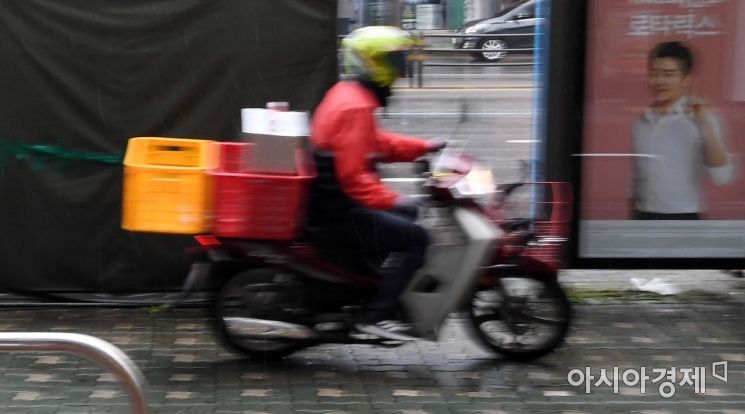 During lunchtime on the 2nd, while 'Social Distancing Level 2.5' is in effect, a delivery worker is riding a motorcycle through a food alley street in Seoul. Photo by Hyunmin Kim kimhyun81@
As delivery demand has surged sharply, delivery fees have also risen accordingly. Delivery companies have consecutively raised prices, causing already struggling self-employed business owners to complain about the burden. According to the distribution industry, small and medium-sized delivery agencies such as Saenggakdaero and Barogo increased the basic delivery fee for a 500m delivery distance from about 500 won to 1,000 won after the implementation of social distancing level 2.5. Mr. A, who runs a restaurant in Jung-gu, Seoul, said, "The call price, which was around 2,500 won in 2018, rose to 3,000 won the following year and increased to 4,000 won this year."
The fierce competition among delivery companies to recruit delivery drivers is also cited as a reason for the increase in delivery fees. In particular, Coupang Eats, which entered the delivery market this year, attracted a large number of drivers by paying up to 20,000 won per delivery. As a result, not only delivery companies affiliated with delivery apps such as Baemin Riders and Yogiyo Plus but also general agencies like Saenggakdaero and Barogo raised delivery fees, leading to an overall increase in average delivery fees.
Self-employed business owners are reluctantly passing on part of the delivery fee increase to consumers. In some franchise coffee shops, ordering a 5,000 won drink requires paying 5,500 won in delivery fees, creating a situation where the delivery fee exceeds the price of the product. Basic delivery fees at individual coffee shops and dessert stores often exceed 5,000 won.
Mr. B, who runs a restaurant in Gangnam-gu, said, "After social distancing level 2.5, the contracted agency raised the delivery fee by 600 won," adding, "We announced a minimum order amount of 8,900 won and a delivery fee of 1,000 won, but considering that the agency fee is 3,800 won for less than 1 km, I might have to learn to ride a motorcycle and deliver myself," expressing his difficulties. Some delivery agencies have even refused to deliver pizzas, which have a high risk of damage and high unit price, due to the risk of compensation, forcing pizza companies to deliver themselves.
Self-employed business owners unanimously agreed that urgent measures are needed to address the decline in in-store sales due to social distancing and soaring delivery fees. Mr. C, who runs a chicken restaurant in Songpa-gu, said, "Due to COVID-19, I have been running at a loss every month this year, and delivery fees have risen to an unbearable level," demanding countermeasures, adding, "At this rate, more than half of self-employed business owners will have to close their doors."
© The Asia Business Daily(www.asiae.co.kr). All rights reserved.


















