KDI Economic Outlook September Issue
KDI: "Economic growth rate likely to decline further and economic recovery to be delayed"
Private consumption -4.6%, exports -4.2%, employment -150,000, unemployment rate forecasted at 4.0% this year
[Sejong=Asia Economy Reporter Joo Sang-don] The Korea Development Institute (KDI), which had forecast positive growth for the Korean economy in May this year, has recently revised its outlook sharply downward to negative growth due to the resurgence of COVID-19.
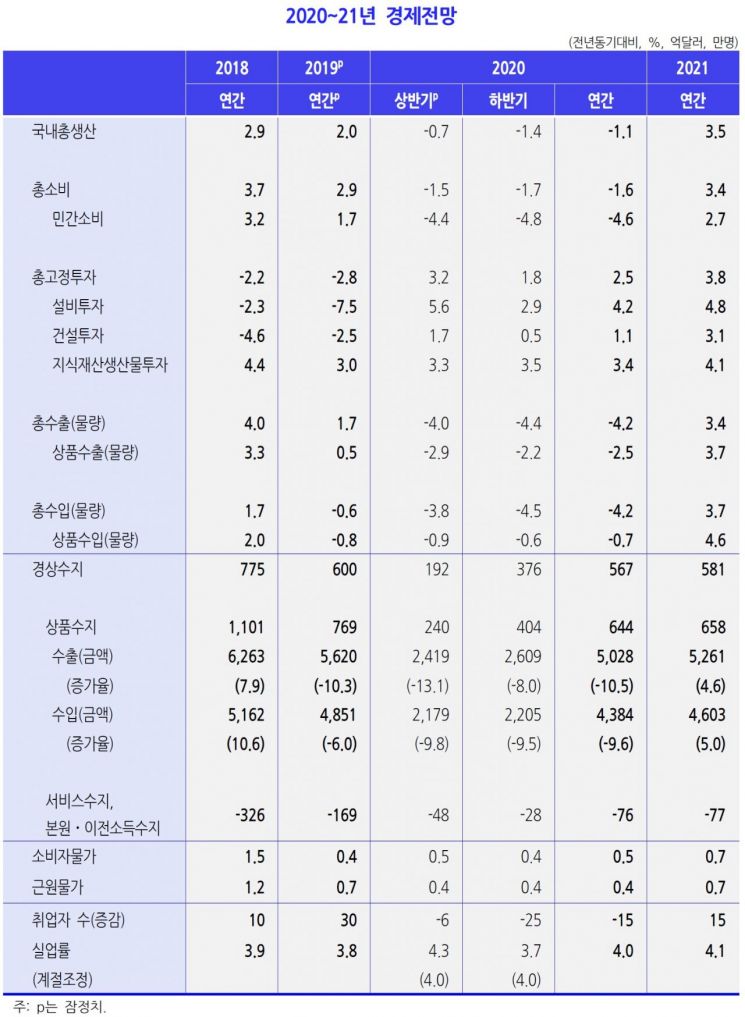
On the 8th, KDI stated in its September Economic Outlook that "private consumption and exports contracted significantly in 2020, resulting in a negative growth rate of -1.1%, and in 2021, economic recovery is expected to remain limited, with growth projected at 3.5%." This is a 1.3 percentage point downward revision from the 0.2% growth rate forecasted in May. KDI has only revised its economic growth rate three times before: in 2008, 2009, and 2012.
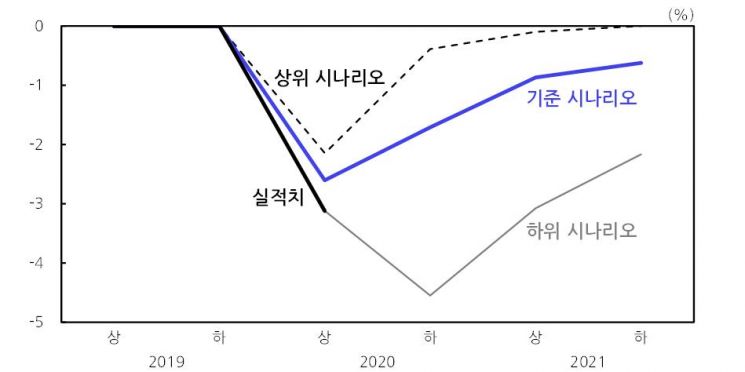
KDI explained, "Recently, as COVID-19 has rapidly resurged, the economic growth rate is likely to decline further and economic recovery is expected to be delayed. The current trajectory resembles the lower scenario rather than the baseline scenario assumed in the May KDI economic outlook, making it highly probable that the 2020 growth rate will fall significantly below the baseline scenario forecast of 0.2%."
At the time of the previous forecast, the baseline scenario assumed that the spread of COVID-19 would slow down domestically from the first half of the year and globally from the second half. However, the spread accelerated in the second half. Additionally, the sharp confrontation between the U.S. and China is expected to act as an additional downward factor on Korea’s growth, given its high export dependence on these two countries.
Private consumption, which showed the fastest recovery after the COVID-19 outbreak, is contracting again. The service sector, which involves many face-to-face interactions, has sharply declined, and consumption of goods has also adjusted due to reduced government policy support, showing a sluggish trend. KDI diagnosed, "Considering the spread of COVID-19, consumption activities are restricted due to infection concerns, and income has decreased due to economic downturn, making it difficult for private consumption to improve in the short term." Both facility investment and construction investment have also slowed their growth. However, the expansion of government spending through a large-scale supplementary budget is partially mitigating the decline in economic growth caused by the sharp drop in private demand.
Private consumption is expected to record a -4.6% growth rate in 2020, as consumption activities are restricted mainly in the service sector involving many face-to-face contacts due to the spread of COVID-19, and income decreases amid economic downturn. KDI expects only a slight rebound of 2.7% in 2021. Facility investment is projected to show a moderate recovery in 2020 (4.2%) and 2021 (4.8%) due to last year’s base effect and the recovery of global semiconductor demand despite the COVID-19 shock. Construction investment is expected to increase by 1.1% in 2020, led by improvements in civil engineering centered on social overhead capital (SOC), and to grow by 3.1% in 2021 as the building sector also recovers.
Exports have been severely contracted due to the global economic recession but have partially eased recently as major countries resume economic activities. Overseas, despite the rapid spread of COVID-19, social distancing measures have not been strengthened. However, KDI expects that if the spread of infectious diseases overwhelms healthcare systems and increases casualties, stricter quarantine measures will be inevitable, making it difficult to expect a recovery in Korean exports.
Exports are forecasted to gradually ease their slump from the second half of 2020, mainly in the goods sector, following the global spread of COVID-19.
The employment market is expected to contract again. Employment sharply decreased mainly in the service sector involving many face-to-face contacts, and although employment weakness partially eased from May, the resurgence of COVID-19 has increased the likelihood of renewed contraction in the employment market.
Ultimately, employment is expected to decrease by 150,000 in 2020 due to contraction in the service sector with many face-to-face interactions, and then increase by 150,000 in 2021 as the economic downturn eases. The unemployment rate is forecasted to be slightly higher than in 2019 (3.8%), at 4.0% in 2020 and 4.1% in 2021.
A KDI official advised, "If the high spread of COVID-19 continues domestically and internationally and social distancing is further strengthened, the economic downturn could deepen and recovery could proceed more slowly. Considering the economic situation, it is necessary to focus economic policies on enduring the COVID crisis and maintaining economic and social systems for the time being."
© The Asia Business Daily(www.asiae.co.kr). All rights reserved.


















