'1st Blue Sky Day Commemoration' Video Message
"20 More Coal Plants to Close by 2034"
"1.13 Million Electric Cars and 200,000 Hydrogen Cars to be Distributed Within 5 Years"
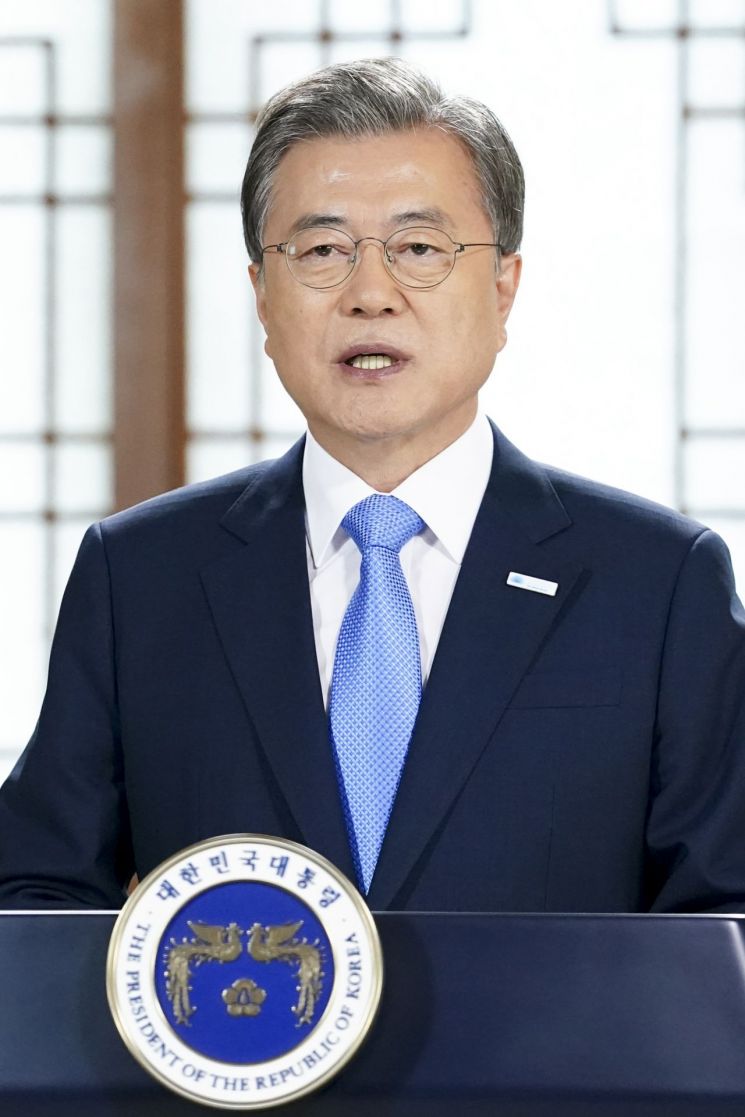 President Moon Jae-in delivered a commemorative speech via video on the 7th to mark the 1st 'Blue Sky Day.' 'Blue Sky Day' is the first UN commemorative day created at South Korea's proposal.
 President Moon Jae-in stated on the 7th, "Including the four outdated coal power plants that have already been shut down, we will close 10 plants during my term and, in the long term, shut down an additional 20 plants by 2034." He also pledged to expand solar and wind power generation more than threefold by 2025 and to significantly increase the distribution of electric and hydrogen vehicles.
President Moon made these remarks in a video message during the '1st Blue Sky Day Commemoration Ceremony,' which was broadcast live online, saying, "We will strengthen policy measures to simultaneously reduce greenhouse gases and fine dust."
'Blue Sky Day' is a national holiday and a UN official commemorative day first proposed by Korea and adopted at last year's UN General Assembly. It is the first time Korea has proposed a commemorative day to the UN that was officially established. The UN and the Korean government plan to commemorate 'Blue Sky Day' annually on September 7 starting this year.
In his commemorative speech, President Moon emphasized that environmental issues such as fine dust, natural disasters caused by abnormal weather, and the spread of the novel coronavirus disease (COVID-19) are all linked to the climate and environmental crisis, and he presented countermeasures.
President Moon said, "We will accelerate the transition to clean and safe energy," adding, "Solar and wind power facilities will be expanded more than threefold compared to last year by 2025."
He continued, "We will establish a power supply system that reflects climate and environmental costs and will gradually shift the fossil fuel-based power system to a renewable energy-based system in the long term."
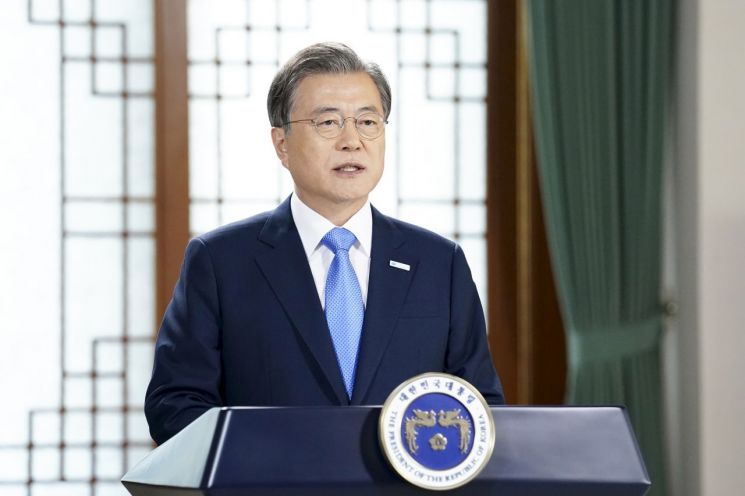 President Moon Jae-in delivered a commemorative speech via video on the 7th to mark the 1st 'Blue Sky Day.' 'Blue Sky Day' is the first UN commemorative day established at South Korea's proposal.
He also promised to expand the distribution of electric and hydrogen vehicles and to build a smart power platform.
President Moon said, "By 2025, the number of electric vehicles will increase from the current 110,000 to 1.13 million, and hydrogen vehicles from 8,000 to 200,000."
He added, "We will distribute 'intelligent power meters' to 5 million apartment units to establish a smart power platform and expand green living infrastructure that enhances energy efficiency through green smart schools and smart green cities."
He reaffirmed his determination to turn the climate and environmental crisis into an opportunity for economic growth.
President Moon said, "As the clean air industry is expected to grow at an annual rate of around 7%, the government will expand R&D investment in environmental technologies and strategically support companies with competitiveness in eco-friendly vehicles and fine dust technologies to lead the global market."
Furthermore, he pledged to fulfill Korea's role as a responsible middle power by leading international cooperation to respond to the climate and environmental crisis.
President Moon stated, "To transition to a carbon-neutral society, we will prepare the country's 2050 long-term low-carbon development strategy by the end of this year and renew the national greenhouse gas reduction target for 2030 to submit to the UN," adding, "We will also strengthen regional cooperation to reduce fine dust."
He emphasized, "Taking the upcoming 'P4G Summit' scheduled for next year as an opportunity, we will seek practical cooperation with major countries and, as the first proposer of 'Blue Sky Day,' continue to make our best efforts for international cooperation toward clean air and blue skies."
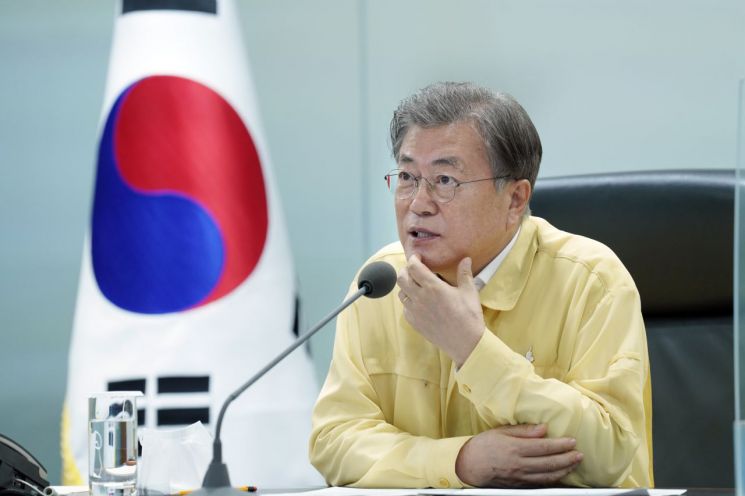 President Moon Jae-in is speaking after receiving a damage report at an emergency situation briefing on Typhoon 'Haishen' held at the Blue House National Crisis Management Center on the afternoon of the 7th.
President Moon also spoke about the Green New Deal, a key pillar of the Korean New Deal, calling it "a strategy to overcome COVID-19 and a policy to respond to the climate crisis," and said, "It will create 660,000 jobs by 2025," urging the public's cooperation.
He said, "K-Quarantine is a model for the international community, and the Green New Deal has also been recognized as a model case for overcoming both the COVID-19 and climate and environmental crises," emphasizing, "We will lead international cooperation on the climate and environmental crisis and play a leading role in the post-COVID era."
He added, "Recently, a kindergarten student tested positive for COVID-19, but the surrounding children wore masks well, creating a 'kindergarten miracle' that prevented further infections," stressing, "We must enable children to take off their masks and play freely."
◆ Full text of President Moon Jae-in’s video message for the 1st Blue Sky Day Commemoration Ceremony
It is very meaningful to commemorate the ‘1st Blue Sky Day’ designated by the UN today.
The ‘International Day of Clean Air for Blue Skies,’ designated last year by consensus of all member states at the UN General Assembly, is a UN commemorative day first led by our country.
The world is now reflecting more deeply on climate and environmental issues than ever before in the face of infectious diseases and natural disasters.
We are practicing small actions to revive the Earth and expanding international cooperation.
Today, ‘Blue Sky Day’ is being commemorated worldwide, including in New York, Bangkok, and Nairobi.
We hold this ceremony at 6:30 p.m. to coincide with Korea’s sunset and the sunrise in countries on the opposite side of the globe, seeking joint action for humanity.
Starting with this first ‘Blue Sky Day’ commemoration, I hope the world will cooperate more strongly to restore the climate and environment.
In 2020, a year when the world is experiencing unprecedented difficulties due to COVID-19, heatwaves, and floods, I hope our joint efforts will reach beyond fine dust to address the more fundamental climate crisis.
This summer, following record-breaking monsoons, three typhoons hit the Korean Peninsula in quick succession, causing severe wind and flood damage.
Due to the typhoons, today’s event is held via video instead of in person. Although I regret not being able to be with many citizens at a meaningful venue, our shared hope for blue skies remains strong.
I extend my condolences to those affected by natural disasters and promise to do our utmost for recovery and to take today as another lesson to respond more actively to the climate crisis.
Citizens,
The frequent and stronger autumn typhoons are also due to abnormal climate.
The world is suffering from abnormal climate, including heatwaves in the Arctic and Siberia.
In Korea, abnormal climate has continued for several months, from the June heatwave to the current typhoons.
Infectious diseases like COVID-19, which have invaded human daily life, are not unrelated to disruptions in natural ecosystems caused by climate change and environmental destruction.
Air pollution is already a cause of many diseases.
Climate change and air pollution are two sides of the same coin.
Due to climate change, stagnant air flow is becoming more frequent on the Korean Peninsula, which is one cause of high concentrations of fine dust.
Climate and environmental issues have become the most important issues of our generation for human health, safety, and sustainable development, and they can no longer be postponed.
Through COVID-19, we have paradoxically confirmed how closely connected the world is.
What is clear is that climate and environmental issues are not problems of any single country, and only international cooperation can bring fundamental change.
The government has worked with the people to overcome climate and environmental issues and has achieved many results.
Since the 1990s, Korea’s greenhouse gas emissions had been steadily increasing but peaked in 2018 and have been decreasing since 2019.
Fine particulate matter has also decreased, improving the annual average concentration and increasing the number of days with blue skies.
There have been bold efforts across the government, including reducing coal power generation, expanding renewable energy, low-emission measures for old diesel vehicles, promoting eco-friendly vehicles, enacting the world’s first special law on fine dust, and large-scale supplementary budgets.
Above all, thanks to the public’s participation and new policy proposals such as the ‘Seasonal Fine Dust Management System’ through the National Climate and Environment Council, despite the inconvenience.
However, fine dust concentrations remain high compared to major advanced countries.
Also, to meet international efforts to limit the global average temperature rise to below 1.5 degrees Celsius since the industrial era, more aggressive greenhouse gas reduction policies are required.
The government will work with the people to regain blue skies through stronger climate and environmental policies.
First, we will strengthen policy measures to simultaneously reduce greenhouse gases and fine dust.
To this end, we will accelerate the transition to clean and safe energy.
The government has completely banned new coal power plant permits and will close 10 plants during my term, including the four outdated coal plants already shut down, and will close an additional 20 plants by 2034.
Solar and wind power facilities will be expanded more than threefold compared to last year by 2025.
We will establish a power supply system that reflects climate and environmental costs and gradually shift the fossil fuel-based power system to a renewable energy-based system.
Also, the ‘2nd Seasonal Fine Dust Management System’ scheduled for December this year will supplement and improve measures in each sector, such as reducing coal power plant operations and voluntary emission reductions by workplaces and ships.
Furthermore, by 2025, electric vehicles will increase from 110,000 to 1.13 million, and hydrogen vehicles from 8,000 to 200,000.
We will distribute ‘intelligent power meters’ to 5 million apartment units to establish a smart power platform and expand green living infrastructure that enhances energy efficiency through green smart schools and smart green cities.
Meanwhile, to reduce damage caused by the climate crisis, we will also enhance climate change adaptation capabilities in various sectors.
To strengthen flood response capabilities against frequent typhoons and heavy rains, we will build a big data-based AI flood forecasting system, promote smart dam safety management, and improve flood defense capabilities of dams and rivers.
We will also ensure that climate crisis response is internalized in corporate activities and investment decision-making through green finance policies.
Second, we will turn the climate and environmental crisis into an opportunity for economic growth.
The ‘Green New Deal,’ a core pillar of the Korean New Deal, is a strategy to overcome COVID-19 and a policy to respond to the climate crisis, creating jobs and enhancing social inclusiveness as a growth model.
The global environmental market is a blue ocean growing at an average annual rate of 3.6%, with our exports reaching 8.2 trillion won annually.
As the clean air industry is expected to grow at an annual rate of around 7%, the government will expand R&D investment in environmental technologies and strategically support companies with competitiveness in eco-friendly vehicles and fine dust technologies to lead the global market.
The OECD has evaluated that the ‘Green New Deal’ will contribute to solidifying economic recovery.
Through the ‘Green New Deal,’ a total of 73 trillion won will be invested and 660,000 jobs created by 2025.
I ask the public to join us to ensure the success of the ‘Green New Deal.’
Third, we will fulfill our role as a responsible middle power and lead international cooperation to respond to the climate and environmental crisis.
As confirmed again during the COVID-19 quarantine process, our people have chosen the path of ‘living well together’ that strengthens humanity’s inclusiveness based on the principle of openness. K-Quarantine has become a model for the international community.
Our Green New Deal has also been recognized as a model case for overcoming both the COVID-19 and climate and environmental crises.
We will spread green reconstruction policies represented by the Korean Green New Deal as a new growth strategy for the international community and lead the way to a sustainable post-COVID era.
Also, to achieve the carbon-neutral society aimed at by the Green New Deal, we will prepare the country’s 2050 long-term low-carbon development strategy by the end of this year and renew the national greenhouse gas reduction target for 2030 to submit to the UN.
We will strengthen regional cooperation to reduce fine dust.
In November last year, Korea, China, and Japan released the ‘Joint Research Report on the Impact of Fine Dust,’ officially confirming the impact of fine dust among regional countries.
Based on the ‘Northeast Asia Clean Air Partnership’ launched in 2018, we will cooperate with neighboring countries in policy coordination such as the ‘Seasonal Fine Dust Management System,’ technology exchange in air environment, and industry promotion.
Korea was the first in the world to launch a geostationary environmental satellite.
We will share related data and utilization technologies with Asian countries within the observation range.
Finally, taking the ‘P4G Summit’ scheduled for next year as an opportunity, we will seek practical cooperation with major countries and, as the first proposer of ‘Blue Sky Day,’ continue to make our best efforts for international cooperation toward clean air and blue skies.
Dear fellow citizens,
Recently, a kindergarten student tested positive for COVID-19, but all 200 children and staff at the same kindergarten remained safe.
This was because the young children wore masks and washed their hands well.
Although it must have been more uncomfortable for children, their honest practice of the social promise called safety rules created the kindergarten miracle.
I feel both proud of the children and a heavy sense of responsibility.
We must quickly enable children to take off their masks and play freely.
Like children, we must keep small promises, create change, and continuously expand practice through solidarity and cooperation.
If I act first today, our today and our future can become a blue Earth and a world free from COVID-19.
Just as ‘Blue Sky Day’ started as Korea’s wish, I hope the wishes of each person for blue skies will come together to create a new world ‘today.’
Thank you.
© The Asia Business Daily(www.asiae.co.kr). All rights reserved.



















