Samsung to Supply $8 Billion Worth of 5G Equipment to US Verizon... Largest Export Deal Ever
Lee Jae-yong's Commitment to Next-Gen Telecom Business Decisive
Current 16.6% Market Share Expected to Rise Sharply
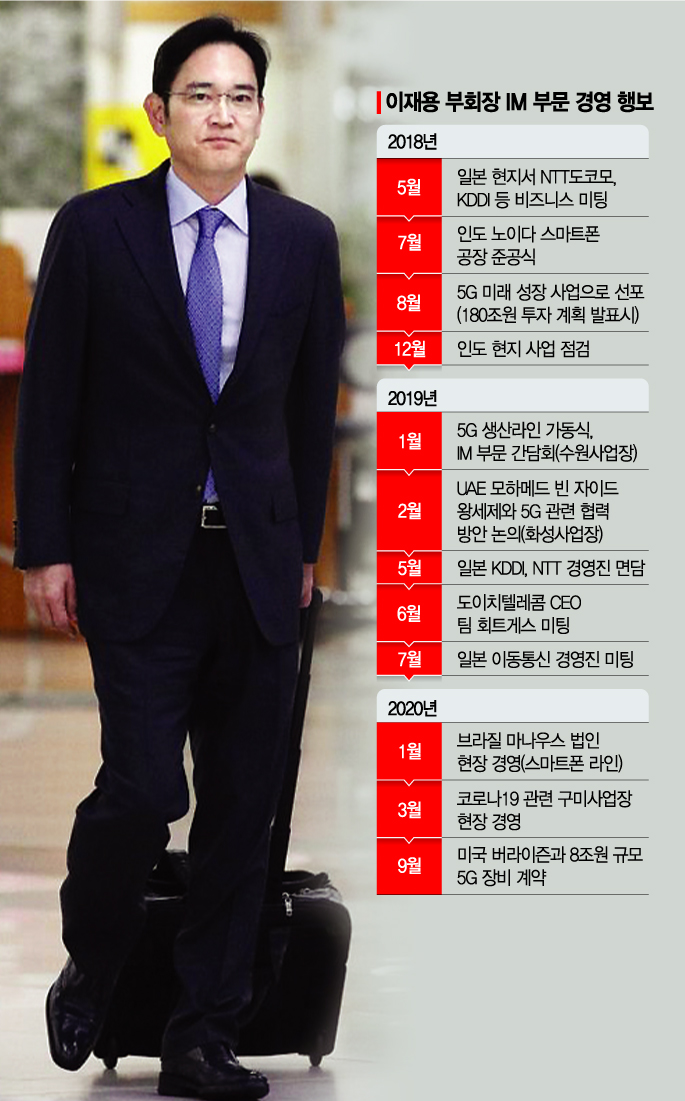
[Asia Economy Reporters Hyewon Kim and Jinju Han] Samsung Electronics securing the largest-ever 5G equipment contract in the history of the domestic telecommunications equipment industry from the US telecom giant Verizon is being evaluated as the starting point of the first flagship project in Vice Chairman Lee Jae-yong’s era, comparable to the semiconductor industry. Next-generation telecommunications is one of the 'four future growth businesses' designated by Vice Chairman Lee alongside AI, automotive semiconductors, and bio, and is a core field leading the way under the management vision of 'looking further ahead and proactively preparing for the future.'
Samsung’s New Challenge Following Semiconductors Sets Sail
On the 7th, Samsung Electronics announced its success in securing a Verizon 5G equipment and network solution order worth approximately 8 trillion KRW, which was decisively based on Vice Chairman Lee’s determination to foster the next-generation mobile communications business. Generally, the telecommunications equipment business involves large-scale contracts, mostly long-term agreements, and has a strong social infrastructure character as a major backbone network, so long-term commitments based on trust determine the success or failure of the business. The strong will of the owner family, surpassing professional managers, inevitably plays a significant role. Vice Chairman Lee has repeatedly expressed his intention to invest 25 trillion KRW over three years to intensively develop the four future sectors. He has actively engaged with global ICT industry leaders in the US, Asia, and Europe, directly and indirectly supporting marketing activities for 5G network telecommunications equipment. In 2018 and last year, he met with executives of major Japanese mobile carriers such as NTT Docomo and KDDI to discuss cooperation plans for the 5G business. Notably, in July last year, despite diplomatic tensions, he personally visited Japan to exchange business-related opinions and build trust.
Following the semiconductor success legacy of former chairmen Lee Byung-chul and Lee Kun-hee, Samsung has embarked on a new challenge as a pioneer of next-generation telecommunications technology. The recently published '6G White Paper,' which carries the slogan 'The Next Hyper-Connected Experience,' embodies this vision. Samsung Electronics is the first manufacturer to release a 6G white paper, expressing its intention to lead 6G standardization and technology following 5G.
In May last year, Samsung Electronics established a Next-Generation Communications Research Center under Samsung Research to study strategies for strengthening 5G competitiveness while conducting advanced research on 6G technologies targeting commercialization by 2028. In September last year, Vice Chairman Lee visited Samsung Research, received a briefing on the industrial outlook for 6G-based next-generation communication technologies, and urged, "We must create a new future with unprecedented new technologies."
Samsung’s Market Share Expected to Soar in 5G Territory Battle
Samsung Electronics’ recent achievement is significant in that it has secured a technological lead in the global 5G market. Samsung is performing well in the early 5G market by supplying commercial equipment in leading 5G markets including Korea, the US, and Japan. The large-scale equipment supply to Verizon is also interpreted as a signal for Samsung’s full-scale dominance of the US 5G market. It is only a matter of time before Samsung surpasses Nokia, the industry’s third-largest player.
According to market research firm Dell’Oro, Samsung Electronics held a 16.6% share of the global 5G base station market last year. Although this is behind Huawei’s 32.6%, Ericsson’s 24.5%, and Nokia’s 18.3%, the market share is expected to rise significantly through this contract.
Globally, competition among major equipment manufacturers for 5G technology is intensifying. Companies are competing fiercely over the development of high-performance chips to support 5G communication speeds, securing performance for large-capacity base stations and multiple-input multiple-output (MIMO) antenna technologies. Discussions on ecosystem changes and expansion, such as securing software-centric virtualization solutions, are also actively underway. Samsung Electronics develops key 5G components including modem chips in-house, known for excellent maximum download speed performance, and its software-centric virtualization solutions are recognized for superior subscriber capacity.
A source from a domestic telecommunications equipment company explained, "There are talks that Nokia has lost trust among US operators, and it is widely speculated that Samsung Electronics will receive Nokia’s orders as well. If Nokia’s and Huawei’s orders are divided, Ericsson and Samsung will get more, and Samsung Electronics’ sales in the US will increase significantly."
© The Asia Business Daily(www.asiae.co.kr). All rights reserved.

















