Department Stores See Sharp Drop in Sales as Foot Traffic for Clothing and Food Purchases Declines
Large Supermarkets Less Affected Due to Increased Grocery Sales
Convenience Stores Experience Surge in Sales After 9 PM
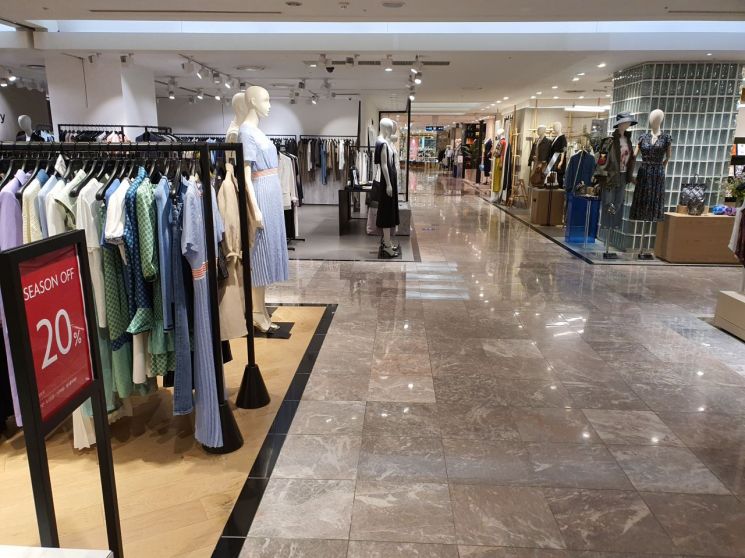
[Asia Economy Reporter Lim Hye-seon] Following the implementation of social distancing level 2.5 in the Seoul metropolitan area due to the resurgence of the novel coronavirus infection (COVID-19), offline retailers experienced mixed fortunes. Department stores saw a sharp decline in sales as foot traffic for purchasing clothing and food products dropped drastically. On the other hand, convenience stores performed relatively well with increased demand after 9 p.m. and higher sales of side dishes. Large supermarkets also suffered less damage as consumers increased purchases mainly of groceries.
According to the distribution industry on the 7th, from the 30th of last month to the 6th of this month, when social distancing level 2.5 was enforced, total sales at Lotte Department Store decreased by 37.0% compared to the same period last year. Sales of women's and men's fashion dropped by 47.0% and 43.0%, respectively. Even sales of overseas luxury brands, which were unaffected by COVID-19, fell by 3%. Food sales plummeted by 68.0% as people opted to use nearby large supermarkets, super convenience stores instead of department stores. During this period, Shinsegae Department Store's sales also declined by 19.9%.
Conversely, with more time spent at home due to telecommuting and other factors, large supermarkets managed to hold up somewhat as grocery sales increased driven by people eating 'home-cooked meals.' According to Emart, from the 30th of last month to the 3rd of this month, sales of vegetables and seafood rose by 11.7% and 11.1% respectively compared to the previous month. Semi-prepared foods that can be easily cooked at home were also popular.
With restaurant use restricted after 9 p.m., convenience store sales during that time surged. CU analyzed sales of key products during late-night hours from 10 p.m. to 2 a.m. between the 30th of last month and the 5th of this month, finding that sales of ready-to-eat foods such as fried chicken increased by 37.2% compared to the previous month. Regionally, sales growth of ready-to-eat foods in Seoul and the metropolitan area was 38.2%, higher than the 31.6% growth in other regions.
The reason for such a significant increase in sales of these products, despite the quarantine authorities banning eating and drinking inside and outside convenience stores in Seoul and the metropolitan area from 9 p.m. to 5 a.m., is that with pubs and restaurants closing at night, demand for purchasing food at convenience stores to eat at home surged sharply.
A CU representative explained, "Most customers usually purchase ready-to-eat foods for takeout rather than eating inside convenience stores, and recently, with 24-hour delivery services, customers can easily buy without face-to-face contact, making convenience stores a substitute purchase channel during late-night hours." Simple late-night snack menus were also very popular. Sales of cooked noodles (pasta, kongguksu, stir-fried noodles, etc.) increased by 36.9%, refrigerated ready meals (pizza, tteokbokki, sujebi, etc.) by 29.6%, porridge and soups by 28.2%, and frozen dumplings by 26.9%. These ready-to-eat foods, which are relatively lighter than rice-based meals, sold more than usual.
Among snacks, popcorn showed the highest growth rate at 24.9%, followed by cookies at 19.1%, general snacks at 16.6%, and jelly products at 10.9%. This is attributed to people refraining from going out and watching OTT services like Netflix or VOD instead of going to theaters.
Alcoholic beverages, which see a surge in demand late at night, recorded high sales growth rates in the order of whiskey 22.2%, soju 14.9%, wine 14.2%, and beer 9.5%. Along with this, sales of refrigerated side dishes with high paired purchase rates increased by 29.0%, processed meat products by 21.7%, and dried snacks by 19.7%.
Emart24 examined sales by time slot at metropolitan area stores from the 1st to the 3rd of this month and found that sales from 8 p.m. to 10 p.m. increased by 17.5% compared to the same period the previous week. Sales during the 9 p.m. hour rose by 23.3%.
Alcohol and food were sold heavily during these hours. Total alcohol sales increased by 49.5%. Whiskey, soju, wine, and beer sales rose by 73.7%, 68.9%, 53.9%, and 46.1%, respectively. Along with alcohol, sales of side dishes, fruits, and snacks increased by 66.4%, 36.9%, and 30.9%, respectively. GS25 also reported that sales at 9 p.m. in stores in Seoul, Gyeonggi, and Incheon from the 31st of last month to the 3rd of this month increased by 27.1% and 23.6% compared to the same period the previous week. Demand for purchasing side dishes at convenience stores also rose. At CU, sales of side dishes increased by 45.7% compared to the previous month.
An industry insider said, "As time spent at home increases, large supermarkets and convenience stores have seen increased grocery sales, which has mitigated the impact somewhat," adding, "With the number of COVID-19 confirmed cases decreasing, it is expected that department store sales will recover with retaliatory consumption once social distancing level 2.5 ends."
© The Asia Business Daily(www.asiae.co.kr). All rights reserved.

















