Likely to Maintain the Position of the Former Abe Shinzo Administration
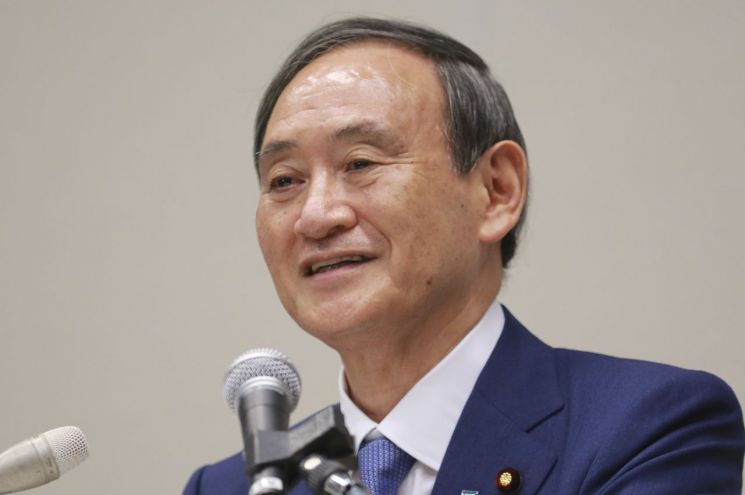 Chief Cabinet Secretary Yoshihide Suga, a leading candidate for the next Japanese Prime Minister
 [Image source=Yonhap News]
[Asia Economy Reporter Seongpil Cho] Yoshihide Suga, the Chief Cabinet Secretary who is a leading candidate for the next Japanese Prime Minister, stated that "the foundation of Korea-Japan relations is the 1965 Korea-Japan Claims Agreement." This indicates his intention to maintain the stance of the previous Shinzo Abe administration.
In an interview with Sankei Shimbun on the 6th, Minister Suga said regarding the worsening Korea-Japan relations due to the compensation issue for forced labor victims, "The Korea-Japan Claims Agreement is the foundation of Korea-Japan relations." He also asserted that "it is natural to be strictly bound by the agreement." This repeated the existing position of the Abe government and is interpreted as meaning that the Suga administration will continue Korea-Japan relations without change.
At a previous regular Cabinet Secretary briefing, Minister Suga said, "The South Korean Supreme Court's ruling on compensation for forced labor victims violates the Korea-Japan Claims Agreement," and warned of possible retaliatory measures against Korea by stating, "If the process of liquidating the assets of the defendant company, Nippon Steel, in South Korea begins, we are reviewing all countermeasures."
In a policy manifesto released on his blog the day before, he stated, "We will pursue diplomacy and security policies based on the Japan-US alliance and build stable relations with neighboring countries led by China." However, he did not directly mention South Korea. This is seen as a deliberate attempt to distance himself from South Korea.
The Liberal Democratic Party presidential election voting and counting will be held on the 14th, and the Prime Minister nomination election will take place at the extraordinary Diet session on the 16th. Although opposition candidates are also nominated in the Prime Minister nomination election and the election is held formally, in Japan's parliamentary system, the party leader of the ruling party holding the majority in the Diet becomes the Prime Minister.
© The Asia Business Daily(www.asiae.co.kr). All rights reserved.
![From Bar Hostess to Organ Seller to High Society... The Grotesque Con of a "Human Counterfeit" [Slate]](https://cwcontent.asiae.co.kr/asiaresize/183/2026021902243444107_1771435474.jpg)
















