Presiding Over the 1st Korea New Deal Strategy Meeting
Policy Finance 100 Trillion · Private Finance 70 Trillion · New Deal Fund 20 Trillion
"Largest Investment Ever in a Single Project Expected"
"Excess Liquidity Shifting from Real Estate to Productive Sectors"
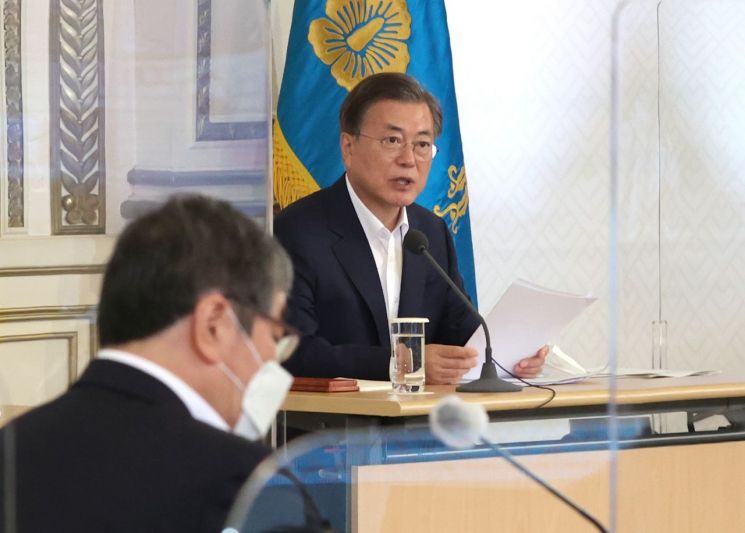 President Moon Jae-in is presiding over the 1st Korean New Deal Strategy Meeting at the Blue House on the morning of the 3rd.
 President Moon Jae-in chaired the '1st Korean New Deal Strategy Meeting' at the Blue House on the 3rd and stated, "The Korean New Deal will open the future of South Korea's economy through New Deal funds and New Deal finance."
Excess liquidity, resulting from financial easing and fiscal expansion due to the COVID-19 pandemic, has been flowing mainly into asset markets such as real estate without finding proper investment destinations. The strategy is to support housing price stabilization through diversification of liquidity while attracting investment into future advanced industries to broaden and deepen the flow of funds.
At the meeting, plans for establishing three types of New Deal funds (policy-type New Deal fund, infrastructure fund, private New Deal fund) to promote the Korean New Deal were discussed, along with funding supply plans from policy financial institutions and the private financial sector. The main content includes a 'New Deal finance' plan targeting a supply of 170 trillion won, consisting of 100 trillion won from policy finance and 70 trillion won from private finance, and inducing 20 trillion won of investment in the private sector.
The government and financial sector announced funding supply measures to support the Korean New Deal.
First, the government will establish a 20 trillion won 'policy-type New Deal fund' to actively discover and invest in Korean New Deal projects and companies. The public sector plans to contribute 7 trillion won over five years (2021?2025) to create a mother fund, which will serve as seed money to match private funds.
In this regard, policy financial institutions such as the Korea Development Bank, Industrial Bank of Korea, Export-Import Bank of Korea, and Korea Credit Guarantee Fund announced that they will supply about 100 trillion won through special loans and guarantees to strengthen the competitiveness of New Deal companies.
The five major financial holding companies?Shinhan, KB, NongHyup, Hana, and Woori?set a goal to supply about 70 trillion won over the next five years through loans and investments in digital and green New Deal-related projects and companies.
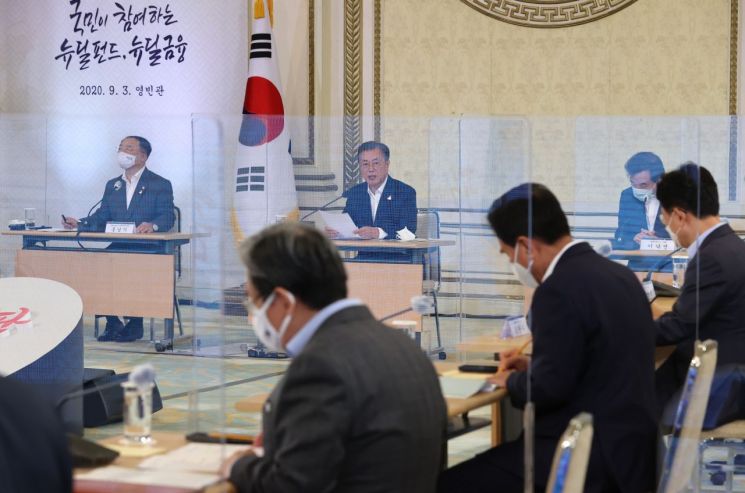 President Moon Jae-in is presiding over the 1st Korean New Deal Strategy Meeting at the Blue House on the morning of the 3rd.
Additionally, participating institutions announced specific implementation plans related to financial support for the Korean New Deal.
Korea Growth Investment Corporation disclosed detailed operation plans for the upcoming policy-type New Deal fund. They aim to encourage active private participation through subordinated financial burdens of fiscal funds and supply sufficient capital for domestic small and medium-sized enterprises and mid-sized companies in the New Deal sector to grow.
The Korea Exchange revealed plans to develop the 'K-New Deal Index (September)' and the 'Carbon Efficiency Green New Deal Index (October),' composed of stocks related to Korean New Deal industries. Once ETFs (Exchange-Traded Funds) linked to these indices are created, the general public is expected to be able to diversify investments in various New Deal companies with small amounts of capital.
Samsung Active Asset Management announced it will launch the first private 'Samsung New Deal Korea Fund' in early September, focusing investments on a select few companies expected to achieve sustainable growth in the green and digital sectors.
NH Financial Group also announced plans to launch the 'Green Korea' fund, a public offering product to foster nationwide participation in the New Deal, following the success of the 'Pilsung Korea' fund investing in materials, parts, and equipment companies (with 40,000 subscribers and a 53% investment return).
In his opening remarks, President Moon said, "We aim to lead the success of the Korean New Deal with the three pillars of finance: fiscal, policy finance, and private finance," adding, "Through citizen-participatory New Deal funds, policy finance, and private finance, the largest investment ever for a single project will be made."
President Moon emphasized, "Over the next five years, 100 trillion won from policy finance and 70 trillion won from private finance will be invested in Korean New Deal projects and companies," and highlighted, "It is also significant in terms of shifting abundant liquidity in the market from unproductive sectors such as real estate to productive sectors."
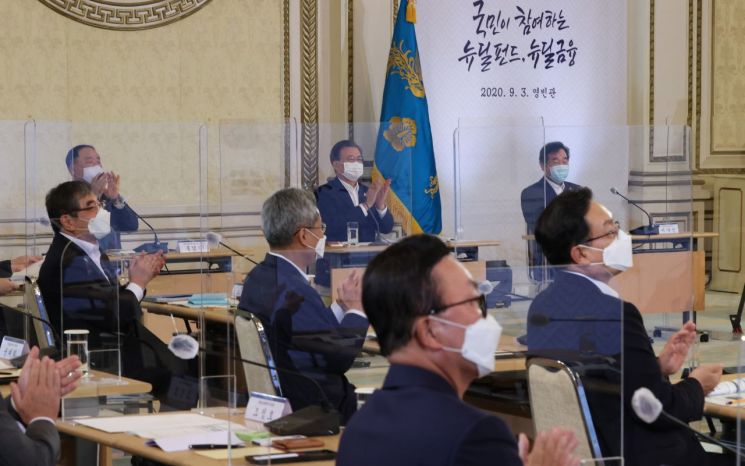 Reporter Juseong Kim = On the morning of the 3rd, President Moon Jae-in is receiving a non-face-to-face video report on the financial sector's participation plan at the 1st Korean New Deal Strategy Meeting held at the Blue House.
The meeting was attended by Deputy Prime Minister and Minister of Economy and Finance Hong Nam-ki, Financial Services Commission Chairman Eun Sung-soo, Financial Supervisory Service Governor Yoon Seok-heon, among others from the government. From the Democratic Party of Korea, Leader Lee Nak-yon and Floor Leader Kim Tae-nyeon participated. Financial sector representatives included chairpersons from Shinhan, KB, Woori, Korea Investment, Meritz, BNK (Busan Bank), JB (Jeonbuk Bank), and DGB (Daegu Bank). Heads of policy financial institutions such as KDB Industrial Bank President Lee Dong-geol, Industrial Bank of Korea President Yoon Jong-won, and Export-Import Bank President Bang Moon-kyu were also present.
While expressing high expectations for the New Deal fund and funding supply plans, attendees requested institutional support from the government.
Opinions were raised that multifaceted support is needed, including support for choosing domestically produced equipment, flexible application of permits and related laws, and cooperation with local governments, beyond just financial support. There were also calls to clearly establish definitions and standards for New Deal projects.
In response, the government stated it plans to work through inter-ministerial cooperation to ensure more practical support, such as regulatory easing.
President Moon said, "The government will swiftly promote necessary institutional improvements and regulatory innovations to facilitate the Korean New Deal," adding, "We will boldly dismantle regulations that restrict projects or corporate activities in the New Deal sector."
Considering the strengthened quarantine measures in the metropolitan area, the meeting minimized on-site participants and was conducted in parallel with online attendance. The Blue House explained that thorough preventive measures such as pre- and post-meeting disinfection, hand sanitization, and temperature checks were implemented.
© The Asia Business Daily(www.asiae.co.kr). All rights reserved.














