Credit Loans from 5 Major Banks Increase by 4.07 Trillion Won Compared to July
Mortgage Loans Also Up by 4.16 Trillion Won... "Let's Borrow First and See"
[Asia Economy Reporters Kim Hyo-jin, Kim Min-young] Last month, personal credit loans at major commercial banks surged by more than 4 trillion won, marking an all-time high. During the same period, mortgage loans also increased sharply by a similar scale, indicating a rapid rise in household debt. This trend is interpreted as being influenced by various factors, including 'debt investment' (bit-tu), where people borrow money to invest in stocks under the ultra-low interest rate environment, and the 'young-chul' movement among people in their 30s and 40s who gather all available loans and assets to buy their own homes.
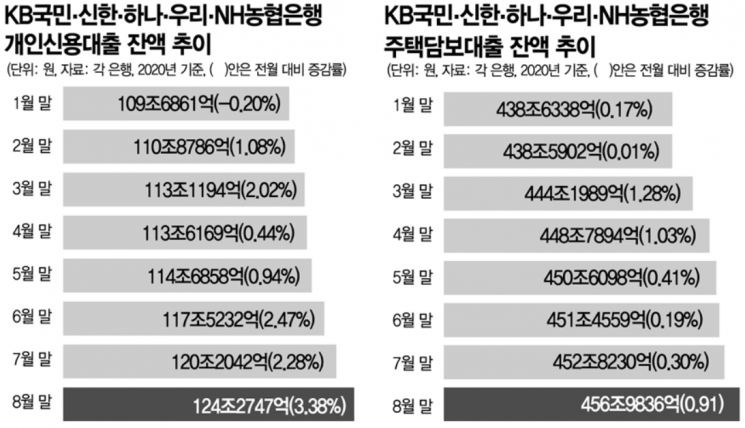
According to the banking sector on the 2nd, the outstanding balance of personal credit loans at the five major commercial banks?KB Kookmin, Shinhan, Hana, Woori, and NH Nonghyup?stood at 124.2747 trillion won at the end of last month, an increase of 4.0705 trillion won (3.38%) compared to the end of the previous month. The growth rate increased by more than 1 percentage point compared to the previous month (2.28%). This is the largest monthly increase on record. The increase in personal credit loans at the five banks dropped from the 2 trillion won level in March to about 500 billion won in April but has since shown a steep upward trend again.
The increase in mortgage loans is also notable. The outstanding balance of mortgage loans at these banks reached 456.9836 trillion won at the end of last month, a sharp rise of 4.1606 trillion won (0.91%) compared to the previous month. This marks the third-largest increase this year following March and April. The growth rate is more than three times that of the previous month (0.30%). Although the increase slowed to about 840 billion won in June, it has been rising rapidly again since July.
A representative from a commercial bank explained, "There appears to be a clear movement of 'young-chul panic buying,' where young people take out the maximum available mortgage loans and cover the shortfall with personal credit loans to buy homes." K Bank reported that about 26,400 people applied in advance for apartment mortgage loans between the 20th and 26th of last month, with 55% of applicants being in their late 30s to early 40s.
Complex Effects of Low Interest Rates, Liquidity, and COVID-19
Concerns Rise Over Defaults Due to Increased Delinquencies Among 20s and 30s
The phenomenon of 'debt investment' (bit-tu), where people borrow to jump into the rising stock market fueled by increased liquidity, is also prominent. A bank official said, "It seems likely that a significant portion of the tens of trillions of won poured into SK Biopharm and Kakao Games subscription recently came from personal credit loans." This analysis is supported by the fact that personal credit loans at the five major banks increased by 1.2 trillion won from the 1st to the 13th of last month and then surged by 2.8 trillion won in less than three weeks from the 14th to the 31st.
The interest rates, which remain in the high 2% range at most, concerns that financial authorities and the banking sector may tighten regulations on personal credit loans following mortgage loans to manage soundness, and worries about funding difficulties due to the spread of COVID-19 have also fueled the recent increase in loans. Bank officials unanimously agree that the prevailing trend is very much 'let's just borrow first and see.'
As loans rapidly increase, concerns about potential defaults, especially among younger generations, are also rising. An analysis by the National Fiscal Research Institute of Korea Credit Bureau (KBC) data as of the end of July shows that both loan amounts and delinquency amounts have significantly increased among people in their 20s and 30s. The average loan amount per person in their 30s was 37.77 million won, up 1.97% from the previous month, while the average delinquency amount per person was 562,000 won, an increase of 3.92% from the previous month.
For those in their 20s, the average loan amount per person was 6.98 million won, up 4.08% from the previous month, and the delinquency amount was 108,000 won, an increase of 3.5% from the previous month.
© The Asia Business Daily(www.asiae.co.kr). All rights reserved.
![Clutching a Stolen Dior Bag, Saying "I Hate Being Poor but Real"... The Grotesque Con of a "Human Knockoff" [Slate]](https://cwcontent.asiae.co.kr/asiaresize/183/2026021902243444107_1771435474.jpg)











