"New Government to Be Formed Within Next 2 Weeks"
Central Bank and Financial System Must Undergo Audits
Lebanese Political Sphere Needs to Restore Public Trust
[Asia Economy Reporter Naju-seok] French President Emmanuel Macron, who is visiting Lebanon, stated, "A new government will be formed in Lebanon within the next two weeks." He emphasized that international support will only begin after the Lebanese government and financial system undergo self-reform.
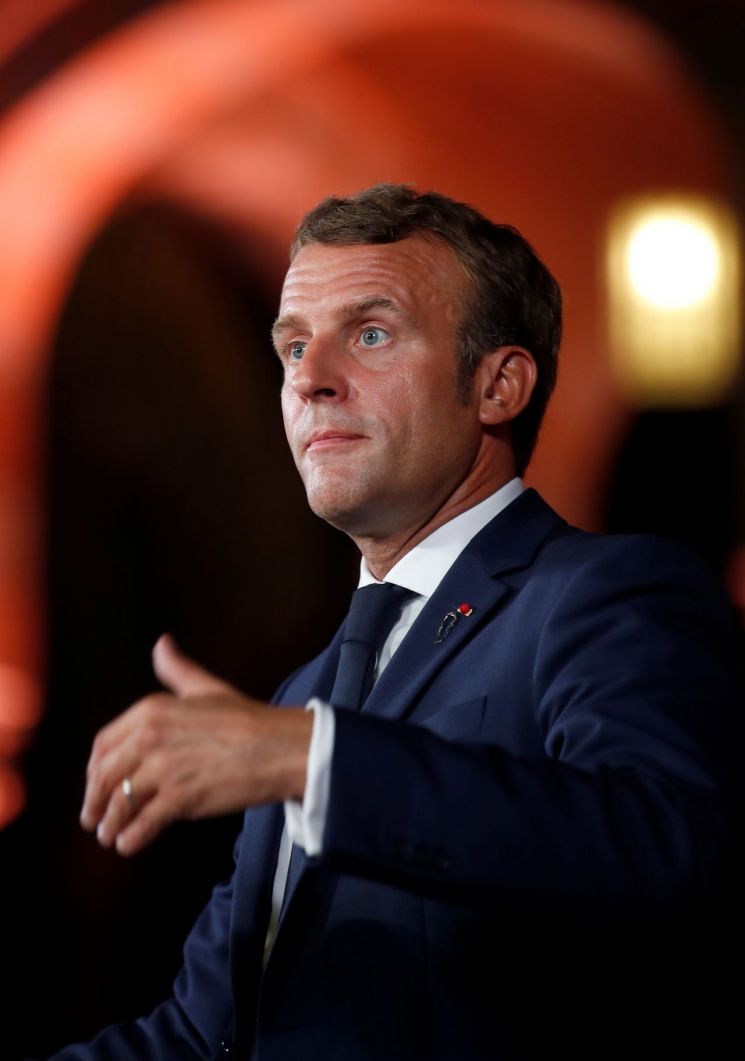
On the 1st (local time), President Macron mentioned the schedule for forming a new Lebanese cabinet during his visit to the site of the explosion disaster at Beirut Port, the capital of Lebanon. Although it usually takes several months to form a government, Lebanese political leaders have expressed their intention to complete the government formation process at an ultra-fast pace this time. After the Beirut Port explosion disaster, the Lebanese government’s cabinet resigned en masse, and just hours before Macron’s visit, Mustafa Adib, an unknown politician and former German ambassador, was appointed as the new prime minister.
Before visiting Beirut Port, President Macron met with Lebanese political leaders. Regarding this, he mentioned that Lebanese political leaders have lost the trust of the people and have failed to implement reforms for a long time. He further emphasized that if Lebanon does not form a new cabinet and fails to achieve results in the reforms demanded by the international community, financial support from the international community will be delayed. To this end, he demanded a large-scale audit of the Lebanese central bank and financial system, as well as a credible investigation into the explosion disaster.
In addition, President Macron warned that the international community could cooperate to impose sanctions on Lebanese politicians involved in corruption.
On the 4th of last month, approximately 2,750 tons of ammonium nitrate, a flammable substance stored for years at Beirut Port in Lebanon, exploded, killing about 180 people and injuring 6,000. Lebanon, already suffering from an economic crisis that began with a financial crisis, is now facing a triple hardship of the explosion disaster, the spread of the novel coronavirus infection (COVID-19), and economic difficulties. In particular, due to the political system that divides political power according to religion, irresponsible politics have continued. After the civil war, Lebanon maintained a sectarian power-sharing political system where the president is a Maronite Christian, the prime minister is a Sunni Muslim, and the speaker of the parliament is a Shia Muslim.
Regarding the newly formed cabinet under Prime Minister Adib, President Macron emphasized that it should be composed of "qualified personnel," unlike the usual appointments.
However, there is significant public opposition in Lebanon regarding the sudden appointment of Prime Minister Adib. Because Adib was once a close aide to former Prime Minister Najib Mikati, many believe he is no different from the established politicians. In fact, protests took place around the Lebanese parliament on the same day, which is interpreted as representing the dissatisfaction of the Lebanese people.
However, the demands of the protesters varied; some called for the resignation of Lebanese President Michel Aoun, while others opposed foreign intervention symbolized by President Macron’s visit to Lebanon.
© The Asia Business Daily(www.asiae.co.kr). All rights reserved.

















