Government Announces 2021 National Budget
Deputy Prime Minister Hong Nam-ki: "Fiscal Soundness Slightly Weakened but Next Year Is Economic Golden Time"
"Budget Must Play a Central Role"
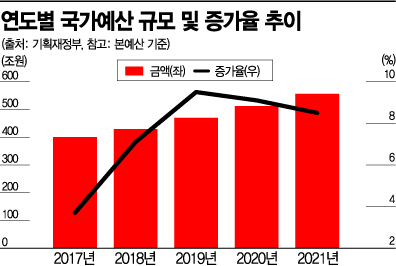
[Sejong=Asia Economy Reporter Kim Hyunjung] Next year's national budget has been set at an 'ultra super budget' level of 555.8 trillion won, an 8.5% increase from this year. The government plans to accelerate expansionary fiscal policy to revitalize the economy, which has been stagnant due to the COVID-19 pandemic, and to promote the 'Korean New Deal,' a leading development strategy. However, due to worsening domestic and international economic conditions, tax revenues are likely to decline, and next year's national debt is expected to reach 945 trillion won.
On the 1st, the government held a Cabinet meeting and announced the 2021 budget totaling 555.8 trillion won. Expenditures increased by 43.5 trillion won (8.5%) compared to this year (512.3 trillion won), showing a high growth rate for three consecutive years following 2019 (9.5%) and 2020 (9.1%). Compared to this year's third supplementary budget, it expanded by 8.9 trillion won (1.6%).
Deputy Prime Minister and Minister of Economy and Finance Hong Nam-ki said at a pre-briefing on the 2021 budget held at the Government Complex Sejong on the 27th of last month, "We have formulated the budget with the strongest possible expansionary stance within a manageable range, reflecting the government's strong will for economic recovery." He added, "Although fiscal soundness has somewhat weakened, in the current pandemic and economic wartime situation, we must faithfully execute the fiscal role required, even if it means temporarily enduring debt and deficits." He emphasized, "Next year is a golden time that will determine the direction of our economy," and "The budget will play a central role."
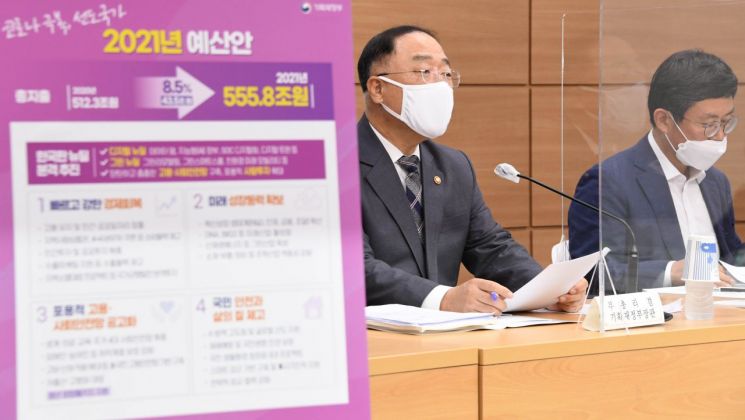
The health, welfare, and employment budget, which will play a key role in recovery from the COVID-19 crisis, was set at 199.9 trillion won, an increase of 19.4 trillion won (10.7%) from this year. This accounts for 35.9% of the total national budget. Among this, the job creation budget alone was expanded by 5.1 trillion won (20.0%) to about 30.6 trillion won. To promote innovative growth through the national development strategies of the Digital and Green New Deals, the budget for industry, small and medium enterprises, and energy was also increased by 5.4 trillion won (22.9%) to 29.1 trillion won. The research and development (R&D) and environment budgets were raised by 3 trillion won (12.3%) and 1.5 trillion won (16.7%), respectively, to 27.2 trillion won and 10.5 trillion won.
The social overhead capital (SOC) budget was allocated 26 trillion won, an 11.9% (2.8 trillion won) increase, marking a double-digit growth for two consecutive years following this year. The defense budget rose by 2.7 trillion won (5.5%) to 52.9 trillion won, while the education budget was the only one to be reduced, decreasing by 1.6 trillion won (-2.2%) to 71 trillion won compared to this year.
Next year's total revenue is expected to increase by 1.2 trillion won (0.3%) to 483 trillion won, reflecting mixed effects from sluggish corporate tax due to the COVID-19 crisis and expanded social security contributions. To cover the shortfall in tax revenue, the government plans to issue 89.7 trillion won in deficit bonds. The managed fiscal balance deficit, which combines government accounts and fund accounts, will surge by 38.2 trillion won to 109.7 trillion won compared to this year's original budget, and national debt will jump by 139.8 trillion won to a total of 945 trillion won. The managed fiscal balance deficit will be -5.4% of GDP, worsening by 1.9 percentage points from this year, and the national debt ratio will deteriorate by 6.9 percentage points to 46.7%.
© The Asia Business Daily(www.asiae.co.kr). All rights reserved.


















