Experts Expect Dollar Weakness to Pause
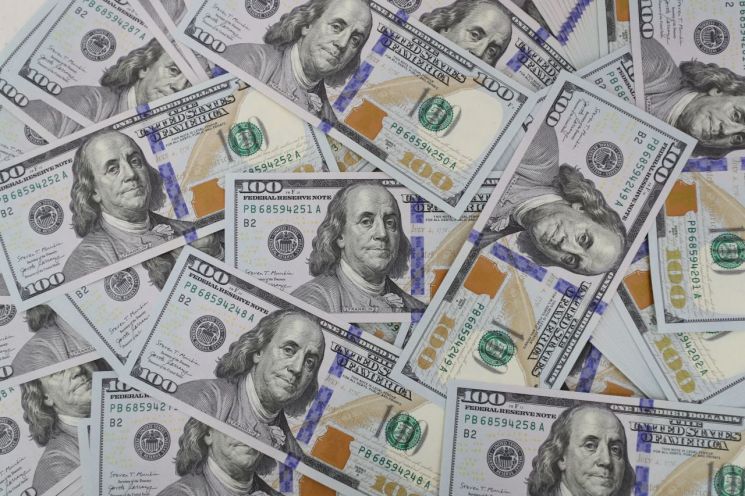
[Asia Economy Reporter Eunmo Koo] The US dollar, which had been steadily weakening since its sharp rise last March due to the impact of the novel coronavirus disease (COVID-19), is seeking a new direction this month. Experts are leaning toward the view that the dollar's weakness will pause, citing factors such as the resurgence of COVID-19 in Europe.
According to Bloomberg on the 28th, the dollar index (DYX) closed at 93.01 points, up 0.01% from the previous trading day. Although it rose slightly the day before, the dollar index had surged close to 103 points last March as COVID-19 rapidly spread and preference for safe-haven assets peaked. Since then, as global financial markets gradually stabilized, it has steadily trended downward.
As the dollar showed continuous weakness, inverse exchange-traded funds (ETFs) linked to the decline of the US dollar futures index and yields also posted steady returns. According to the Korea Exchange, Mirae Asset Management's TIGER US Dollar Futures Inverse 2X recorded a 14.3% return from March 19 to the day before. During the same period, KODEX US Dollar Futures Inverse 2X and KOSEF US Dollar Futures Inverse 2X also posted returns of 14.2%.
However, this month, the dollar has not shown a clear direction and appears to be searching for a new path. The dollar index fell to 92.27 points on the 18th, hitting a 27-month low due to difficulties in agreeing on additional US stimulus measures, weak weekly employment data, and a decline in US Treasury yields. But it rebounded afterward, influenced by the more hawkish-than-expected July Federal Open Market Committee (FOMC) minutes, marking the first weekly increase since mid-June.
With market attention focused on the future direction of the dollar, experts generally expect the dollar's weakness to pause. The narrowing gap in real interest rates between the US and the Eurozone is slowing, and the COVID-19 situations in the two regions are reversing, creating overall conditions around the dollar and euro that are unfavorable for the dollar's continued weakness.
Jung Mi-young, a researcher at Samsung Futures, explained, "From an interest rate perspective, both nominal and real interest rate spreads between the US and Eurozone have supported a weak dollar, but the recent slowdown in spread narrowing is hindering further downward momentum for the dollar."
The reversal of COVID-19 situations in the US and Europe is also a reason for the dollar's weakness to pause. Previously, the persistent spread in the US supported the weak dollar. However, recently, while the US is showing signs of containment, the Eurozone is experiencing signs of resurgence due to increased summer holiday travel, posing an obstacle to Eurozone economic improvement that could have fueled the weak dollar.
The lack of a clear economic recovery is also cited as a reason why further dollar weakness is hard to support. Kwon Ah-min, a researcher at NH Investment & Securities, said, "In 2009 and early this year, when the global leading economic index rose sharply, the dollar's weakness was also steep, but in 2012 and 2016-2017, when the index rose moderately, the dollar was sideways. Given that the global leading economic index has been moving within a long-term downward trend since the global financial crisis, the potential for the dollar index to fall further is limited." This means that a stronger economic recovery than currently seen is necessary for the safe-haven dollar to weaken more significantly.
© The Asia Business Daily(www.asiae.co.kr). All rights reserved.
![User Who Sold Erroneously Deposited Bitcoins to Repay Debt and Fund Entertainment... What Did the Supreme Court Decide in 2021? [Legal Issue Check]](https://cwcontent.asiae.co.kr/asiaresize/183/2026020910431234020_1770601391.png)















