Companies Shift to Remote Work Amid COVID Spread... Verbal Abuse and Sexual Harassment via Messengers, SNS
4 out of 10 Workers Report "Online Workplace Bullying"
Experts Warn "Verbal Abuse and Harassment More Likely Online"
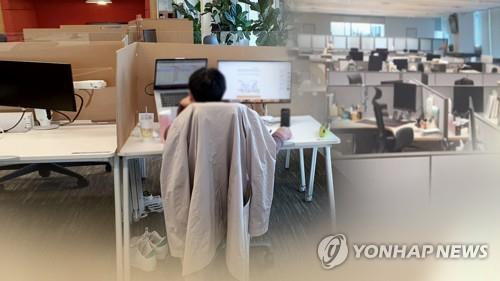
[Asia Economy Reporter Kim Ga-yeon] As the novel coronavirus infection (COVID-19) resurges, more companies are adopting remote work. The problem is that workplace harassment, such as sexual harassment, which continued in face-to-face situations, is persisting online as well, raising concerns among office workers. Some employees even complain that the severity of the harm has worsened. Experts point out that the level of violence has increased in non-face-to-face situations.
With the surge in COVID-19 cases, the number of daily new confirmed cases has rapidly increased to the 400s. According to the Central Disease Control Headquarters on the 27th, as of 12 a.m. that day, the number of new confirmed cases was confirmed to be 441. The cumulative number of confirmed cases rose to 18,706.
In private companies, there is a trend to expand the implementation of remote work to prevent the spread of infection. Samsung Electronics plans to pilot remote work next month by accepting applications from employees responsible for tasks that can be done remotely. LG Electronics reportedly started operating remote work for more than 30% of its employees company-wide from the 27th. Kakao, LG Uplus, NCSoft, and Netmarble have also started remote work.
While implementing remote work amid the COVID-19 spread, some office workers complain that workplace harassment remains unchanged. Harassment that continued offline is now happening online as well.
Office workers have reported continuous harm through video conferences and online chats. Acts of verbal abuse, sexual harassment, and other direct forms of aggression that were previously conveyed through words or actions are continuing, only through different methods.
Employees suffering from harassment have complained about being subjected to appearance-related criticism during video conferences.
Employee A (28), who has been working remotely for two weeks, said, "I hear verbal abuse from my boss every day through phone calls or internal messengers." A added, "Before remote work, the boss would call people over, yell, and curse. I hoped it would lessen with remote work, but it didn’t decrease just because they don’t see my face."
A said, "Maybe because the abuse is poured out through messages or calls, it feels even worse. Every time I get a call from my boss, my heart pounds so hard and I can barely breathe. The economy is bad, so I can’t quit, and it’s very stressful," he added.
Another office worker B in their 30s said, "I recently had a video conference, and my senior criticized my appearance. When I showed displeasure, they said it was a joke, but it still made me feel very bad." B added, "Sometimes I worry someone might capture it and post it somewhere strange. I hope this situation ends soon so I can return to normal work."
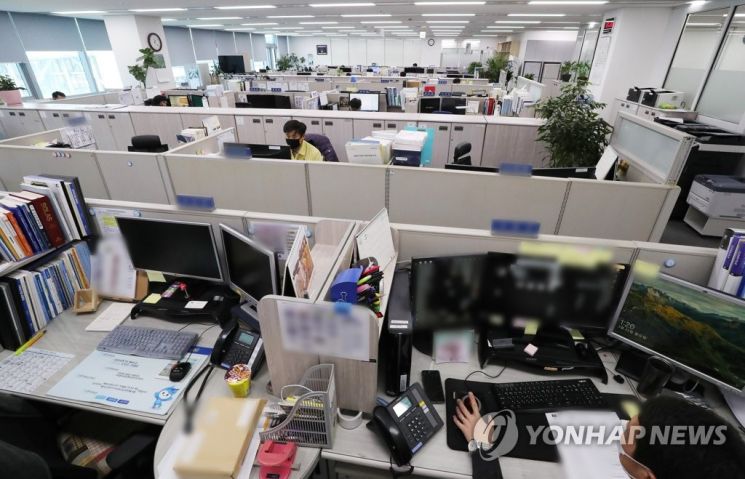 In March, employees of the Ministry of Oceans and Fisheries at the Government Complex Sejong in Sejong City were working while sitting apart from each other. The photo is unrelated to specific expressions in the article. Photo by Yonhap News
A survey found that 4 out of 10 office workers complain of workplace power harassment online.
According to a survey conducted last month by the job portal Incruit on 530 office workers about 'remote work stress and online power harassment experience,' 41.8% of those with remote work experience said they had experienced online workplace power harassment.
Examples they cited included 'work orders outside working hours' (47.4%), 'interference in family/children’s private life' (15.8%), 'appearance/clothing/attitude criticism during video conferences' (12.2%), and 'sexual harassment during video conferences' (2.0%).
This phenomenon is also known to occur in other countries. In June, Japan’s Mainichi Shimbun reported that with the introduction of remote work, cases of supervisors harassing subordinates or invading their privacy have occurred.
According to the report, C (35), who works at a telecommunications company in Tokyo, was sexually harassed by a supervisor after not immediately closing the window following a video conference. The supervisor reportedly said things like, "You stayed because you want to have an online drinking party with me, right? Want to drink?" and "Is your home a one-room with a kitchen? Is your boyfriend there now in that room?"
Tokyo Kaijo Nichidokasai Insurance has also launched an insurance product that comprehensively prepares for risks caused by remote work. It provides compensation to cover lawyer fees and damages if an employee who suffered online harassment during remote work files a lawsuit against the company.
As cases of harm continue, new terms such as 'telehara' and 'rimohara' have emerged. These are portmanteaus combining telework (remote work via equipment), remote, and harassment.
Experts point out that because guilt and responsibility for harmful acts are lower in non-face-to-face situations than in face-to-face ones, the level of violence can increase.
Professor Kwak Geum-ju of the Department of Psychology at Seoul National University said in a phone interview with Asia Economy on the 27th, "Bullying within groups can occur in any organization. As remote work increases, naturally it moves online."
She continued, "Verbal abuse and harassment can occur more easily online because the victim is not face-to-face. When you verbally abuse or assault someone in front of them, you see their facial expressions change or their struggle, which can lower the severity of your violent behavior. Conversely, online, because you cannot see the victim, the sense of responsibility decreases, and the level of aggression and violence can increase," she explained.
© The Asia Business Daily(www.asiae.co.kr). All rights reserved.
![User Who Sold Erroneously Deposited Bitcoins to Repay Debt and Fund Entertainment... What Did the Supreme Court Decide in 2021? [Legal Issue Check]](https://cwcontent.asiae.co.kr/asiaresize/183/2026020910431234020_1770601391.png)

















