[Monthly Defense Times Editor-in-Chief An Seung-beom] Recently, the Indian Air Force suffered a blow to its reputation. Although the Indian Air Force bombed a camp in Pakistan, with which it is in conflict, the operation ended in a major failure.
At the time, the Indian Air Force deployed Mirage fighter jets that launched the guided bomb ‘SPICE 2000.’ However, the guided bomb fell into a pine forest beside the camp. The problem lies in the low accuracy of the missile. The SPICE 2000 uses complex algorithms with three-dimensional video data but has the disadvantage of being unpowered and gliding during flight.
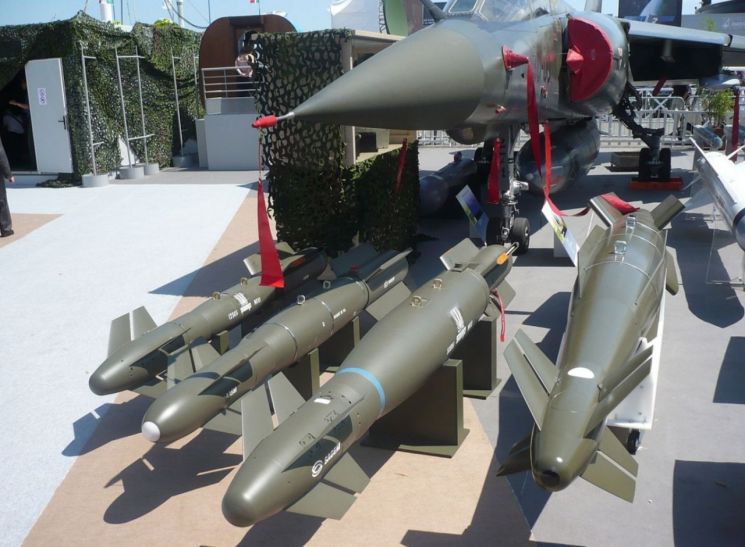
To compensate for these drawbacks, the French AASM (Armement Air-Sol Modulaire) guided bomb has attracted attention. AASM is the French abbreviation for ‘Armement Air-Sol Modulaire.’ Internationally, it is known as Hammer.
This guided bomb is a guidance kit combined with 2,000-pound (lbs) aerial munitions (MK.84, BLU-109). Unlike the SPICE 2000, the AASM includes a rocket motor and uses simpler video data with the ATA algorithm. The AASM guided bomb can also be mounted on F-16 and KF-X fighter jets.
Hammer gained fame after successfully completing operations during French airstrikes in Afghanistan and Libya. It combines a guidance kit including IR imaging sensors or laser sensors and a rocket motor with 2,000-pound munitions such as MK.84 and BLU-109.
Hammer can be dropped from low altitudes and still accelerate using its rocket motor to secure the energy needed for ascent. This means it can strike targets even in no-fly zones.
Hammer is known for its very high target dive angle. It can maintain flight control even when diving vertically onto a target. Because of this steep dive angle and the added thrust from the rocket motor, Hammer’s impact energy is inevitably high.
Using warheads of 2,000 pounds like the MK.84, Hammer has high penetration power. When equipped with the BLU-109 penetrator warhead of the same weight, it can also be used as a bunker buster.
Hammer’s terminal guidance can use either laser guidance or infrared imaging guidance. Hammer combines the video generated by the infrared imaging sensor with reference data simply, avoiding identical errors. When using the video matching technique, Hammer’s circular error probable (CEP) is only about 1 meter.
If Hammer is used on our Air Force’s FA-50, it can be mounted and operated with a 500-pound kit combined with the MK.82. Military experts predict that equipping Hammer on the KF-X fighter jet will also aid in exports.
Hammer’s algorithms, infrared imaging sensors, and laser sensors are all proprietary French technologies. In other words, it is free from U.S. export control restrictions, meaning that exporting the KF-X fighter jet to Islamic countries will not face obstacles.
© The Asia Business Daily(www.asiae.co.kr). All rights reserved.

















