Hospital Bed Supply Also in Emergency
[Asia Economy Reporter Kim Heung-soon] On the 27th, with an additional 441 confirmed cases of the novel coronavirus infection (COVID-19) in South Korea, concerns grew over the supply and demand of hospital beds for severe patients and sporadic cluster infections nationwide.
According to the Central Disaster and Safety Countermeasure Headquarters' (CDSCH) "COVID-19 Patient Bed and Residential Treatment Center Status" data as of the 25th, there are a total of 3,260 COVID-19 patient beds nationwide, of which only 1,038 beds (31.8%) are available for admission.
The situation in the Seoul metropolitan area, where most of the new confirmed cases are concentrated, is worse. The metropolitan area has secured 2,024 COVID-19 patient beds, but only 444 beds (21.9%) remain available. Seoul (152 beds) and Incheon (263 beds) have relatively more availability, but Gyeonggi Province has only 29 beds left.
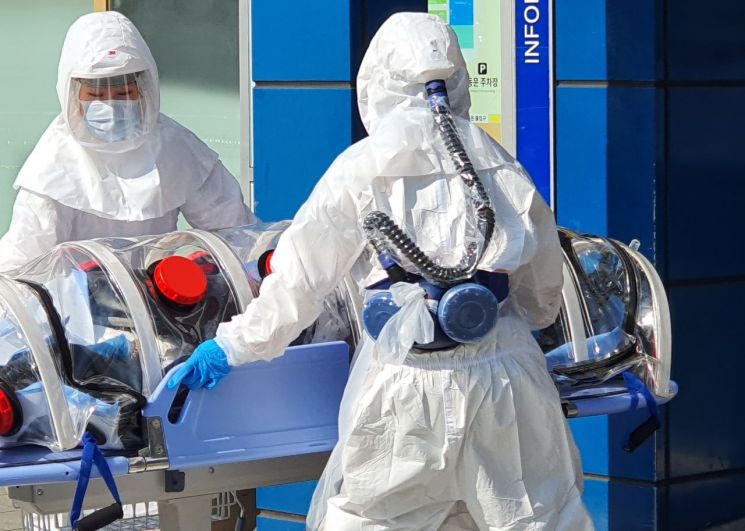
There is even less availability for intensive care unit (ICU) beds needed for patients whose condition is severe or critical and require intensive treatment. The government has a total of 519 beds nationwide for treating severe COVID-19 patients, but as of the 25th, only 62 beds (11.9%) are available.
In the metropolitan area, excluding Seoul (11 beds), Incheon (3 beds) and Gyeonggi (5 beds) have fewer than 10 available beds. According to government estimates, the current number of remaining beds will not last even a week.
Only 1,038 Available Beds Nationwide... Just 444 in the Metropolitan Area
Currently Unable to Last Even a Week
As of midnight on the day, the number of patients in isolation treatment increased by 347 in one day, reaching a total of 3,932. The number of severe and critical patients also rose by 4 to 46. Previously, when daily confirmed cases surged mainly in Daegu and Gyeongbuk in February, there were cases where patients who tested positive for COVID-19 had to wait for a bed due to unavailability, resulting in deterioration or death. The possibility of such incidents recurring cannot be ruled out.
Residential treatment centers, where asymptomatic or mild patients stay, are also running low on capacity. As of the 25th, a total of 8 residential treatment centers (with a capacity of 1,744 people) are operating, but only 618 spots are available for admission.
It is also concerning that new confirmed cases are occurring nationwide, not only in the metropolitan area but also in Gwangju, Chungnam, Gangwon, Jeonnam, Daegu, Busan, Gyeongnam, Daejeon, Gyeongbuk, Jeonbuk, Ulsan, Chungbuk, and Jeju. Infectious disease experts said, "If confirmed cases occur in many places beyond cluster infections traceable within the quarantine network, new amplification clusters may emerge through secondary and tertiary transmissions," adding, "In such cases, the epidemiological investigation system will struggle to keep up with the speed of occurrence."
Especially, the situations in the metropolitan area and Daegu are serious. Recently, about 200 confirmed cases have been reported daily in the metropolitan area, and if this trend continues, the cumulative confirmed cases in Seoul, Gyeonggi, and Incheon are expected to surpass Daegu's cumulative 6,999 confirmed cases on this day. Daegu had the highest number of confirmed cases among domestic regions due to the impact of the Shincheonji Church of Jesus cluster infection in February and March.
© The Asia Business Daily(www.asiae.co.kr). All rights reserved.