P2P Companies Entering Regulatory Framework with On-to-Law Enforcement on 27th
Selection of Quality Among 240+ Proliferated Firms Expected to Begin
Investor Losses Inevitable as Closures Increase
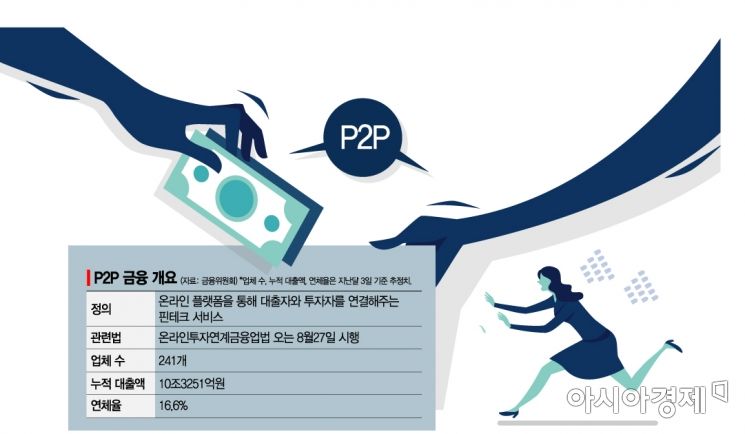
[Asia Economy Reporter Kim Min-young] The Online Investment-Linked Finance Business Act, commonly known as the 'P2P Finance Act,' takes effect today (27th). This marks the emergence of a new type of financial business after 17 years since loan businesses were incorporated into the tertiary financial sector in 2003. As P2P finance companies, which had sparked controversies over issues like 'eating and running' and 'rolling over debts,' enter the regulatory framework, it is expected that a thorough sorting out will begin, with insolvent companies being weeded out.
According to financial authorities and the P2P industry on the 27th, the P2P Finance Act will be enforced starting today. This legislation comes more than four years after the first proposal by Min Byung-doo, a member of the Democratic Party of Korea, in 2016. Riding the wave of fintech (finance + technology) innovations such as internet-only banks, simple remittances, and easy payments, P2P finance has now been institutionalized.
Side Effects of P2P Industry Emerge... Institutionalization After Four Years
The future is not entirely bright. With about 240 companies flooding the market, criminals resembling 'scammers' have been rampant, leading to repeated incidents such as company CEO arrests, closures, and delinquencies. The government’s tightening of mortgage loans by banks has also raised suspicions that some people are borrowing money from P2P platforms to buy houses.
Recently, 'Popfunding,' a movable collateral loan company cited by the Financial Services Commission as an example of innovative finance, is under prosecution investigation for allegedly rolling over 55 billion KRW in investment funds. Last month, the CEO of 'Nexrich Funding,' a used car collateral loan company, was also arrested on charges of fraud and embezzlement. Companies like Sisofunding and Topfund, which have recently experienced frequent redemption delays, are also abundant.
Delinquency rates are also severe. According to P2P statistics firm Midrate, as of the 25th, the average delinquency rate among 141 P2P companies is 16.26%, which is higher than the average yield of 12.87%. This means investing 1 million KRW to earn about 130,000 KRW involves a high risk of default. The financial sector considers a delinquency rate of 10% as the investment product’s limit, so P2P companies are expected to make every effort to reduce delinquency rates going forward.
What Will Change?
With the law’s enforcement, P2P companies must register with the Financial Services Commission (Financial Supervisory Service) within one year to operate legally. They must also meet requirements such as a minimum capital of 500 million KRW, preparation of regulatory measures for business activities including post-loss compensation for investors, and appointment of compliance officers. Failure to meet these requirements will result in registration refusal or cancellation. If not registered within one year, the business will be converted to a traditional loan business and will no longer be allowed to attract investments from unspecified multiple investors.
With the law’s enforcement, an online investment-linked finance association with corporate status will also be established. Currently, the P2P Finance Association, which is a voluntary organization, is actively preparing to transition into a statutory association.
The newly enforced law provides a grace period until August 26 of next year. This gives new and existing companies time to adapt to the law, but before strict enforcement, the financial authorities will implement a revised version of the existing P2P guidelines starting today.
The investment limit for general individual investors will be reduced from 20 million KRW to 10 million KRW per company. The investment limit related to real estate will be tightened from 10 million KRW to 5 million KRW. Additionally, handling of P2P loans and investment products secured by assets such as loan claims and principal and interest collection rights will be restricted. P2P loans to loan businesses or special purpose companies (SPCs) will also be prohibited.
The loan limit for the same borrower is restricted to the smaller amount between 7% of the loan claim balance of the relevant company and 7 billion KRW.
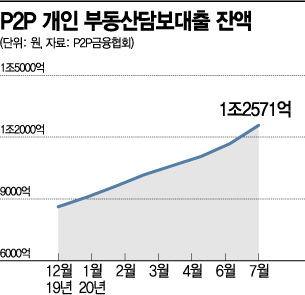
Financial authorities have mandated that the maturity, interest rate, and amount of investment products and the loans executed with the funds raised through those products must match to restrict unhealthy business practices such as rolling over debts. Acts of unfairly favoring or discriminating against specific investors in relation to borrower information provision and investor recruitment, as well as providing or receiving excessive financial benefits to or from investors, have been prohibited.
It is also prohibited to mislead consumers by promising compensation for losses or profits on P2P investment products that do not guarantee principal protection.
The industry argues that the revised guidelines are too strict and hinder proper business operations, but since the investment limit applies per company, there is a clear limitation in preventing investors from distributing their money across multiple companies.
Concerns Over Mass Closures Following OnTuBeop Enforcement
The Financial Supervisory Service has requested about 240 P2P companies to submit audit reports on loan claims by the 26th of this month. However, it is known that only about 20 companies have submitted reports, suggesting that many companies may fail to pass even the first hurdle to operate within the legal framework.
Companies that fail to submit or receive adverse opinions on their reports are likely to be prohibited from conducting P2P business in principle. However, financial authorities are reportedly considering granting a grace period to companies with special reasons for failing to submit reports to minimize market shocks.
A financial industry official said, "With the law’s enforcement, a significant number of insolvent companies will be filtered out," adding, "Many companies may fail to pass even the first hurdle as they could not submit the reports requested by the day before yesterday."
© The Asia Business Daily(www.asiae.co.kr). All rights reserved.
!["The Woman Who Threw Herself into the Water Clutching a Stolen Dior Bag"...A Grotesque Success Story That Shakes the Korean Psyche [Slate]](https://cwcontent.asiae.co.kr/asiaresize/183/2026021902243444107_1771435474.jpg)

















