Comprehensive Survey on Living Conditions of 15,455 Low-Income Households Through Big Data Analysis...Focused Identification of Residents Below 50% Median Income in High-Density Housing Areas
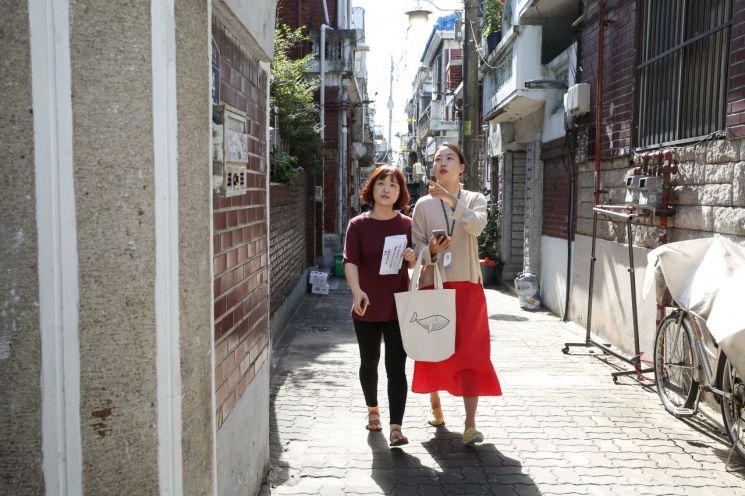 Employees searching for residents in welfare blind spots living in densely populated housing areas through big data analysis
[Asia Economy Reporter Jongil Park] Seongdong-gu (Mayor Jeong Won-oh) has been conducting a living condition inspection and welfare blind spot survey since July for 15,455 households with less than 50% of the median income among the 50,094 households eligible for Seoul City's emergency disaster living expenses.
This survey aims to identify households experiencing difficulties due to the prolonged COVID-19 pandemic through a customized intensive investigation based on big data analysis using the Seoul City emergency disaster living expenses data applied for in May.
According to the big data analysis, among the 15,455 households subject to the full survey, single-person households accounted for 7,963 households, or 51%, and more than 73% of these were concentrated in multi-family houses in densely populated residential areas with low housing prices.
Accordingly, it was confirmed that more than 35% of households with less than 50% of the median income were concentrated in densely populated residential areas with relatively few apartment complexes, such as Geumho-dong, Seongsu-dong, and Yongdap-dong, and an intensive discovery survey was conducted.
The district first signed an agreement with the local real estate agents' association, which has a good understanding of the housing situation, to report and share information about impoverished crisis households in residential areas. They visited and contacted all households subject to the full survey by phone to provide guidance on the usage period of Seoul City's emergency living expenses and to assess living conditions.
Through this survey, customized benefits such as livelihood benefits, medical benefits, and housing benefits were linked to 522 households, including single-person households, and 264 households were enabled to receive Seoul-type emergency support and national emergency support.
Mr. Choi (66) from Yongdap-dong said, "After filing for bankruptcy, I moved into a semi-basement house as if being chased, and it was very difficult to find daily wage jobs due to COVID-19." He added, "Fortunately, a welfare officer visited and helped me apply for housing benefits, so now I can breathe easier." In addition to linking customized benefits, the district matched Mr. Choi one-on-one with the 'Our Neighborhood Care Team,' which helps with welfare checks and counseling in the area, so he can receive welfare check services at least once a week.
A district official said, "Although we contacted and sent notices by visits and phone calls, we will continue to provide information and promote welfare service systems through various methods for the 1,437 households that did not respond."
Jeong Won-oh, Mayor of Seongdong-gu, said, "As COVID-19 prolongs, the invisible welfare blind spots are gradually expanding." He added, "Since face-to-face contact is difficult, it is challenging to find blind spots, but we will strive to discover hidden welfare blind spots thoroughly through efficient survey methods such as big data analysis and public cooperation with the local community."
© The Asia Business Daily(www.asiae.co.kr). All rights reserved.
![From Bar Hostess to Organ Seller to High Society... The Grotesque Con of a "Human Counterfeit" [Slate]](https://cwcontent.asiae.co.kr/asiaresize/183/2026021902243444107_1771435474.jpg)
















