Insurance Companies Compete to Launch Products for the Elderly
Frequent Requests for Unnecessary Insurance and Re-enrollment After Cancellation
Authorities "Strengthen Crackdown on Illegal Sales"
[Asia Economy Reporter Oh Hyung-gil] Recently, office worker Park Ji-soo (alias, 42) heard a complaint from her mother, who lives separately in the provinces, that she had signed up for insurance through an acquaintance a few months ago but found the premium payments too burdensome. When Park visited her parents' home on the weekend, she was shocked after reviewing the insurance documents.
Her mother, who does not even have a driver's license, had been persuaded by an agent that she could receive coverage for surgery and diagnosis fees, leading her to sign up for two driver insurance policies. Park said, "It's outrageous that they could sell driver insurance to a 70-year-old senior who doesn't even have a license," and expressed her frustration, saying, "Not only the unscrupulous agent but also the insurance company that just wants to sell at any cost should be held responsible."
Recently, as insurance products targeting people with pre-existing conditions and the elderly have flooded the market, incomplete sales practices targeting these groups have been on the rise, calling for consumer caution.
Typical cases include selling insurance that elderly people do not need by deception or requiring them to cancel existing insurance and re-enroll in similar policies.
In particular, most of these products are simplified underwriting insurance policies that reduce the screening criteria for insurance enrollment, which is seen as increasing the risk of incomplete sales. Some point out that insurance companies are competitively increasing products targeting high-risk groups to boost new contract rates, but this could worsen loss ratios due to increased future insurance payouts.
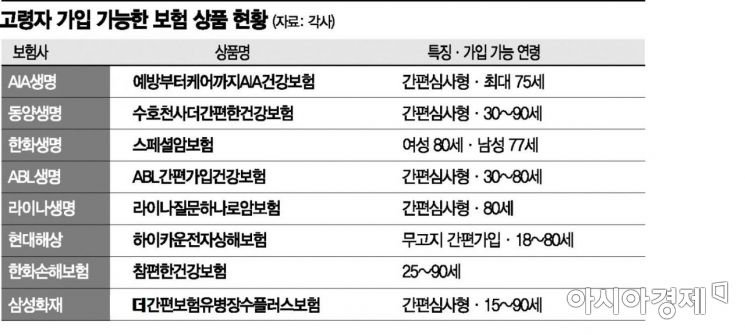
According to the insurance industry on the 25th, insurance products that have recently expanded the eligible enrollment age up to 90 years old are emerging rapidly. Most share the common feature of allowing enrollment through simplified underwriting combined with pre-existing conditions.
Simplified underwriting allows enrollment if the applicant meets conditions such as: no hospitalizations, surgeries, or additional tests requiring a doctor's opinion within the last 3 months; no hospitalizations or surgeries due to illness or accidents within the last 2 years; and no hospitalizations or surgeries due to cancer diagnosis within the last 5 years.
Especially recently, a large number of products allowing enrollment up to the age of 90 have appeared. Last month, Tongyang Life Insurance launched a simplified underwriting product called 'Guardian Angel The Easier Health Insurance,' which allows enrollment from age 30 to 90.
Samsung Fire & Marine Insurance's 'The Easier Chronic Disease Longevity Insurance' allows enrollment if there have been no hospitalizations, surgeries, or re-examination opinions within 3 months, and no diagnosis, hospitalization, or surgery for the four major diseases (cancer, stroke, angina, myocardial infarction) within 5 years. Enrollment is possible from age 15 to 90. Hanwha General Insurance's 'Very Comfortable Health Insurance' allows enrollment from age 25 to 90.
Lina Life Insurance expanded the enrollment age for its 'Lina One Question Cancer Insurance' from 60 to 80 last month, and ABL Life's 'ABL Easy Enrollment Health Insurance' also allows enrollment up to age 80 with simplified underwriting. Hanwha Life Insurance's 'Special Cancer Insurance' allows women to enroll up to age 80 and men up to age 77.
Financial Authorities Promote Elderly Coverage Insurance in 2013
The emergence of elderly insurance products originated from institutional improvements in 2013 aimed at promoting coverage insurance for the elderly. As rapid aging increased the need for coverage insurance among seniors, product design requirements were relaxed.
Since October last year, a designated person confirmation service has been in operation for those aged 65 and older, allowing designated persons such as children to be informed of insurance coverage details and to take actions such as exercising the right to withdraw if the product is deemed unsuitable. However, this is not mandatory. As a result, complaints about incomplete sales by some large corporate agencies (GA) that fail to properly disclose risks to elderly subscribers have been increasing.
Some argue that, similar to the private fund redemption suspension incidents centered on banks and securities firms, cases of incomplete sales targeting the elderly are increasing, and thus sales confirmation measures for this group should be strengthened.
A financial authority official said, "Making designated person confirmation mandatory as a requirement for insurance contracts could unjustly infringe on the elderly's free will to subscribe to products," adding, "We will strengthen crackdowns on illegal sales practices through product sales monitoring systems and happy calls."
Meanwhile, the Financial Supervisory Service plans to conduct mystery shopping inspections on financial companies starting next month. Amid a series of large-scale fund redemption suspension incidents, incomplete sales of financial products heavily sold to the elderly and sales that do not match investors' investment tendencies are expected to be the focus of intensive inspections.
© The Asia Business Daily(www.asiae.co.kr). All rights reserved.


















