Yujin Robot Autonomous Driving Robot Go-Kart
3D Sensor Accurately Identifies Space
Price One-Fifth of Similar Japanese Products
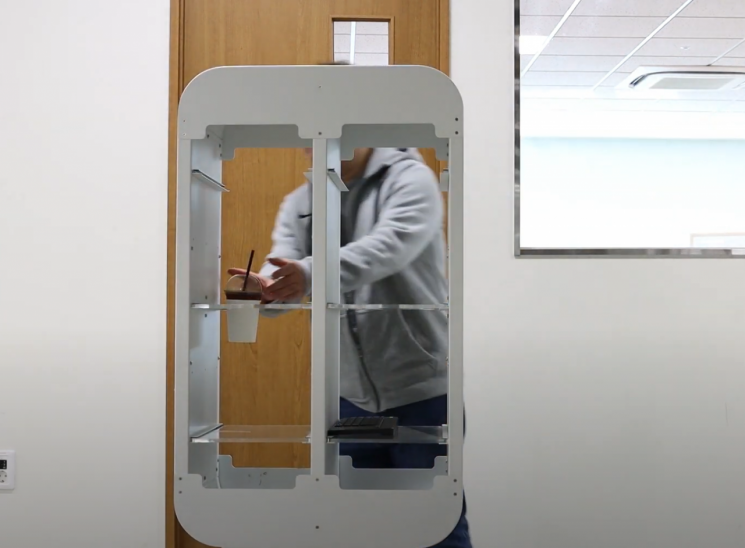 An employee is receiving coffee delivered by an autonomous driving robot go-kart at the headquarters of Yujin Robot in Songdo, Incheon. Photo by Yujin Robot
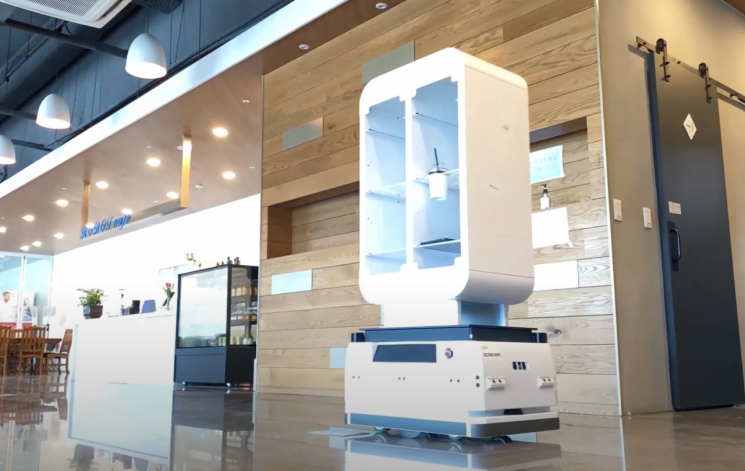 An autonomous driving robot go-kart is delivering coffee at the cafe on the first floor of the Eugene Robot headquarters in Songdo, Incheon. Photo by Eugene Robot
[Asia Economy Reporter Moon Hyewon] 'Ding dong.' An order for an iced Americano was placed at the cafe counter on the first floor of the Eugene Robot headquarters in Songdo, Incheon. The autonomous delivery robot 'GoCart,' which had been waiting quietly behind the busy owner making drinks, smoothly picked up the coffee from the cup holder and headed to the elevator. Its destination was the meeting room on the 4th floor of the headquarters. Although still in the pilot operation stage and moving slowly, it quietly goes its way without any collisions with passing employees. After completing the delivery mission, it autonomously returns to the GoCart parking area on the first floor cafe to wait. The delivery took about five minutes. Employees holding a buyer meeting in the conference room were able to continue their meeting without needing to visit the cafe to buy coffee.
This delivery robot is equipped with Eugene Robot's recently self-developed three-dimensional sensor called the '3D LiDAR sensor.' LiDAR serves as a kind of 'eye' for the robot, used for position recognition, obstacle detection, and object identification.
Eugene Robot's 'ultra-compact 3D scanning LiDAR sensor' simultaneously performs a 270-degree horizontal scan and a 90-degree vertical scan, enabling it to create a 3D map of a space without blind spots. From the moment the LiDAR sensor operates, it draws all objects within the detected space like a 3D printer. When the reporter observed a demonstration on the 14th, the sensor accurately depicted everything from Eugene Robot's historical robot vacuum products displayed on one wall of the first-floor experience room to the shapes of window frames and the postures of standing people. The rainbow-colored beams, drawn once every 1 to 2 seconds, overlapped increasingly over time, expressing the silhouettes of objects more precisely.
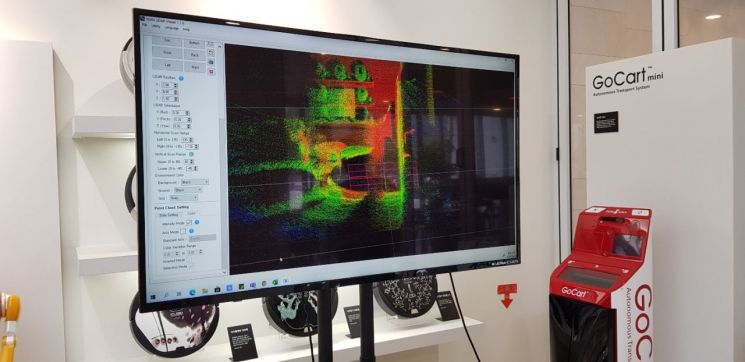 Demonstration of the 'Ultra-compact 3D Scanning LiDAR Sensor' held on the 1st floor experience room of Eugene Robot headquarters in Songdo, Incheon on the 14th. Photo by Moon Hyewon
Eugene Robot recently succeeded in obtaining a patent for this product, becoming the second in the world after Japan. Eugene Robot's patent expands the scanning area by placing a high-reflectivity mirror in a specific space between the optical transmitter module and the receiver module. The light reflected from the mirror is reflected again in the second reflection area of a moving mirror, and a blocking wall that separates the light path is installed to eliminate scattered light.
The existing Japanese patented product was developed by Hokuyo and, as of last year, was a high-priced product costing about 8 million KRW. It has been evaluated as lacking price competitiveness for commercialization in the autonomous robot market. Eugene Robot's 3D LiDAR minimized the number of multiple mirrors used for light reflection, reducing costs to about one-fifth of the Japanese product.
Lee Hyung-joo, head of domestic sales at Eugene Robot, explained, "The Japanese 3D LiDAR product is so expensive that demand in the robot market was low, whereas our product can lower the unit price to 1.5 to 1.6 million KRW, overcoming the limitations of the Japanese product."
Founded in 1988, Eugene Robot (formerly Gina World) initially produced industrial robots used for assembling and welding products in manufacturing plants. After the IMF financial crisis, demand for industrial robots declined, and in 2000, the company shifted its business direction to personal service robots. In 2004, it launched the educational robot 'iRobi,' which reads books and plays children's songs, selling 3,000 units over five years. The following year, it introduced the cleaning robot 'iClebo' to the market. The annual sales of iClebo, which were 20,000 units at launch, increased to 50,000 units in 2012 and soared to 100,000 units after 2015, becoming the 'originator' of cleaning robots.
Eugene Robot is recently restructuring its business around robot solutions. Kim Young-jae, executive director and head of sales at Eugene Robot, said, "There has been a growing demand for robots, autonomy/automation, and contactless solutions to increase productivity across various industries, a trend that has been amplified by the COVID-19 pandemic. Since our core business is robots, this will be an opportunity to expand our business areas."
© The Asia Business Daily(www.asiae.co.kr). All rights reserved.
![Clutching a Stolen Dior Bag, Saying "I Hate Being Poor but Real"... The Grotesque Con of a "Human Knockoff" [Slate]](https://cwcontent.asiae.co.kr/asiaresize/183/2026021902243444107_1771435474.jpg)


















