Controversy Over Google and Apple App Market Fees
KCC Conducting Preliminary Legal Review
Lawmakers and Legal Circles Say "Current Law Insufficient"
Urgent Passage Needed for Proposed Telecommunications Business Act
[Asia Economy Reporter Koo Chae-eun] As the controversy over application market commissions, so-called 'toll fees,' spreads significantly, regulatory authorities have begun reviewing violations of current laws. The issue started when Google and Apple, which dominate 90% of the domestic market, announced they would take a 30% commission from app payment amounts. Content providers are urging government intervention, saying, "We could become digital tenant farmers," "The burden will be passed on to consumers," and "This is an abuse of monopoly power and unfair treatment."
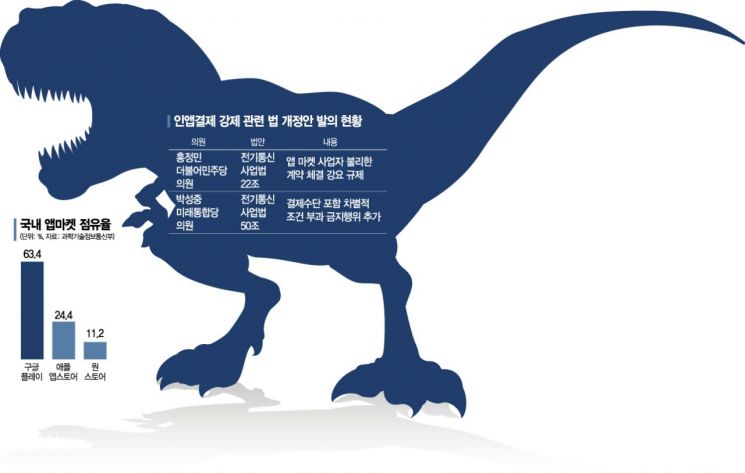
The problem is that there are no clear means to sanction this. The Korea Communications Commission (KCC) is reviewing whether this violates Article 50 of the Telecommunications Business Act, but both inside and outside the National Assembly and the legal community believe there is insufficient basis to consider it illegal. This is why discussions on new amendments to the Telecommunications Business Act, proposed by Democratic Party lawmaker Hong Jeong-min and United Future Party lawmaker Park Seong-jung, are gaining momentum.
Does the Current Law Apply or Not?
According to industry sources on the 25th, the KCC has started reviewing whether Google's forced in-app payment can be considered a violation of the Telecommunications Business Act. They are also in contact with the Ministry of Science and ICT and the Fair Trade Commission to share information. A KCC official said, "We are conducting a legal review regarding whether this violates the law," adding, "(Since KCC is a post-regulation agency) it is difficult to conduct a fact-finding survey before the 'act' occurs. We are carefully monitoring the situation while reviewing the legality in advance."
Experts believe that the current legal framework has difficulty encompassing the toll fee issue. Prohibited acts under the Telecommunications Business Act involve issues such as provision, joint use, interconnection, or wholesale provision of facilities or information. Although the KCC has established the 'App Market Mobile Content Payment Guidelines,' these lack legal enforceability and are largely advisory. An expert from the Democratic Party, Ahn Jeong-sang, said, "Article 50 of the Telecommunications Business Act prohibits acts related to telecommunications operators' facilities or joint use that infringe on user interests, so this issue is different," adding, "It is rather closer to a market monopoly issue under the Fair Trade Act." Therefore, a legislative amendment specifying 'prohibited acts' related to monopolies is necessary.
Even if the Fair Trade Commission law is applied, problems remain. Under the current Fair Trade Act, dominant market operators are prohibited from unfairly determining product prices, and violations can result in imprisonment of up to three years or fines up to 200 million KRW. However, concerns about fairness issues with Apple have been raised. Apple, which holds a 24.4% share of the app market, has enforced in-app payments and collected a 30% commission since July 2011. At that time, Apple was not subject to special regulations under the Fair Trade Act. A legal expert said, "Apple's 2011 policy and Google's current forced payment method are not different, so raising price issues now regarding in-app payments could lead to questions about fairness and consistency."
Follow-up Legislation Must Continue
For this reason, voices calling for the urgent passage of currently proposed bills are emerging. Lawmaker Hong Jeong-min proposed an amendment to Article 22 of the Telecommunications Business Act at the end of July to prevent app market operators from unfairly using their transactional position to impose disadvantageous contracts. Lawmaker Park Seong-jung recently proposed an amendment to Article 50 of the Telecommunications Business Act to prohibit acts that force specific payment methods or impose discriminatory conditions. A National Assembly official said, "If the issue of forced payment methods using transactional position is defined as a prohibited act, investigative authority will be triggered, providing a means to ensure effectiveness."
Meanwhile, according to the '2019 Mobile Content Industry Status Survey' by the Ministry of Science and ICT and the Korea Mobile Industry Association, Google accounts for 63.4% and Apple 24.4% of the domestic app market. Professor Kim Hyun-kyung of Seoul National University of Science and Technology pointed out, "If Google enforces a 30% commission on non-game apps and expands bundling practices, Google could dominate not only the mobile OS and app market but also the domestic cloud market," adding, "The absence of competition directly leads to market disruption and consumer harm, and failure to foster app market competition is a problem that requires related legal and institutional improvements."
© The Asia Business Daily(www.asiae.co.kr). All rights reserved.

![Clutching a Stolen Dior Bag, Saying "I Hate Being Poor but Real"... The Grotesque Con of a "Human Knockoff" [Slate]](https://cwcontent.asiae.co.kr/asiaresize/183/2026021902243444107_1771435474.jpg)















